Fall science is already happening on the sidewalk. Leaves change color. The air gets colder. Fog sits on the grass in the morning. You do not need a lab kit to turn that into a week of real experiments. A jar, a coffee filter, and a walk around the block will do.
These 10 kitchen labs stay tied to weather and leaves, so September does not turn into a random vinegar volcano. Keep a notebook nearby. Write one prediction before you mix anything. The National Science Teaching Association has long treated fallen leaves as ready-made props for observation, not decoration [1].
If you want a year-round set that is not seasonal, we already have 10 science experiments to try with kids. For rainfall and temperature logging, see measurement activities for kids.
Before you start
Stay close for anything hot, sharp, or involving rubbing alcohol. Work over a tray or baking sheet so a spill is annoying, not a cleanup spiral. Skip setups that look like food if your kid still puts things in their mouths.
This is also where you set the habit that makes these labs science, not just a mess. Before you pour, mix, or bag anything, write down a prediction. That is a guess about what will happen, like "I think the wet leaf will break down faster." The guess is the science. Mixing, bagging, or waiting is how you test it.
If your kid hates writing, or forming letters takes so much effort that they shut down before the lab even starts, that is a real load. Dysgraphia, ADHD, anxiety about "getting it wrong," or a young hand that tires fast can all show up here. Let them talk the guess while you write it. A voice memo counts. The experiment still happened.
Use this list to pick a lab, then skip to the matching one below:
- Leaves and color: chromatography, color walk, water beads on a leaf
- How plants move water and break down: transpiration bag, decomposition race
- Weather: cloud in a jar, rain gauge
- Fall air and pumpkins: static, sink or float, mug insulation
Leaf labs (1 to 5)
1. Leaf chromatography
Chromatography is a way of separating colors that are mixed together. Tear a green leaf into bits, put them in a small amount of rubbing alcohol, and stand a coffee-filter strip in the liquid. As the alcohol climbs the paper, hidden yellows and oranges often show up. Chlorophyll, the green pigment that helps a leaf catch sunlight, fades in fall. Other pigments were there all along.
Dry the leaf first. Wet leaves smear and the colors stay muddy. Have an adult nearby to help with the alcohol.
2. Why do leaves change color?
Take a walk and collect three leaf colors. Sketch them, then write one sentence: more hours of sunlight, or fewer? This is observation, not a trick. Kindergarteners and first graders can use pictures instead of sentences. If drawing is the fight, they can sort the leaves into piles and you label the page.
3. Leaf transpiration bag
Transpiration is how a plant moves water from roots to leaves, then out into the air. Slip a clear bag over a live leafy branch, twist it gently, and leave it in the sun for a few hours. Water beads inside. Use a twist tie, not a hard knot, so you do not damage the branch.
4. Decomposition race
Decomposition is what happens when a leaf breaks down. Seal one dry leaf in a bag and one damp leaf in another. Check in a week. Moisture often speeds the breakdown. This often fits third through fifth graders. Observe through the bag. If it smells off or you see mold, do not open it.
5. Leaf surface and water beads
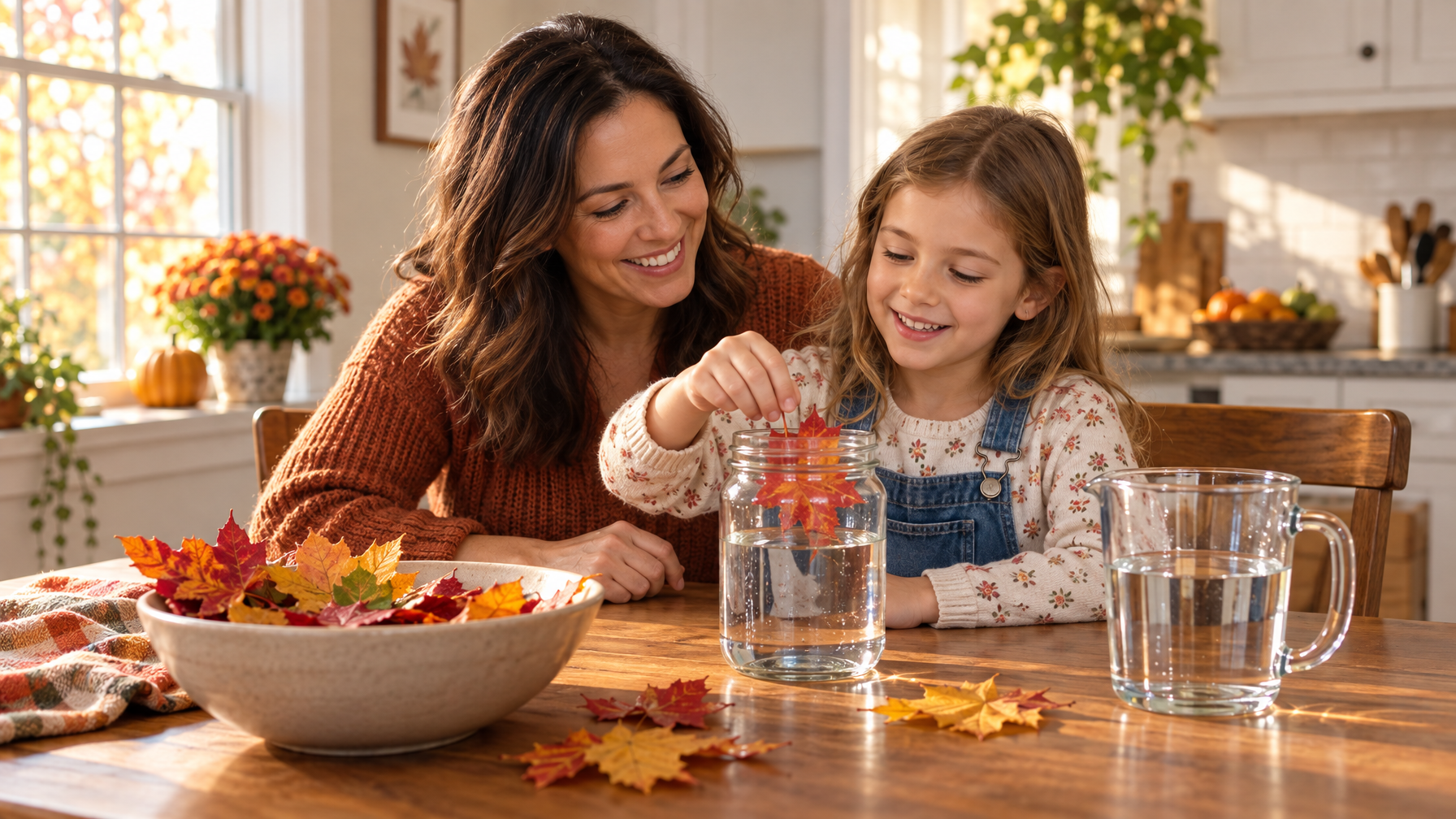
Drop water on a waxy leaf and on a thin, dry one. Some leaves shed water because of their surface. That is a structure-and-function conversation without a worksheet: the shape of the leaf changes what the water does.
Weather labs (6 to 7)
6. Cloud in a jar
Put warm water in a jar and set ice on the lid. A cloud needs water vapor plus something tiny to cling to. A small squirt of hairspray can stand in for that "something." Skip smoke or matches if that feels like too much. If the cloud is faint, write down what you saw anyway. A faint cloud is still data.
7. DIY rain gauge
A rain gauge is just a straight-sided jar that catches rain so you can measure it. Set it outside with a ruler, then record three days. This ties to measurement and to map skills if you chart which way storms usually move in your town.
$20 off your first class WITH promo code: blog
Build the Education your Kid Deserves
Discover thousands of live classes taught by expert teachers, across academics and enrichment.
Browse classesAir, water, and pumpkin-adjacent labs (8 to 10)
8. Static and dry fall air
Rub a balloon on a sweater, then hold it near small paper bits or clean dry hair. Dry fall air often makes static easier to see. Static is an imbalance of electric charge that makes light things jump toward the balloon. Skip latex if anyone in the house has an allergy. A wool sock on a dry day can stand in.
9. Pumpkin sink or float, then seed count
Put a whole mini pumpkin in a tub of water. Many float because they hold a lot of air inside, even though they feel heavy. That is density: how much stuff is packed into the space. Have an adult cut the pumpkin open, then estimate the seeds before counting. Start with the float test, then collect the seed numbers.
If counting past 20 is a shutdown, estimate by tens and stop. The science was the float, not a perfect tally.
10. Insulation test with mugs
Insulation is anything that slows heat from leaving. Fill two mugs with warm water. Wrap one in a dry leaf layer or a towel. Leave the other bare. Check after about 10 minutes with a kitchen thermometer if you have one, or with careful hands. Fall is a physics season, not only a biology season.
Watch for
- Calling it a fail if the cloud is faint. Record what you saw.
- Using leaves from sprayed lawns. Stick to untreated yards or parks that allow collecting.
- Skipping the prediction. The sentence before the mix is the science.
- Turning the notebook into a second assignment. For kids who freeze at writing, a photo of the setup plus one spoken sentence is enough. Many families hit this wall on lab day, and it does not mean science is not happening.
FAQ
Are these safe for early elementary?
Labs 2, 5, 7, and 9 (float only) are the gentlest. Save alcohol chromatography and anything hot for older kids with an adult at the table.
How do we log this for homeschool hours?
Date, question, what you used, what you noticed. That is enough for many portfolios. See hours by grade if you need a time rule of thumb.
What if we want a teacher to run the lab?
Live science classes can walk the method while you keep the mess in your kitchen. Browse science classes on Outschool.
Sources
[1] National Science Teaching Association. "Fall leaves, props for learning." NSTA Blog, October 14, 2017. https://www.nsta.org/blog/fall-leaves-props-for-learning
Keep the season going with a live science class
Kitchen labs cover the question. A small class can cover the next one, including weather, earth science, and experiments you would rather not invent from scratch. Start with science on Outschool.


.svg)
.svg)