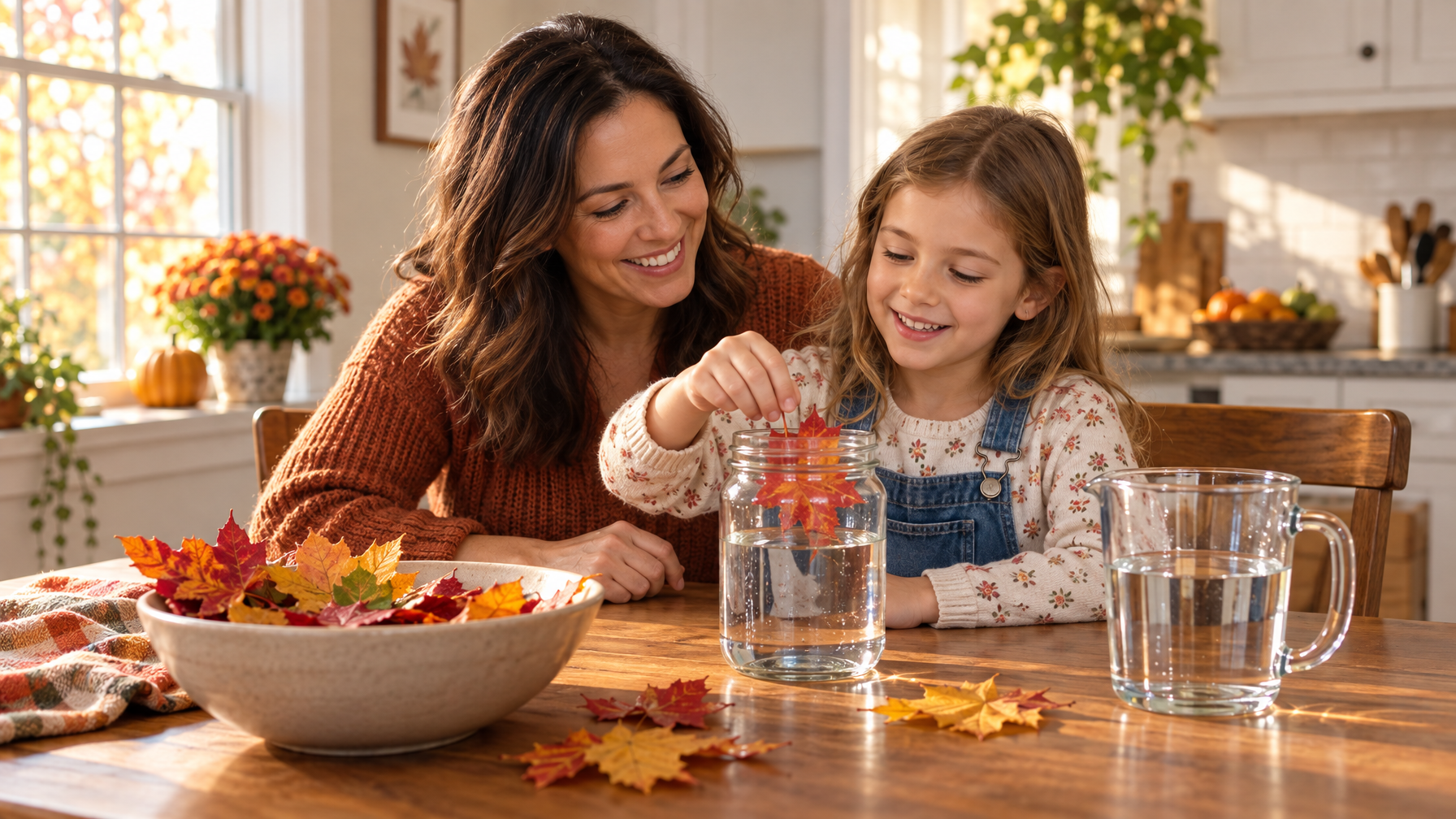
You do not need a field guide the size of a textbook. You need one leaf, two questions, and a kid who is willing to look closely for ten minutes.
Leaf identification for kids works when it stays small. Name the tree in front of you: maple, oak, pine. Those everyday names are enough. Fall is the easy season because color, shape, and the crunch underfoot all give extra clues.
This guide is a walk-first key: needles or broad leaves, simple or compound, opposite or alternate, then eight common trees many US families can find in a park, a yard, or along a sidewalk. Pair it with a nature-based homeschool week if you already work that way, or treat it as one science afternoon.
What to bring (and what to skip)
Keep the kit light so you actually leave the house.
Bring:
- A small notebook or index cards and a pencil
- One paper bag or a folding envelope for 3 to 5 leaves, not a whole branch
- A phone camera if you want a photo of the bark and the whole tree
- A 10x hand lens if you already own one. You do not need to buy one.
- A small notebook or index cards and a pencil
- One paper bag or a folding envelope for 3 to 5 leaves, not a whole branch
- A phone camera if you want a photo of the bark and the whole tree
- A 10x hand lens if you already own one. You do not need to buy one.
Skip:
- A 200-species app dump on the first walk
- Pulling live twigs off a street tree
- A promise that you will do nature study every day. One honest walk beats a laminated schedule you abandon.
- A 200-species app dump on the first walk
- Pulling live twigs off a street tree
- A promise that you will “do nature study every day.” One honest walk beats a laminated schedule you abandon.
If your kid has sensory load around crunchy piles, wet mud, or bugs, stay on a paved path and pick up one dry leaf. The science is the looking, not the wilderness cosplay.
The four questions that identify most trees
Foresters and state agencies teach the same first splits. The Virginia Department of Forestry walks families through attachment pattern, leaf form, and needles in bundles before anyone names a species. [1] North Carolina State Extension uses a dichotomous key: each step is a this-or-that choice. [2] Wisconsin DNR says a dichotomous key is the easiest way for a beginner to ID a tree. [3]
Ask these in order. Have your kid say the answer out loud.
1. Needles or a flat leaf?
Needles or scales usually mean a conifer: pine, spruce, fir, hemlock, cedar. Count whether needles sit alone or in a bundle, and how many are in the bundle. [1]
A flat, broad blade usually means a deciduous tree that drops leaves in fall. Most of this article is about those.
2. Simple or compound?
A simple leaf is one blade on one stalk. Maple, oak, birch, beech, sweetgum.
A compound leaf is several leaflets on one stalk. Ash, hickory, walnut, locust. The whole compound leaf drops as a unit. If you are not sure, look for a bud at the base of the stalk. Leaflets do not have their own buds. [1]
3. Opposite or alternate?
Opposite: two leaves attach at the same point, across from each other. Maple, ash, dogwood, buckeye. A common memory hook is MAD: maple, ash, dogwood.
Alternate: one leaf per attachment point, zigzagging up the twig. Oak, birch, beech, elm, sweetgum. [1]
Look at older parts of the twig, not the crowded tip, or new leaves can fool you. [1]
4. Lobes, teeth, or a smooth edge?
Lobes are the big in-and-out shapes (maple, many oaks). Teeth are small jagged bites along the edge (elm, some birches). A smooth, even edge is entire (magnolia, some dogwoods). Virginia DOF treats margin and lobe pattern as a core ID trait. [1]
Write those four answers in the notebook before you guess the name. Guessing first trains kids to skip the evidence.
Why fall color is a clue, not the whole ID
Color is fun. It is also unreliable as the only test. The same red maple can look scarlet on the sunny side and yellow in the shade. USDA Forest Service notes that chlorophyll breaks down in fall, green fades, and yellow carotenoids show. Extra reds and purples come from anthocyanins, especially after warm sunny days and cool nights. [4] The National Park Service describes the same sequence: less daylight, chlorophyll taken apart, other pigments visible. Carotene is the same family of pigment that colors carrots. [5]
Use color as a hint:
- Sugar maple: orange, gold, red
- Aspen and many birches: yellow
- Many oaks: russet or brown, and some brown leaves hang on into winter [4]
- Sweetgum: mixed yellow, red, purple on one tree
- Sugar maple: orange, gold, red
- Aspen and many birches: yellow
- Many oaks: russet or brown, and some brown leaves hang on into winter [4]
- Sweetgum: mixed yellow, red, purple on one tree
Shape, attachment, and fruit (acorns, samaras, balls, cones) still beat color.
Eight common trees kids can learn this month
These show up in a lot of US yards, parks, and school lots. Your region will swap a few. That is fine. Master the four questions, then swap in the local tree.
1. Maple (look for opposite leaves and a helicopter seed)
Leaves are simple, opposite, with palmate veins (several main veins from the base). Sugar maple has five lobes with U-shaped spaces. Red maple lobes are sharper. The seed is a paired samara, the “helicopter.”
Kid check: two leaves across from each other, plus a seed that spins.
2. Oak (look for alternate leaves and an acorn)
Leaves are simple and alternate. White-oak group: rounded lobes. Red-oak group: pointed lobes with a bristle at the tip. USDA materials group oaks by that leaf shape. [6]
Kid check: one leaf per joint, plus an acorn on the ground or the tree.
3. Sweetgum (star leaf, spiky ball)
Simple, alternate, star-shaped with five (sometimes seven) points. Fall color is a mix. Fruit is a spiky ball.
Kid check: count the points on the star. Find one ball.
4. Ginkgo (fan leaf, often a street tree)
Simple, fan-shaped, often notched in the middle, veins spreading from the base. Turns gold, then drops fast.
Kid check: it looks like a little paper fan, not a maple.
5. Sycamore (big leaf, camouflage bark)
Simple, alternate, maple-ish but usually larger, with a paler underside. Bark peels in puzzle pieces of cream, green, and brown. Ball fruits hang on strings.
Kid check: bark you can spot from the sidewalk before you pick up a leaf.
6. Birch (toothed leaf, peeling bark on many species)
Simple, alternate, oval to triangular, with teeth. Paper birch peels in white sheets. River birch peels in cinnamon curls.
Kid check: teeth on the edge, plus bark that wants to peel.
7. American beech (smooth gray bark, even teeth)
Simple, alternate, oval, with straight parallel veins to each tooth. Bark is smooth and gray, like elephant skin. Golden-bronze in fall. [4]
Kid check: silky bark you want to touch, veins that run neatly to the teeth.
8. Pine (needles in bundles)
Needles, not broad leaves. Count needles in a bundle: two, three, or five is the usual split in many eastern pines. [1] Cones on the ground help.
Kid check: grab one bundle and count. Do not strip a live branch.
If none of these match, you still did the work. You have a recorded leaf. That is science, not a failed quiz.
A 20-minute walk script
Use this when attention is short, including for many neurodivergent kids who do better with a clear start and stop.
Minutes 0 to 3. Pick one tree you can stand next to. No wandering yet.
Minutes 3 to 8. Four questions. Kid answers. Parent writes. If writing is a motor load, the parent scribes while the kid talks. Kindergarteners and first graders can point and dictate. Older kids can sketch the outline.
Minutes 8 to 12. One extra clue: bark photo, seed, or cone. Compare to the eight-tree list.
Minutes 12 to 18. Optional second tree, only if they ask.
Minutes 18 to 20. Bag three leaves max. Go home.
A 2022 mixed-methods review of nature-based early childhood programs (36 studies) found positive links with self-regulation, social skills, and nature relatedness, with play as a common pathway. Evidence quality was often weak, so treat it as a reason to get outside, not as a guarantee. [7]
What to record in the nature journal
You are building a record, not a pretty scrapbook. One page per tree is enough.
Copy this onto a card or a notebook page:
- Date and place (park name, yard, street)
- Needles or broad leaf
- Simple or compound
- Opposite or alternate
- Edge: lobes, teeth, or smooth
- Color today
- Bark in a few words (smooth, shaggy, puzzle, peeling)
- Fruit, cone, or seed if you saw one
- Best guess, and a question mark if you are not sure
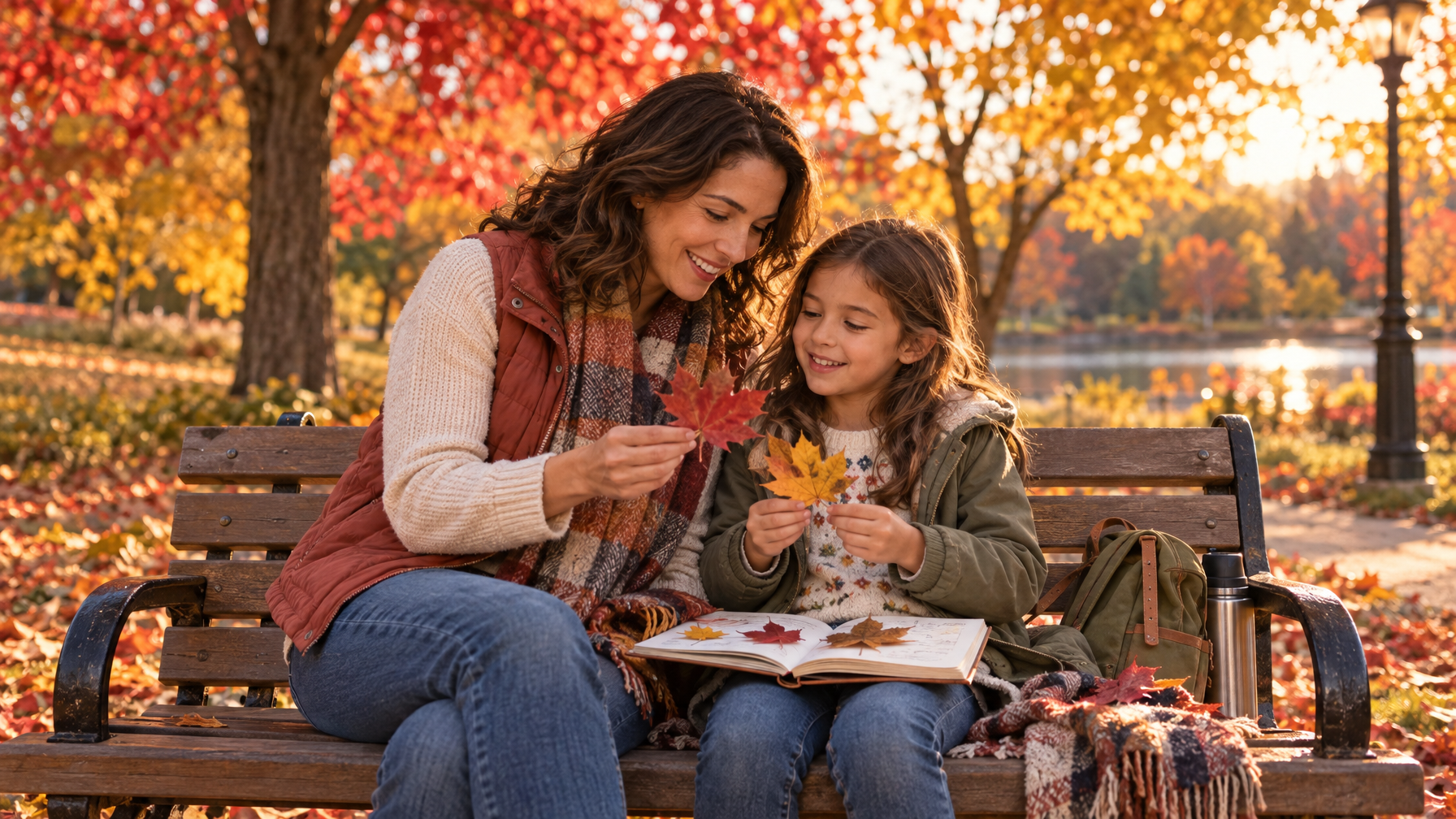
USDA Forest Service even suggests crayon rubbings: leaf underside up (veins raised), thin paper on top, fast slanting strokes. Cut out the rubbing and keep it with the name. Stamp-pad prints work the same way. [4]
If your kid hates writing, take the photo of the four-question answers on a sticky note. The observation is the work.
Watch for
Poison ivy is a vine or shrub, not a canopy tree, but it shows up on the same walks. "Leaves of three, let it be" is still the useful rule. Do not put unknown vines in the bag.
Do not strip living branches. Fallen leaves are enough.
Apps are a second opinion, not the teacher. If the app names a tree your four questions contradict, trust the questions and look again.
Street trees include nursery varieties and trees that are not native to your region (ginkgo, many maples). A backyard oak in Texas is not the same oak as a white oak in Ohio. Stay with the family name (oak, maple, pine) until you are ready to go narrower.
How this fits a homeschool week
One walk is science. Three walks become a mini unit.
- Walk 1: four questions plus one tree
- Walk 2: same route, second tree, compare opposite vs alternate
- Walk 3: seeds and bark only, because some leaves are already down
Tie it to kitchen labs in easy science experiments for fall if you want chlorophyll and weather in the same month. For a bigger outdoor plan, start from nature-based homeschool curriculum. Middle schoolers who want labs and classification can add online science classes or biology classes so a teacher can check their key with them.
Use ESA funds or programs like OpenEd if available in your state, if you are already buying science materials or live classes this semester.
FAQ
What is the easiest way to start leaf identification for kids?
Four questions on one tree: needles or broad, simple or compound, opposite or alternate, lobes or teeth. Write the answers before you name it.
Can we identify trees after the leaves drop?
Yes. Virginia DOF leans on bark, twigs, buds, and leaf scars in late fall and winter. Opposite vs alternate still shows in the bud pattern. [1] Oaks that hold brown leaves give you extra time.
How specific does the name need to be?
Maple, oak, pine is enough at first. Add the more specific everyday name (sugar maple, red oak) when you have fruit or a clear lobe pattern.
What if we live in a city with only street trees?
Street trees are still trees. Ginkgo, linden, maple, and honeylocust show up on a lot of blocks. One sidewalk specimen taught well beats a forest trip you never take.
How do I help a kid who wants the "right" answer immediately?
Call the first pass a working name. Put a question mark in the journal. Check bark and seeds on the next walk. Certainty is allowed to wait.
Sources
[1] Virginia Department of Forestry. "Tree Identification." https://www.dof.virginia.gov/education-and-recreation/learn-about-education-recreation/tree-identification/
[2] North Carolina State Extension. "Identification of Common Trees of North Carolina." https://content.ces.ncsu.edu/identification-of-common-trees-of-north-carolina
[3] Wisconsin Department of Natural Resources. "Tree identification." https://dnr.wisconsin.gov/education/treeID
[4] USDA Forest Service. "Why Leaves Change Color." https://www.fs.usda.gov/media/74087
[5] U.S. National Park Service. "Why Do Leaves Change Colors in the Fall?" https://www.nps.gov/articles/why-do-leaves-change-in-the-fall.htm
[6] USDA Forest Service, Northeastern Area (via New York DEC reprint). "How To Identify, Prevent, and Control Oak Wilt." https://extapps.dec.ny.gov/docs/lands_forests_pdf/oakwiltusda.pdf
[7] Johnstone, A., Martin, A., Cordovil, R., et al. "Nature-Based Early Childhood Education and Children's Social, Emotional and Cognitive Development: A Mixed-Methods Systematic Review." International Journal of Environmental Research and Public Health 19, no. 10 (2022): 5967. https://www.mdpi.com/1660-4601/19/10/5967
Try a live science class when you want a second pair of eyes
A walk teaches the habit. A small live class can help when your kid wants someone else to look at the sketch and say, "Yes, that is opposite." Browse science classes when you are ready, or stay outside with the notebook. Both count.


.svg)
.svg)