Scratch and Python enrollments are down 35–50% year over year. If you're a parent who spent the last few years making sure your kid learned to code, that number might give you pause.
It shouldn't. Here's what's actually happening — and what families are doing instead.
Why entry-level coding is declining
The honest explanation is simple: the ROI of teaching a kid to write basic code has changed.
Five years ago, knowing how to program in Python was a meaningful differentiator. Today, AI writes competent Python on demand. The syntax-level skills that took years to develop can be approximated in seconds.
This doesn't mean coding is dead. It means that coding as a subject has split into two tracks:
- Low-value coding: syntax memorization, writing scripts that do simple things, beginner-level Scratch projects. This is what's declining.
- High-value coding: systems design, debugging complex programs, working at the intersection of software and hardware, building things with real-world constraints. This is growing.
The families pulling out of Scratch and Python aren't giving up on technology. They're moving past the entry level.
What's growing instead
Three subject areas are seeing significant enrollment increases, all for the same reason: they put technology in physical and applied context.
Robotics
Robotics is up over 100% in bookings year over year.
The distinction from coding: robotics adds physical constraint. A program that controls a robot doesn't just have to run — it has to run correctly in the real world, where sensors are imperfect, motors vary, and friction exists. Debugging a robot is categorically harder than debugging a Python script, and it builds a different kind of thinking.
For kids who find abstract coding exercises unmotivating, robotics is often the subject that finally makes technology feel real.
Browse robotics classes →
3D modeling and design
3D modeling is up nearly 200% in bookings.
Spatial design — creating objects that have to obey real-world constraints, fit within specific dimensions, connect to other physical things — is a tech skill with growing value in engineering, product design, architecture, and manufacturing. And unlike coding, AI hasn't made it trivially easy. Designing a functional object that prints correctly requires genuine skill and iteration.
Browse 3D modeling classes →
Arduino and electronics
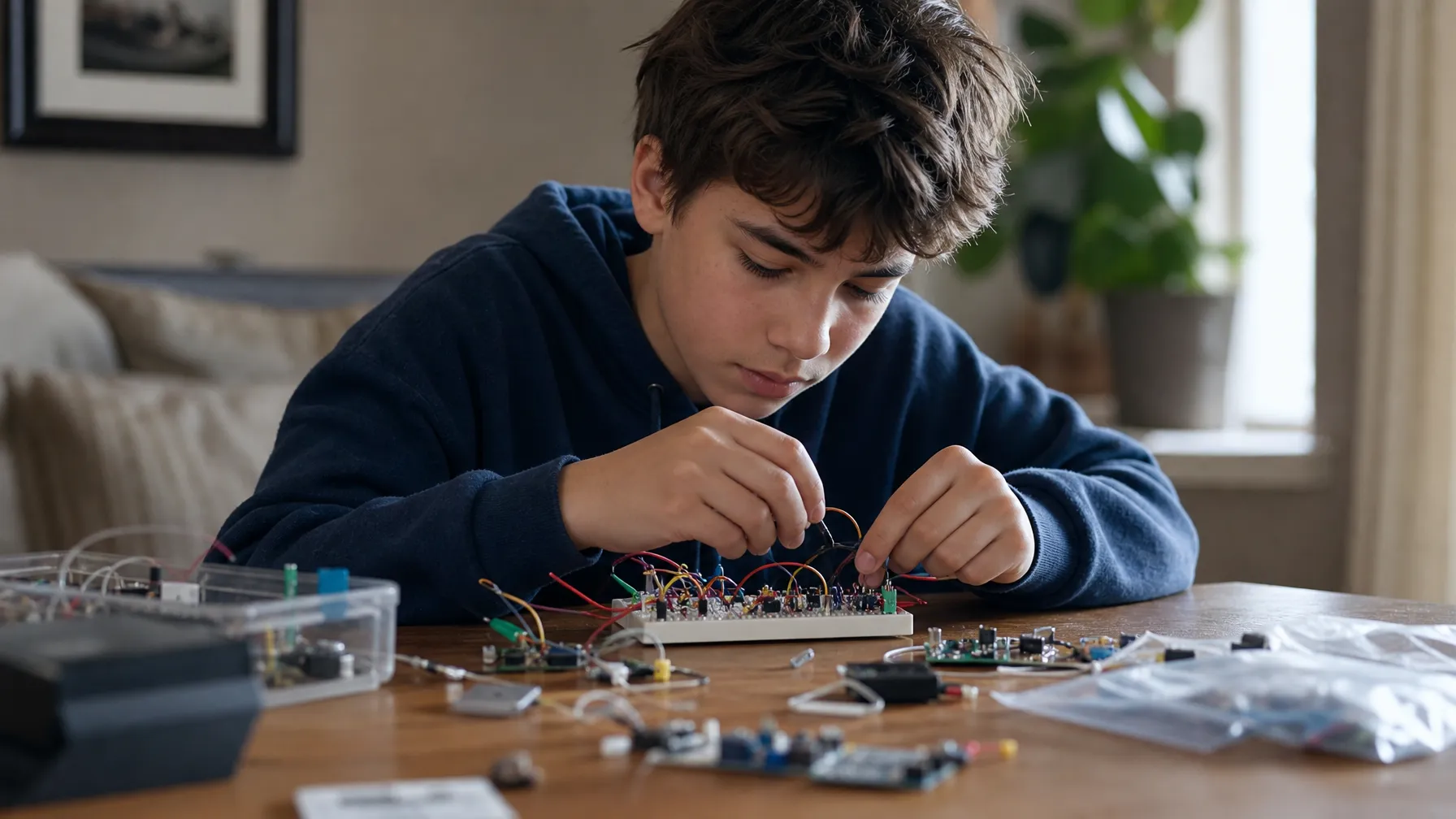
Arduino is a microcontroller platform — real hardware, not simulation. Kids who learn Arduino aren't writing scripts; they're wiring circuits, reading sensors, controlling physical outputs, and building projects that interact with the world.
The gap between Arduino and Scratch is the gap between playing a video game and understanding how one works. Different skill level, different intellectual engagement, different outcome.
Browse Arduino classes →
$20 off your first class WITH promo code: blog
Build the Education your Kid Deserves
Discover thousands of live classes taught by expert teachers, across academics and enrichment.
Browse classesHow to think about this transition for your kid
Not every kid who moved past Scratch belongs in robotics or Arduino. Here's a rough framework:
Your kid loves building physical things: Robotics or Arduino. The physical-digital loop is the motivating factor. Start with robotics if they're new to both; Arduino if they have some electronics or tinkering background.
Your kid is drawn to design and aesthetics: 3D modeling. Spatial, creative, and precise. Good for kids who liked Minecraft for the building, not the game.
Your kid still loves programming but wants more depth: Advanced coding tracks (data science, algorithms, competitive programming) exist and are worth pursuing. The issue isn't coding as a discipline — it's that beginner coding has low ceiling. Intermediate and advanced coding is a different story entirely.
Your kid did Scratch for a year and is bored: That's the signal most parents are responding to. Boredom with entry-level coding usually means readiness for something more challenging, not disinterest in technology.
A note on AI and applied tech
The reason applied tech subjects are growing isn't just that entry-level coding is declining. It's that families are increasingly interested in how technology interacts with the physical world — which is exactly what AI doesn't do.
AI is software. Robotics, electronics, and physical design work with atoms, not just bits. The kids who understand both layers — digital logic and physical reality — are going to be in short supply.
That's the real reason these subjects are growing.
Frequently asked questions
Should my kid still learn to code?
Yes — but at the right level. Basic syntax is less valuable than it was. Systems thinking, algorithmic reasoning, and the ability to work with hardware are more valuable. Intermediate and advanced coding (not Scratch) is still worth pursuing for the right kid.
At what age should kids transition from Scratch to something more advanced?
Most kids hit the ceiling of Scratch-level coding around ages 10–12. If your kid is running out of interesting things to build, that's the signal to move.
What's the right next step after Scratch?
It depends on the kid. Robotics and Arduino for hands-on learners. Python in depth (data science, algorithms) for abstract thinkers. 3D modeling for spatial, design-oriented kids. One intro class in each will tell you more than any framework.
If you're not sure where your kid fits, an intro robotics class is usually the best starting point — it combines physical and software elements, which makes it broadly engaging.
Browse robotics, 3D modeling, and Arduino classes on Outschool →


.svg)
.svg)