Why math manipulatives work (and the research behind them)
Kids who can hold a fraction tile in their hand and see that two-fourths is the same size as one-half learn something different than kids who are told 2/4 = 1/2 on a worksheet. The difference is not just engagement. It is cognitive.
The National Council of Teachers of Mathematics (NCTM) has long recommended a progression called CRA: Concrete, Representational, Abstract. [1] Kids start with physical objects (concrete), move to pictures and diagrams (representational), and then work with numbers and symbols (abstract). Manipulatives are the concrete stage, and rushing past it is one of the most common reasons kids hit a wall in math later.
This guide maps specific manipulatives to the math concepts they teach, organized by grade band so you can pick what your child needs right now rather than buying a bin of random supplies.
Best manipulatives by math concept
Number sense and counting (ages 4-7)
Before kids can add or subtract, they need to understand what numbers mean: that "5" is not just a symbol but a quantity you can count, compare, and break apart.
- Counting bears or cubes. Sorting by color and size builds one-to-one correspondence. Line up 7 bears, remove 3, count what is left. That is subtraction before it has a name.
- Rekenreks (arithmetic racks). A two-row abacus with 10 beads per row, color-split at 5. Rekenreks help kids see number relationships: "8 is 5 and 3 more." This is the kind of number sense that makes mental math fluent later.
- Ten frames. A simple 2x5 grid where kids place counters. Ten frames make the benchmarks of 5 and 10 visual, which supports addition strategies like "making ten."
- Number lines. Physical or floor-taped number lines let kids walk or hop to answers, connecting counting to spatial reasoning.
Place value (ages 6-9)
Place value is where many kids first struggle, because the idea that the "3" in 35 means something different than the "3" in 300 is genuinely abstract. Manipulatives make it concrete.
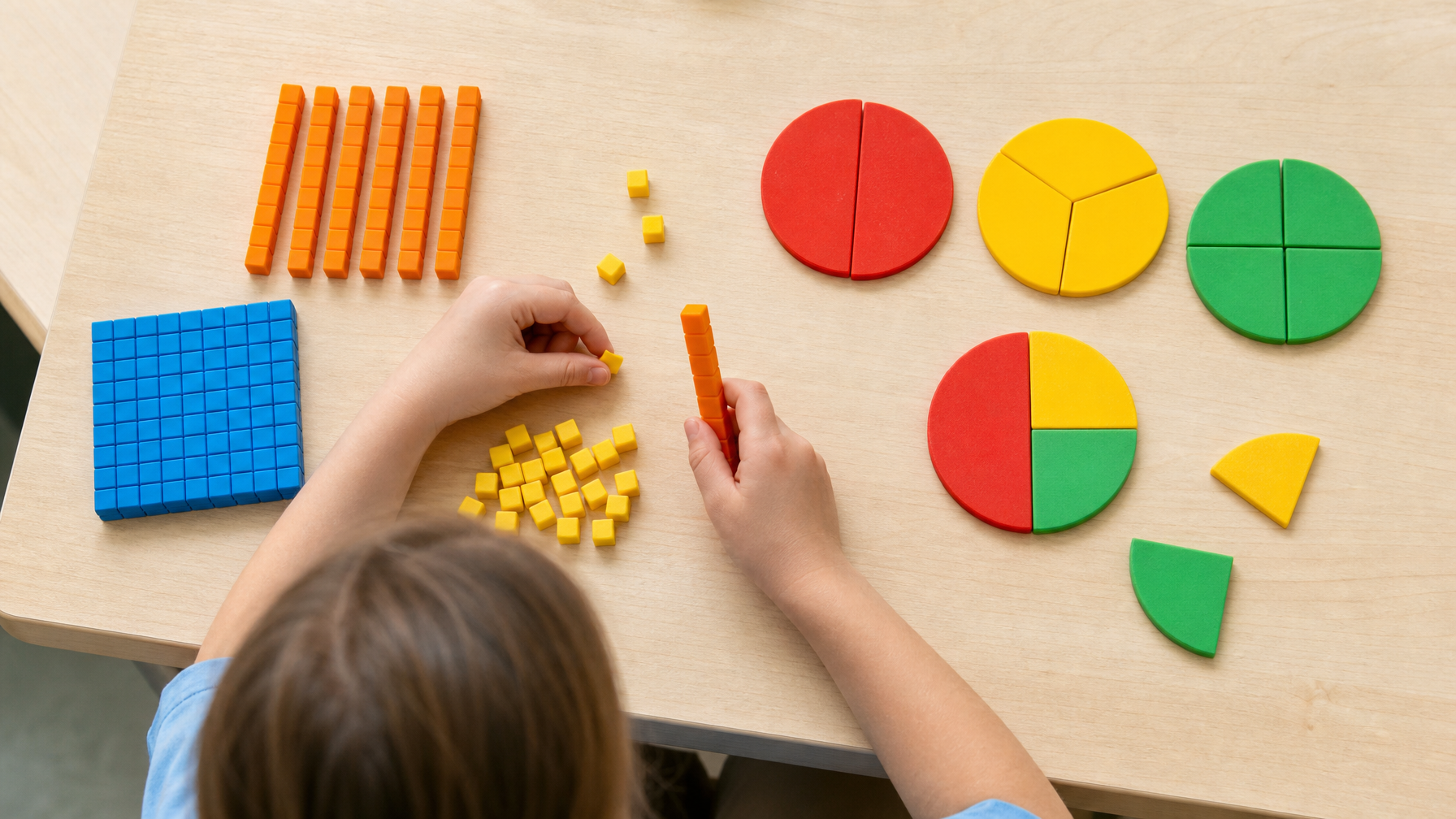
- Base-ten blocks. The gold standard for place value. Units (ones), rods (tens), flats (hundreds), and cubes (thousands) let kids physically trade 10 ones for 1 ten, which is the foundation of regrouping in addition and subtraction.
- Place value discs. Labeled discs (1, 10, 100, 1000) work similarly to base-ten blocks but take up less space and translate more directly to written algorithms. Many Outschool math classes use virtual versions of these.
- Bundling sticks. Craft sticks bundled with rubber bands (10 sticks = 1 bundle) are low-cost and effective. Kids can unbundle to subtract and rebundle to add.
Fractions (ages 7-11)
Fractions are the single most-cited topic where manipulatives make the biggest difference. A child who has spent time physically comparing fraction tiles has a much easier time with equivalent fractions, ordering, and operations.
- Fraction tiles and circles. Color-coded pieces (1 whole, 1/2, 1/3, 1/4, up to 1/12) that kids stack and compare. "How many 1/6 pieces fit on top of 1/2?" answers the equivalence question without any cross-multiplying.
- Fraction bars. Similar to tiles but rectangular, which makes them easier to line up side by side for comparison.
- Pattern blocks. Hexagons, trapezoids, rhombuses, and triangles fit together in ways that naturally teach fractional relationships: the trapezoid is 1/2 of the hexagon, the triangle is 1/6.
$20 off your first class WITH promo code: blog
Build the Education your Kid Deserves
Discover thousands of live classes taught by expert teachers, across academics and enrichment.
Browse classesGeometry (ages 6-12)
- Pattern blocks. Beyond fractions, pattern blocks teach symmetry, tessellation, and spatial reasoning. Kids who build with them develop stronger geometric vocabulary naturally.
- Geoboards. Pegged boards with rubber bands let kids create shapes and explore area, perimeter, angles, and symmetry. A geoboard makes "area of a triangle = 1/2 base x height" something you can see and count.
- Tangrams. Seven flat pieces that combine to form hundreds of shapes. Tangrams build spatial reasoning, rotation skills, and geometric vocabulary.
- 3D geometric solids. Plastic or wooden spheres, cubes, cones, cylinders, and prisms help kids compare faces, edges, and vertices. Filling solids with rice or water teaches volume concretely.
Algebra and pre-algebra (ages 10-14)
- Algebra tiles. Rectangular tiles representing x, x², and unit values. Kids model equations by balancing tiles on both sides, which makes solving for x a physical process before it becomes a symbolic one.
- Two-color counters. Red/yellow counters model integers: red for negative, yellow for positive. Adding 5 yellow and 3 red, then removing pairs, shows that 5 + (-3) = 2 without memorizing sign rules.
- Balance scales. A real or virtual balance scale makes the concept of "equation" tangible: both sides must be equal. Add a weight to one side, add the same to the other.
Manipulatives by grade band: the CRA progression
The CRA framework from NCTM suggests that kids need different levels of concreteness at different stages. [1] Here is how that maps to grade bands:
K-2: mostly concrete
At this stage, every math concept should start with something kids can touch. Counting bears, ten frames, rekenreks, and base-ten blocks should be on the table daily. Drawing pictures (the representational step) comes after kids have had enough time with the physical objects.
Priority manipulatives: counting cubes, ten frames, rekenreks, base-ten blocks (ones and tens), pattern blocks.
Grades 3-5: concrete to representational
Kids at this stage are ready to move between physical objects and drawings or diagrams. Fraction tiles are essential here, as are base-ten blocks for multi-digit multiplication and division. The goal is for kids to eventually draw what they have been building.
Priority manipulatives: fraction tiles/circles, base-ten blocks (through thousands), geoboards, place value discs, protractors.
Grades 6-8: representational to abstract
Middle schoolers benefit from manipulatives when they encounter a new concept (algebra tiles for equation-solving, integer counters for negative numbers) but should be transitioning to diagrams and symbolic work. Virtual manipulatives are especially useful here because they bridge the gap between physical and abstract.
Priority manipulatives: algebra tiles, two-color counters, virtual fraction tools, coordinate plane grids.
Free virtual manipulatives worth bookmarking
You do not need to buy every physical manipulative. Several free platforms offer high-quality virtual versions:
- Didax Virtual Manipulatives (didax.com/math/virtual-manipulatives): base-ten blocks, fraction tiles, pattern blocks, and geoboards. Clean interface, no login required.
- Mathigon Polypad (mathigon.org/polypad): fraction bars, algebra tiles, number lines, and geometry tools on one customizable canvas. Excellent for screen-sharing during online math classes.
- National Library of Virtual Manipulatives (nlvm.usu.edu): maintained by Utah State University. Organized by grade band and content strand.
- Toy Theater (toytheater.com): simple, ad-free virtual manipulatives designed for younger kids (K-3).
How to use manipulatives effectively (not just as toys)
Having manipulatives on the table is not enough. The research behind CRA shows that kids need structured interaction, not just free play. A few principles:
- Connect the object to the math. Always name what the manipulative represents. "This rod is one ten. How many ones is that?" keeps the math front and center.
- Move to drawing. After kids work with physical objects, ask them to draw what they built. This is the representational step, and skipping it is like skipping a rung on a ladder.
- Fade gradually. The goal is not to use manipulatives forever. It is to build understanding strong enough that the child no longer needs them. When your child can explain the concept without the objects, they are ready for the abstract step.
- Keep them accessible. Store manipulatives where kids can grab them during independent work, not locked in a closet. Kids who reach for base-ten blocks when they are stuck are doing exactly what mathematicians do: finding a way to visualize the problem.
If your child is working through math anxiety, manipulatives can be especially helpful because they give kids a way into the problem that does not depend on memorized procedures. When you can see the answer in front of you, the stakes feel lower.
Frequently asked questions
At what age should kids stop using math manipulatives?
There is no hard cutoff. The CRA framework suggests a gradual transition, not an abrupt stop. Many middle schoolers benefit from algebra tiles when they first encounter variables, and some high school students use geometric models for trigonometry. The better question is whether your child can explain the concept without the manipulative. If they can, they are ready to work abstractly. If not, the manipulative is still doing important work.
Can virtual manipulatives replace physical ones?
For younger kids (K-2), physical manipulatives are preferable because the tactile experience adds a sensory dimension that supports memory. For older kids (grades 3+), virtual manipulatives are often more practical and work well for remote or online learning. A blend of both is ideal.
My child just plays with the manipulatives instead of doing math. What should I do?
Give them a few minutes of free exploration before the lesson. Kids need to satisfy their curiosity about the objects before they can focus on the math. Then redirect with a specific question: "Can you show me 14 using only tens and ones?" Structure turns play into learning.
Which manipulative should I buy first?
Base-ten blocks. They are the most versatile manipulative across grade levels, covering counting, place value, addition, subtraction, multiplication, and division. A basic set costs under $15 and will be useful from kindergarten through fourth or fifth grade.
Does Outschool use math manipulatives in classes?
Many Outschool math teachers incorporate manipulatives (physical and virtual) into their live classes. Teachers often share supply lists before class so families can follow along at home. Browse math classes on Outschool to find options that match your child's grade and learning style.
Sources
[1] National Council of Teachers of Mathematics. Principles to Actions: Ensuring Mathematical Success for All. NCTM, 2014. https://www.nctm.org/Store/Products/Principles-to-Actions--Ensuring-Mathematical-Success-for-All/


.svg)
.svg)