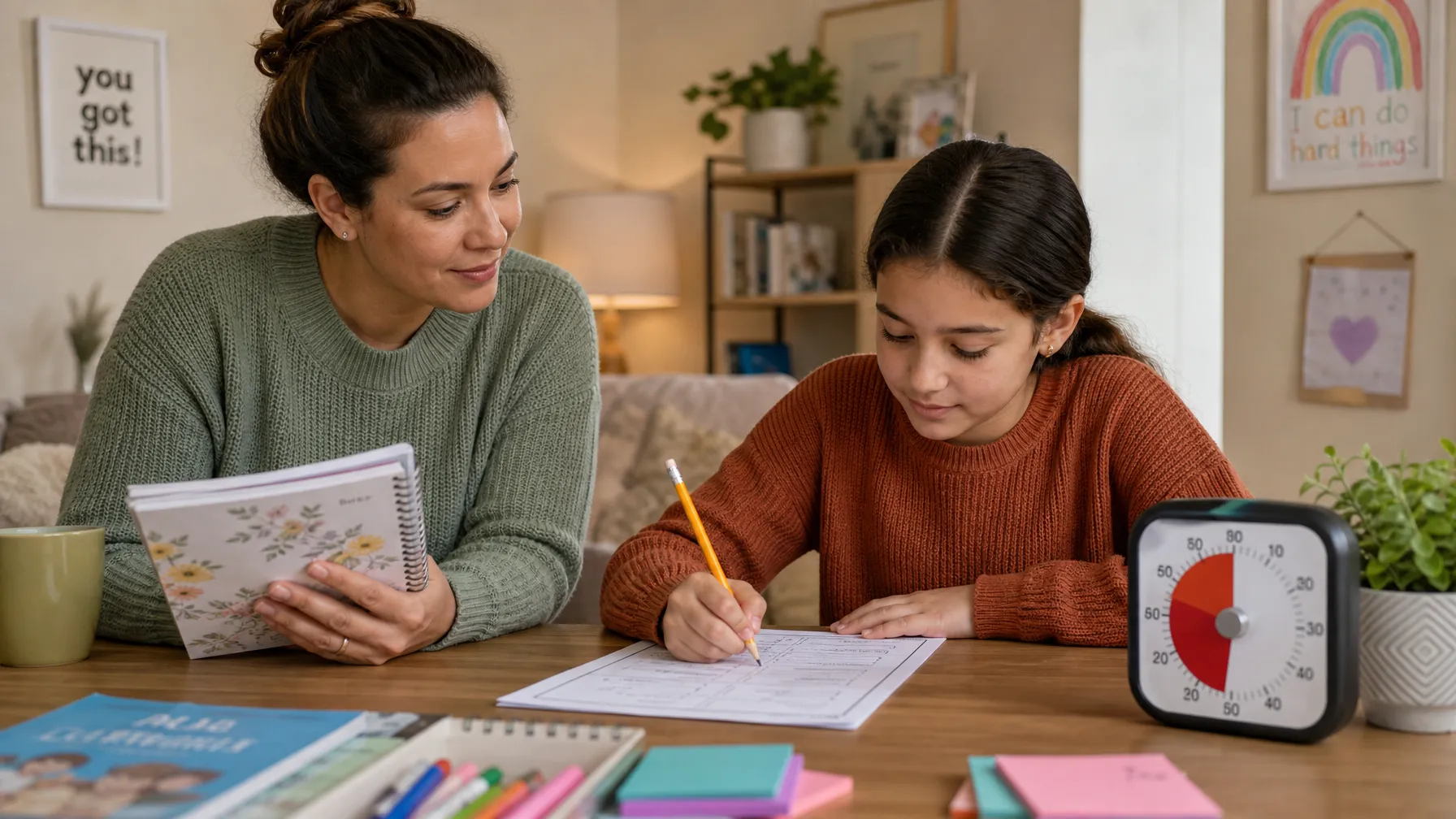
Most parents notice something before they can name it. Maybe your kid reads fluently out loud but can't recall what the paragraph said. Maybe math homework that should take 15 minutes stretches into an hour of tears, not because the material is new, but because something about how the numbers land on the page doesn't click.
Roughly 1 in 5 kids in the United States has a learning or attention issue, according to the National Center for Learning Disabilities [1]. Many go unidentified for years, not because parents aren't paying attention, but because the signs often look like something else: laziness, anxiety, defiance, or just "not being a math kid."
Here's what learning disabilities look like at different ages, when testing makes sense, and what to do once you have answers.
What a learning disability is (and isn't)
A learning disability is a neurological difference in how the brain processes information. Kids with learning disabilities often have average or above-average IQs, but their brains handle specific types of input (reading, writing, math, auditory processing) differently than their peers.
The most common learning disabilities include:
- Dyslexia: difficulty with reading fluency, decoding, and spelling. Affects roughly 5 to 17% of kids.
- Dyscalculia: difficulty with number sense, math facts, and spatial reasoning. Often missed because math struggles get normalized.
- Dysgraphia: difficulty with handwriting, spelling, and organizing thoughts on paper. Sometimes mistaken for carelessness or poor effort.
- Auditory processing disorder: difficulty making sense of spoken language, especially in noisy environments. Kids hear fine but struggle to process what they hear.
- Visual processing disorder: difficulty interpreting visual information, affecting reading, math, and spatial awareness.
A learning disability is not a phase kids outgrow. But with the right support, kids learn to work with their brains rather than against them.
Things to look for by age
Preschool (ages 3 to 5)
- Late talking or persistent difficulty with pronunciation
- Trouble learning the alphabet, numbers, colors, or days of the week
- Difficulty following multi-step directions
- Avoiding drawing, coloring, or activities that require fine motor control
- Struggling to rhyme or recognize rhyming patterns
At this age, uneven development is normal. The concern isn't one of these in isolation; it's a cluster that persists while peers move on.
Early elementary (first through third grade)
- Reading significantly below grade level by the end of first grade
- Reversing letters or numbers past age 7 (occasional reversals before then are typical)
- Difficulty sounding out unfamiliar words despite phonics instruction
- Avoiding writing or producing far less written work than verbal ability would suggest
- Trouble memorizing math facts even with repeated practice
- Losing track during multi-step math problems
This is the window where learning disabilities become most visible, because the curriculum demands jump. A kid who was "keeping up" in kindergarten may start falling behind when reading shifts from learning-to-read to reading-to-learn.
Upper elementary and middle school (fourth through eighth grade)
- Strong verbal skills but weak written output
- Needing significantly more time than peers to complete the same assignments
- Test performance that doesn't match classroom understanding
- Avoidance behaviors: "forgetting" homework, shutting down during certain subjects, physical complaints before school
- Difficulty with organization, note-taking, or following written instructions
By this age, many kids with unidentified learning disabilities have developed school anxiety or a fixed belief that they're "bad at school." The disability didn't cause the anxiety directly, but years of unexplained struggle did.
$20 off your first class WITH promo code: blog
Build the Education your Kid Deserves
Discover thousands of live classes taught by expert teachers, across academics and enrichment.
Browse classesWhen to pursue testing
If your kid's struggles are persistent (lasting more than a few months), pervasive (showing up across settings, not just one class), and disproportionate (requiring far more effort than peers for the same results), testing is worth pursuing.
Two paths exist:
Through your school district: Under IDEA (Individuals with Disabilities Education Act), public schools are required to evaluate kids for learning disabilities at no cost when a parent or teacher requests it. The process can take 60 to 90 days depending on the state. If your kid qualifies, they'll receive an IEP (Individualized Education Program) with specific accommodations and services. For a breakdown of how IEPs and 504 plans differ, see our IEP vs. 504 guide.
Through a private neuropsychologist or educational psychologist: Private evaluations are faster (usually 2 to 4 weeks for results) and often more comprehensive, but they cost $2,000 to $5,000 out of pocket. Some insurance plans cover part of the evaluation. Private results can still be submitted to a school district to request an IEP.
Homeschool families can also request evaluations through their local school district. The district is required to evaluate, even if your kid isn't enrolled.
What to do after a diagnosis
A diagnosis is a map. Once you know how your kid's brain processes information, you can stop guessing and start building support around the specific gap.
Adjust the learning environment. Kids with dysgraphia may need speech-to-text tools instead of handwritten assignments. Kids with dyscalculia may need manipulatives, visual models, and extra processing time rather than more drill sheets. Kids with auditory processing challenges benefit from visual instructions, written summaries, and reduced background noise.
Find instruction that fits. One-size-fits-all classrooms often can't accommodate the pacing and method changes that learning disabilities require. Small-group or 1:1 instruction, where a teacher can adjust in real time, makes a measurable difference. For kids who struggle specifically with math, our guide on ADHD and math covers strategies that apply broadly to processing-based math struggles.
Watch for the emotional layer. Kids who've struggled without understanding why often carry shame, frustration, or a deep belief that they're not smart. Addressing the academic gap without addressing the emotional one leaves half the problem unsolved. The twice-exceptional checklist can help parents identify when giftedness and a learning disability coexist, a combination that's frequently missed.
Build on strengths, not just deficits. A kid with dyslexia who's a brilliant verbal storyteller doesn't need to be defined by reading scores. A kid with dyscalculia who builds intricate structures out of anything available has strong spatial reasoning that traditional math instruction may not be tapping. The goal is to support the gap while leaning into what comes naturally.
When it's not a learning disability
Not every academic struggle points to a disability. Sleep deprivation, vision problems, hearing issues, anxiety, ADHD, and gifted underachievement can all mimic learning disability symptoms. A thorough evaluation rules these out or identifies them as co-occurring conditions.
Sensory processing challenges can also look like learning difficulties in classroom settings, where the environment itself overwhelms the kid before the content even lands.
If you're seeing some of these signs but aren't sure whether testing is warranted, start by documenting what you observe: which subjects, which tasks, how long the struggle has persisted, and what you've already tried. That record becomes the foundation of any evaluation request.
FAQ
At what age can a learning disability be diagnosed?
Most learning disabilities can be reliably identified between ages 5 and 7, though some signs appear earlier and some may appear later. Dyscalculia is often identified later (around third or fourth grade) because early math curricula don't demand the number sense skills it affects.
Can a kid have more than one learning disability?
Yes. Co-occurring learning disabilities are common. A kid with dyslexia may also have dysgraphia or an auditory processing disorder. Comprehensive testing evaluates across multiple domains.
Do learning disabilities get worse over time?
The disability itself doesn't worsen, but the gap between a kid's performance and grade-level expectations can widen without intervention. Early identification leads to better outcomes because support starts before the gap compounds.
Can online classes help kids with learning disabilities?
Small-group and 1:1 online classes can be a strong fit because they reduce sensory overload, allow flexible pacing, and let teachers focus on individual needs. The key is finding a teacher who understands how to differentiate instruction for the specific disability.
Sources
[1] Cortiella, C. and Horowitz, S.H. "The State of Learning Disabilities: Facts, Trends and Emerging Issues." National Center for Learning Disabilities, 2014. ncld.org



.svg)
.svg)