Some kids melt down over the sound of the vacuum cleaner. Others can't sit still unless they're chewing something. Some are so sensitive to fluorescent light that school classrooms are genuinely painful, and others don't notice they've bumped into things repeatedly until someone points it out.
These aren't behavioral issues or attention-seeking. They're sensory processing differences, and they're far more common than most parents realize.
Sensory processing disorder (SPD) describes a pattern where the brain has difficulty receiving, organizing, and responding to sensory information in a typical way. For kids with SPD, the sensory environment that most people filter automatically can be overwhelming, distracting, or — in the opposite direction — barely noticeable when it should be obvious.
Understanding sensory processing disorder
The sensory system processes more than the classic five senses. It also handles proprioception (awareness of where your body is in space), interoception (awareness of internal body signals like hunger), and the vestibular system (balance and movement). SPD can affect any or all of these systems.
Kids with SPD fall into two broad profiles — though many have a mix of both:
Sensory-seeking: These kids need more sensory input than the environment typically provides. They fidget, crash into things, touch everything, chew non-food items, and seek movement. Their behavior is an attempt to get the sensory input their nervous system needs to function.
Sensory-avoiding: These kids are easily overwhelmed by input that others barely register. Loud sounds, certain textures, bright lights, unexpected touch, or crowded spaces can trigger significant distress. They may refuse certain foods, clothes, or environments that seem tolerable to everyone else.
SPD is not a standalone diagnosis in the DSM-5, but it's recognized by occupational therapists and appears in a significant percentage of kids with ADHD and autism. Many kids have sensory differences without meeting criteria for either condition. The label matters less than understanding how your specific child processes their environment.
How SPD shows up during learning
In a traditional classroom, SPD creates a constant, invisible tax on attention and energy. A child managing sensory overwhelm from fluorescent lights, ambient noise, physical contact of nearby classmates, and an itchy shirt tag is spending cognitive resources on sensory management that aren't available for learning.
Signs that SPD may be affecting your child's learning:
- Strong difficulty focusing in environments with background noise or visual busyness
- Frequent movement, fidgeting, or difficulty staying seated during tasks
- Emotional dysregulation that seems disproportionate and is triggered by sensory inputs
- Fatigue after typical school days that seems out of proportion to the academic workload
- Strong preferences about learning environment — needing specific lighting, a specific level of quiet, a specific seat
- Resistance to activities involving certain textures, sounds, or physical movement
These patterns are often misread as oppositional behavior, anxiety, or ADHD. If your child has executive function challenges alongside sensory sensitivities, this guide on executive function covers how the two frequently interact.
Building a sensory-supportive home learning environment
One of the most significant advantages of home-based learning for SPD kids is control over the sensory environment. You can eliminate most of the involuntary sensory load that drains attention in institutional settings — and you can build in the sensory input your child's nervous system needs to stay regulated.
A few foundational adjustments:
Lighting. Swap fluorescent bulbs for warm LED or natural light where possible. Many SPD kids are specifically sensitive to fluorescent flicker (even when they can't consciously identify it). A space with good natural light and adjustable warm lighting often makes a measurable difference.
Sound. White noise, nature sounds, or low-frequency ambient music can provide consistent auditory input that reduces the jarring effect of unexpected sounds. Over-ear headphones — even without music — provide both noise dampening and proprioceptive input for sensory-seeking kids.
Movement breaks. Build movement into the schedule deliberately. Short, vigorous movement breaks between learning blocks — jumping, carrying heavy items, climbing — provide proprioceptive and vestibular input that helps sensory-seeking kids regulate. These breaks improve focus during academic work. They're not interruptions; they're infrastructure.
Seating options. A wobble stool, exercise ball, floor cushion, or standing desk allows movement during seated work. Many SPD kids focus better when allowed to move, and forcing stillness removes a regulatory strategy rather than building one.
$20 off your first class WITH promo code: blog
Build the Education your Kid Deserves
Discover thousands of live classes taught by expert teachers, across academics and enrichment.
Browse classesSensory diets and what they mean for your homeschool
Occupational therapists who work with SPD kids often develop what they call a sensory diet — a scheduled set of sensory activities throughout the day that keep the nervous system regulated. Just as a food diet provides what the body needs to function, a sensory diet provides what the nervous system needs to stay regulated.
You don't need a formal OT evaluation to start building sensory diet principles into your homeschool day. Observe your child: when are they most regulated and focused? What activities precede those windows? What sensory input seems to help them reset?
Common sensory diet activities:
- Jumping on a trampoline or trampoline board
- Wall push-ups or heavy work activities that provide proprioceptive input
- Carrying items — a weighted backpack for a short walk, helping carry groceries
- Deep pressure — a weighted lap pad, a tight-squeeze hug, rolling up in a blanket
- Chewing — crunchy snacks, gum, or a designated chew tool
- Tactile play — playdough, kinetic sand, water play
The timing of sensory activities matters. A sensory-seeking child who gets vigorous proprioceptive input before a focused task often sustains attention significantly longer than one who hasn't had that input. Think of it as fueling the focus window, not interrupting it.
Online learning and sensory processing disorder
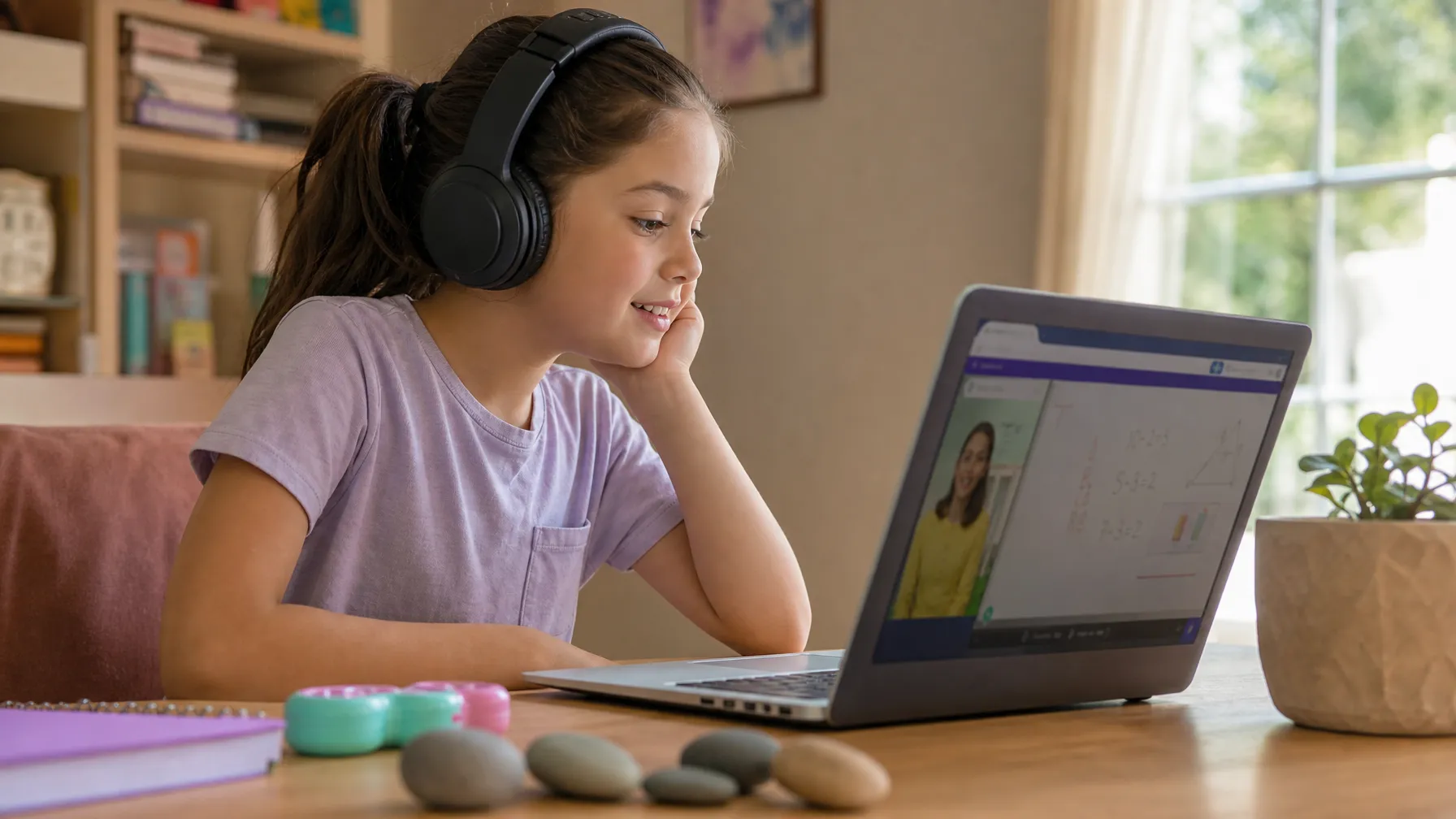
Live online classes are often a better sensory fit for SPD kids than traditional classroom settings — not because of anything specific to the platform, but because of what they eliminate. An online class removes the involuntary physical contact of nearby classmates, the ambient noise of a room full of kids, the sensory chaos of hallway transitions, and the visual complexity of a busy classroom. What remains is one face on a screen, one teacher's voice, and a home environment the parent has calibrated for their child.
Parents of SPD kids also have more flexibility to let their child participate from a couch with a weighted blanket, from a floor cushion, or while using a fidget tool — without the social stigma those accommodations might carry in a traditional classroom.
Browse Outschool classes for live, small-group options across every subject — taught in a low-stimulation video format that many sensory-sensitive kids find more manageable than in-person instruction.
When to seek an OT evaluation
A formal occupational therapy evaluation is worth pursuing if sensory challenges are significantly affecting your child's daily life — not just learning, but eating, dressing, sleeping, or maintaining relationships. An OT can provide a specific sensory profile, targeted recommendations for your child's particular needs, and a sensory diet designed around their profile.
For more on how sensory sensitivities interact with attention and regulation, you can also read about executive function and ADHD in families managing multiple learning differences.
Frequently asked questions
Is sensory processing disorder a formal diagnosis?
SPD is recognized by occupational therapists and widely used as a clinical description, but it's not currently listed as a standalone diagnosis in the DSM-5. Many kids receive an SPD designation from an OT as part of a broader evaluation. In practice, the diagnostic label matters less than understanding your child's specific sensory profile.
Is SPD the same as ADHD?
They're separate but frequently co-occurring. ADHD involves difficulties with attention regulation, impulse control, and executive function. SPD involves the processing of sensory information. A significant percentage of kids with ADHD also have sensory sensitivities, and some behavioral patterns look similar on the surface — which is one reason they're sometimes confused.
Can SPD improve over time?
For many kids, yes. The nervous system continues developing throughout childhood and into adolescence, and many kids become better at self-regulating sensory responses as they get older. Occupational therapy accelerates this by building specific regulatory skills. Most adults who had significant SPD as children develop effective coping strategies, though the underlying sensory differences typically remain.
My child seems fine at home but melts down at school or in public. Is that SPD?
This is a classic pattern for sensory-avoiding kids. They hold it together in a manageable sensory environment (home) and dysregulate when the sensory load exceeds their threshold in crowded or unpredictable settings. The meltdown isn't about behavior — it's about a nervous system taxed past its capacity. This pattern is one of the stronger indicators that a sensory evaluation could be useful.
What's the difference between sensory sensitivity and sensory processing disorder?
Almost everyone has some sensory preferences. SPD describes a pattern where sensory differences are significant enough to regularly affect daily functioning — learning, eating, dressing, relationships, or participation in ordinary activities. The severity and pervasiveness of the impact is what distinguishes typical sensory preferences from a disorder that warrants intervention.


.svg)
.svg)