Why ADHD makes homework so hard
ADHD is primarily a disorder of executive function, not attention in the casual sense. The prefrontal cortex — the part of the brain that manages planning, prioritizing, regulating emotions, and holding information in working memory — develops more slowly in children with ADHD and functions differently even when mature. [2]
Homework hits almost every one of these functions at once. Starting a task requires initiation, which is one of the most common ADHD challenges — the internal signal that tells most people it is time to begin is muted or absent. Staying on track requires working memory, and gaps mean kids lose the thread of what they are doing mid-task. Managing frustration requires emotional regulation, so a hard problem can escalate into a shutdown quickly. And estimating time is genuinely different for kids with ADHD — they do not experience time passing the way other people do, which is why "just 20 more minutes" never lands the way you expect it to.
None of this is willful. Knowing it changes how you approach the problem.
Before homework starts: environment and timing
The single biggest lever most families have is when and where homework happens — not any particular strategy during the session itself.
Timing: account for the after-school crash
Many children with ADHD have used up their executive function resources at school by the end of the day. The hour after they get home is often the worst time for homework. If you can, build in a 30 to 60 minute decompression window first — outdoor time, a snack, unstructured movement — before starting. The homework goes faster when your child is not already depleted. [3]
If medication is a factor, stimulant medications typically wear off by late afternoon. Talk to your child's doctor if homework time consistently falls outside the medication window and is creating significant problems.
Location: reduce friction and distraction
Clear the work surface before starting. Clutter competes for attention. Remove unrelated objects from arm's reach — phones, toys, anything that could trigger a redirect. Some kids with ADHD focus better with background noise (white noise, instrumental music) than in silence. Try both and see what works. Sit nearby without hovering — your calm, available presence reduces anxiety-driven stall behavior without becoming a prompt every 30 seconds.
A consistent homework start signal
Routine reduces the initiation problem. A consistent trigger — the same time, the same location, a short ritual like sharpening pencils and writing the date — signals the brain that it is time to shift into work mode. Over time, the routine does some of the executive function work that the ADHD brain struggles to do independently.
During homework: strategies that actually help
Break tasks into smaller pieces
"Do your homework" is not a usable instruction for a child with ADHD. "Write your name at the top, then do the first two math problems" is. Breaking tasks into discrete, completable steps reduces the activation energy required to start and gives your child frequent small wins instead of one distant finish line. Before starting, have your child write a list of every task they need to complete — and cross off each one when done. The physical act of crossing something off is genuinely motivating and makes progress visible.
Use timers strategically
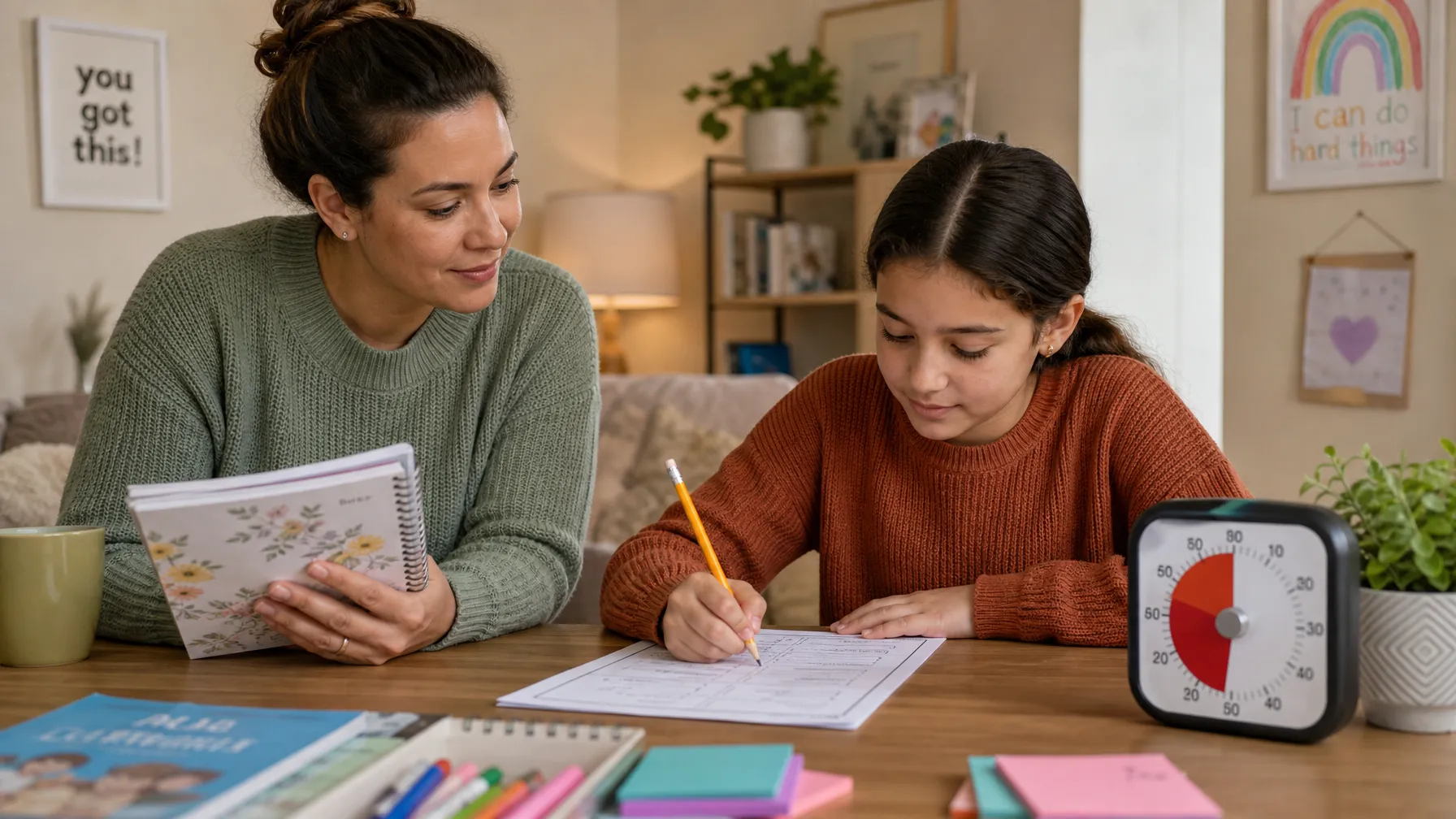
Working in short intervals — 10 to 25 minutes on, 5 minutes off — works well for many kids with ADHD. A visual timer (the kind with a shrinking arc) works better than a digital countdown for children who struggle with time perception because they can see how much time is left without having to calculate.
Narrate the thinking out loud
Many kids with ADHD benefit from narrating their work as they do it — reading problems out loud, saying what step they are on, talking through their reasoning. This keeps them in the task and uses verbal processing to compensate for working memory gaps. It might seem odd, but it works consistently.
$20 off your first class WITH promo code: blog
Build the Education your Kid Deserves
Discover thousands of live classes taught by expert teachers, across academics and enrichment.
Browse classesReduce the demand, not the learning
If your child is spending 90 minutes on 20 math problems and getting increasingly frustrated and inaccurate, consider a different frame: the learning goal is demonstrated mastery, not completed quantity. Talk to their teacher about whether doing the first 10 problems accurately satisfies the assignment's purpose. Many teachers familiar with ADHD are open to this if you approach it collaboratively. This is not lowering expectations — it is recognizing that quantity-based homework does not always measure what it is supposed to measure.
Movement breaks are not optional
Brief physical activity between tasks genuinely helps ADHD brains reset. Research shows that even 10 minutes of moderate physical activity improves executive function in children with ADHD. [4] Build movement in as a cognitive tool, not a reward for finishing.
When homework breaks down completely
Some evenings will go off the rails. Your child will refuse, shut down, or escalate into a full meltdown. Forcing a dysregulated child to complete homework rarely produces any learning and often produces significant harm to your relationship and your child's association with schoolwork. If your child has hit a wall, the most productive thing is usually a full reset: stop, let them calm down, and pick it up later or the next morning.
Write a brief note to the teacher when this happens. A two-sentence note explaining that your child hit a wall is a legitimate and appropriate thing to send. Most teachers want to know when ADHD is affecting homework completion because it informs how they support your child in school.
If homework breakdowns are happening more than occasionally, start tracking when, which subjects, and what happened that day. Patterns often reveal something actionable — a timing problem, a specific subject needing more support, or a mismatch between current ability and assignment difficulty.
When to talk to the school
If homework is consistently taking more than twice the school's stated time estimate, involving major emotional distress, or producing daily conflict, that is information the school should have. An IEP or 504 plan can include homework accommodations — reduced quantity, extended time, alternative formats — that do not require changing what your child is learning.
Homeschooling families have even more flexibility here: homework as a concept can be redesigned from the ground up. If the traditional homework model is not working, it is worth asking whether it needs to look the same at all.
What Outschool can add
For kids who do better with a different instructor for a difficult subject, or who need a low-stakes space to get extra practice without the pressure of school expectations, Outschool has live and self-paced classes in math, reading, writing, and most other subjects. Small group sizes and teacher responsiveness make a meaningful difference for kids who get lost in a larger classroom setting.
Browse ADHD-supportive classes on Outschool
Sources
[1] Langberg, J.M. et al. (2011). Homework problems in children with ADHD: Their frequency, problem areas, and treatment outcomes. Journal of Psychoeducational Assessment, 29(4), 322-331. https://journals.sagepub.com/doi/10.1177/0734282910378428
[2] Diamond, A. (2013). Executive functions. Annual Review of Psychology, 64, 135-168. https://www.annualreviews.org/doi/10.1146/annurev-psych-113011-143750
[3] Barkley, R.A. (2015). Attention-Deficit Hyperactivity Disorder: A Handbook for Diagnosis and Treatment (4th ed.). Guilford Press. https://www.guilford.com/books/Attention-Deficit-Hyperactivity-Disorder/Russell-Barkley/9781462536788
[4] Pontifex, M.B. et al. (2013). Exercise improves behavioral, neurocognitive, and scholastic performance in children with ADHD. Journal of Pediatrics, 162(3), 543-551. https://www.jpeds.com/article/S0022-3476(12)00937-2/fulltext


.svg)
.svg)