It's 8:47 in the morning. You've asked your 9-year-old three times to put on shoes, and you just found their lunch box in the backyard from yesterday. Their backpack is missing one strap, their homework is done but not in the folder where homework goes, and they are currently explaining why the dog needed to be narrated over the school start time.
If that scene is familiar, there's a good chance your child is struggling with executive function — a cluster of brain-based skills that govern the ability to plan, focus, follow through, and manage impulses. It doesn't mean something is wrong. It means their brain is working a certain way, and there are specific, evidence-backed things you can do to help.
This guide covers what executive function actually is, what it looks like when a child is struggling, and practical activities that help build these skills at home — organized by the specific skill area each one targets.
Quick takeaways
- Executive function is a set of mental skills — not a single thing — that develops throughout childhood and into early adulthood.
- Many kids with ADHD, autism, anxiety, or sensory processing differences have executive function challenges, but these skills can also be a struggle for neurotypical kids.
- The skills can be practiced and strengthened. Activities, routines, and consistent structured practice all help.
- Structured learning environments — including live online classes with small groups and clear expectations — give kids a low-stakes arena to practice executive function skills in real time.
- Progress is gradual. Building these skills takes months, not days. Consistency matters more than intensity.
What executive function actually is (in plain parent language)
The term "executive function" refers to a group of mental processes that act like the management system of the brain. Researchers generally include three core components, each of which involves a cluster of related skills:
Working memory is the ability to hold and use information in your mind while doing something with it — like keeping the first three steps of an instruction in your head while you're doing step one. Kids with working memory challenges forget what they were just told, lose their place in multi-step tasks, and struggle to follow complex directions.
Cognitive flexibility is the ability to shift gears — to switch between tasks, adjust to changes in plans, and think about a problem from a different angle when the first approach isn't working. Kids who struggle here get stuck, have meltdowns when plans change unexpectedly, and have trouble moving from one activity to another.
Inhibitory control (also called impulse control or self-regulation) is the ability to stop a response that isn't appropriate — to think before acting, wait your turn, resist the urge to blurt something out, and stay on task when distractions are competing for attention. This is the skill most commonly associated with ADHD.
These three core processes support higher-order skills that show up constantly in school and daily life: planning and organizing, time management, emotional regulation, goal-directed persistence, and metacognition (the ability to think about how you're thinking).
Executive function skills develop throughout childhood and into the mid-20s. The prefrontal cortex — the part of the brain most responsible for these processes — is still maturing well into early adulthood. For kids with ADHD, the development is often delayed by about three years relative to neurotypical peers. For kids with autism, the profile is different: some executive function skills may be strong while others lag significantly. The key is identifying specifically which skills need support, rather than treating executive function as one undifferentiated problem.
Signs your child might be struggling with executive function
Executive function challenges show up in different ways depending on the specific skill and the child's age. Here are common patterns parents describe:
Working memory struggles:
- Forgets a two- or three-step instruction by the time they start it
- Loses place when reading or doing multi-step math problems
- Seems to not hear you, even when they were looking directly at you
- Has to re-read a paragraph multiple times because they can't retain what they just read
Cognitive flexibility struggles:
- Intense distress when plans change unexpectedly
- Gets stuck on one approach to a problem and can't try another one
- Has trouble transitioning between activities, even enjoyable ones
- Black-and-white thinking, difficulty with nuance or "it depends"
Inhibitory control struggles:
- Speaks before thinking, frequently interrupts
- Acts impulsively (grabbing, hitting, running) without apparent awareness of consequences
- Can't sustain attention on non-preferred tasks, even briefly
- Emotional reactions that feel disproportionate to the trigger
Planning and organization struggles:
- Can't start a task without step-by-step external guidance
- Loses items constantly (shoes, pencils, jackets) even with designated places
- Produces work that's disorganized even when they clearly know the material
- Underestimates time needed for tasks consistently
If several of these feel familiar, that's worth noting — not as a source of worry, but as a roadmap for the specific skills worth prioritizing in the activities below.
Working memory activities for kids
Working memory is like a mental scratchpad — you can exercise it. These activities are most effective when done consistently over weeks and months, not as a one-time fix.
Sequence recall games: Give your child a sequence of instructions — "go to the kitchen, bring back something red, and tap the front door on your way" — and progressively increase the length as they succeed. This directly exercises the ability to hold multiple pieces of information in mind while acting on them. Simon (the electronic game) is the formal version of this; you can do it informally anytime.
Teach-back exercises: After explaining a concept or a set of instructions, ask your child to explain it back to you in their own words. This isn't a test — it's a practice. The act of retrieving and reformatting information strengthens working memory encoding. Make it low-stakes and conversational.
Chunked instructions: Break multi-step tasks into written or visual checklists rather than verbal strings. This externalizes the working memory load so your child isn't holding all the steps mentally while also doing them. Over time, reduce the prompts — go from a 6-step checklist to a 4-step one as the routine becomes more automatic.
Reading with narration: After reading a chapter or passage, have your child narrate back what happened — in order, with details. This trains the ability to retain and sequence information over a sustained period. Charlotte Mason homeschool families have used this practice for generations; the working memory research backs it up.
Memory strategy games: Classic matching card games, 20 Questions, and category-sorting games all exercise working memory in a context that feels like play rather than practice. Play them regularly rather than as a special activity.
Planning and organization activities
Planning and organization are skills that can be explicitly taught — and they respond well to consistent practice with appropriate scaffolding. The goal is to gradually transfer the organizational structure from external supports (checklists, timers, parent reminders) to internal habit.
Daily planning practice: Spend 5-10 minutes each morning reviewing what needs to happen that day. Ask your child to put the tasks in order, identify what they need for each one, and name any potential problems ("what might make this harder today?"). This brief daily practice builds planning habits more effectively than any formal curriculum.
Time estimation exercises: Ask your child to estimate how long a task will take before they start it, then track the actual time. Review the gap together — without judgment. Kids with executive function challenges consistently underestimate time required. Making the gap visible, repeatedly, starts to calibrate their internal clock.
Backward planning projects: Give your child a small multi-day project — a book report, a science demonstration, a cooking project — and work backward together from the deadline. "It's due Friday. What needs to happen the day before? What needs to happen two days before?" This teaches project thinking in a concrete, low-stakes context.
Visual schedules and system design: Work with your child to design their own organizational systems — a homework folder, a morning routine chart, a place for shoes that they chose and helped create. Kids are far more likely to use systems they helped build. Keep systems simple and visual; complexity defeats the purpose for most executive function-challenged kids.
Impulse control and self-regulation activities
Impulse control is the hardest executive function skill to build through direct practice because it requires the child to override an automatic response in real time. The most effective approach combines in-the-moment tools with practice outside of high-stress situations.
Stop-signal games: Games like Red Light/Green Light, Freeze Dance, or Simon Says are literal impulse-control practice — they require the child to override an action already in motion when a signal appears. These aren't just for little kids. Even older children benefit from regular practice with response inhibition in a playful, no-consequences context.
Emotions vocabulary work: Kids who can accurately name what they're feeling are better able to regulate those feelings than kids who can only experience them. Build an emotions vocabulary through conversation, books, and feeling charts. "Frustrated," "overwhelmed," "overstimulated," and "anxious" are more useful labels than just "bad" or "mad." The naming practice reduces emotional reactivity over time.
The "pause" cue: Establish a shared pause signal with your child — a gesture, a word, a breath count — to use when they're about to act impulsively. Practice it during calm moments so it becomes automatic. This gives them a tool in the moment rather than just instruction after the fact.
Mistake recovery practice: Create low-stakes situations where your child can practice recovering from an impulsive action — apologizing, repairing, trying again. Executive function-challenged kids often spiral after mistakes. Building a routine around recovery ("okay, that didn't go well — what can you do now?") makes the recovery feel predictable and achievable rather than catastrophic.
Mindfulness-adjacent practices: Brief, playful body-awareness exercises — noticing five things you can see, slow deep breathing, progressive muscle relaxation — help kids develop awareness of their own physiological states. This awareness is the foundation of self-regulation. Keep these short, low-pressure, and routine.
Cognitive flexibility activities
Flexible thinking — the ability to shift approaches, tolerate ambiguity, and adapt when plans change — develops gradually through exposure to change in predictable, safe contexts. The goal is to build tolerance for uncertainty through repeated low-stakes practice.
Change-of-plan practice: Deliberately introduce small, predictable changes to routines when everything is calm. "Today we're going to do math first instead of reading — let's see how that goes." Naming the change, framing it positively, and following through helps your child build a track record of successfully navigating changes. Start with tiny changes; increase gradually.
Alternative solution brainstorming: When your child hits a problem, instead of solving it for them, ask: "Can you think of a different way to try?" Then brainstorm three alternatives together before deciding which to try. Over time, this builds the habit of considering multiple approaches rather than perseverating on one.
Perspective-taking activities: Stories, role-play, and games that require seeing a situation from another person's point of view directly exercise cognitive flexibility. Read books with unreliable narrators, play "what is the other character thinking?" during storytime, or debrief games by asking "what was your opponent trying to do?"
Tolerance-building for ambiguity: Start open-ended tasks with no single right answer — art projects, creative writing, open-ended STEM building challenges. Executive function-challenged kids often struggle intensely with tasks that have no clear correct path. Regular exposure to open-ended work, in low-stakes contexts with lots of encouragement, builds tolerance gradually.
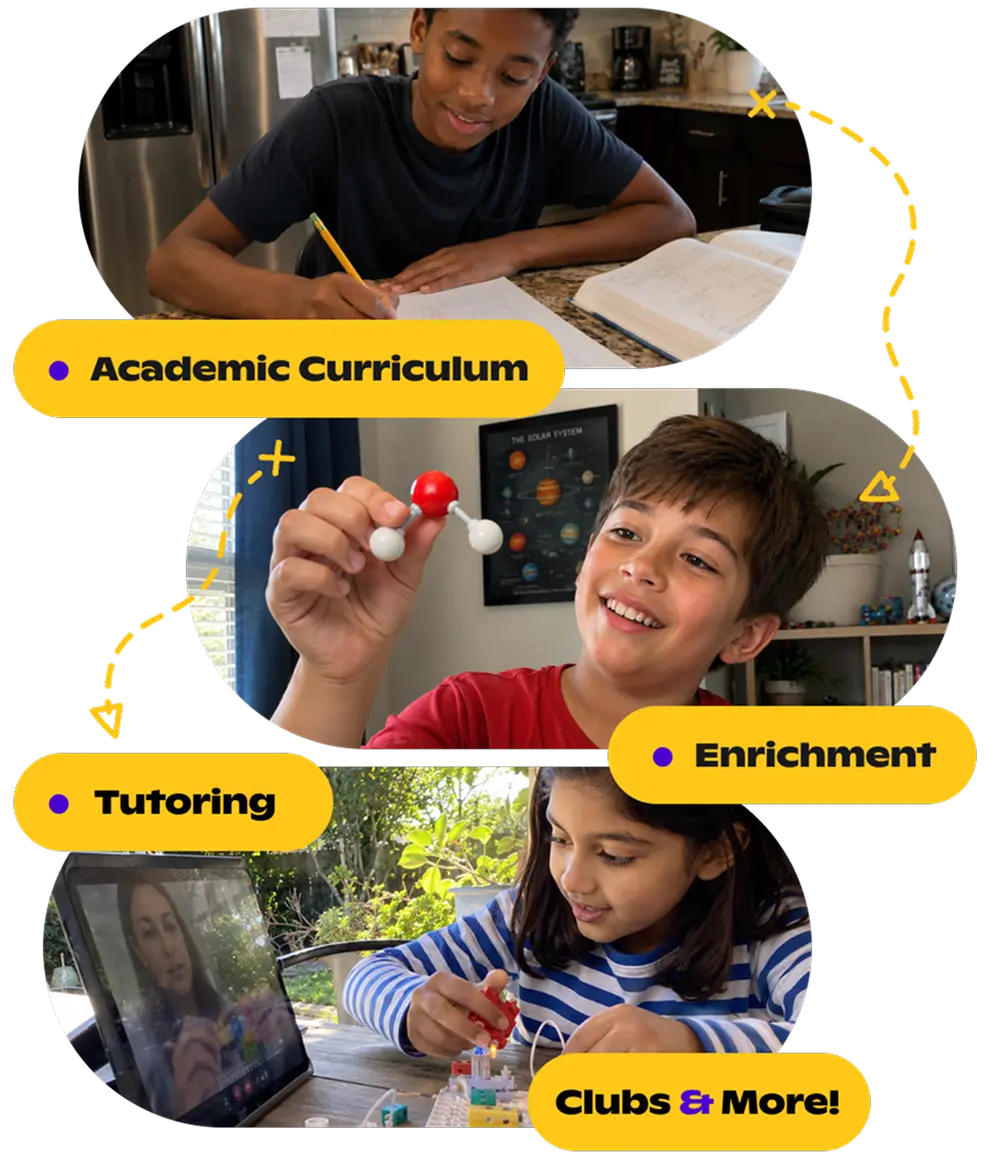
How structured online classes can help build executive function
One of the patterns parents notice when their executive function-challenged kids start taking live online classes is that the class structure itself becomes a form of practice.
In a small-group live class, a child has to hold the thread of a conversation while also waiting their turn to speak — working memory plus inhibitory control. They have to follow the flow of a teacher-directed lesson while also keeping track of their own contributions — planning plus attention. When the class topic shifts, they have to shift with it — cognitive flexibility. And they have to stay present for 30-55 minutes on a non-preferred topic, with a group watching — sustained attention and self-regulation.
None of this is the explicit focus of the class. The class is about marine biology or creative writing or algebra. But the demands of a structured, interactive learning environment are exactly the kind of low-stakes repetitive practice that builds executive function over time.
Live executive function classes on Outschool go a step further — these are classes explicitly focused on teaching planning, organization, time management, and self-regulation skills to kids and teens, often taught by educators with backgrounds in learning differences. For students who need direct skill instruction in addition to environmental practice, these classes can be a meaningful complement to what you're doing at home.
For older kids and teens who are working specifically on organization and time management, teen organization classes cover practical systems for managing school work, keeping track of commitments, and building the kind of habits that carry through high school and into adult life.
If your child has a formal ADHD diagnosis and you're also thinking about curriculum planning, the guide to homeschool curricula for ADHD covers how to choose and structure learning materials around an ADHD learner's specific profile.
Frequently asked questions about executive function activities for kids
At what age should I start working on executive function skills?
You can begin age-appropriate executive function practice as early as 3-4 years old, though the skills that show the most gains from direct practice tend to emerge more in the 5-12 age range. That said, it's never too late — teenagers and even adults can meaningfully improve executive function skills with the right strategies and consistent practice.
Is executive function the same as ADHD?
They're related but not the same. ADHD is a neurodevelopmental condition, and executive function challenges are one of the core features of ADHD. But executive function difficulties also appear in autism, anxiety, depression, sensory processing differences, and in some neurotypical kids. You don't need an ADHD diagnosis for these strategies to be useful.
How long does it take to see improvement?
Most families see meaningful change over a period of months with consistent practice, not days or weeks. Executive function skills develop gradually, and they're heavily tied to brain maturation that happens on its own timeline. What you're doing with activities and routines is supporting that development and giving your child the tools to compensate while their brain catches up — not forcing faster maturation. Consistency over the long term matters much more than intensity over a short period.
My child gets extremely frustrated during these activities. What should I do?
Frustration is a signal that the challenge level is a little too high, the time is too long, or the stakes feel too real. Adjust one variable at a time — make the task simpler, shorten it, or reduce the pressure by making it a game rather than a skill-building exercise. The practice needs to feel approachable, not like therapy. If frustration is consistently high, that's useful data about where your child's threshold is right now, and backing off a level is the right move.
Should I tell my child we're working on executive function?
Age-appropriately, yes — especially for kids who are old enough to understand. "Your brain works really hard on staying organized, and we're going to practice some stuff that makes that easier" is a more empowering frame than running the activities without any explanation. Kids who understand their own brain often have more patience with themselves than kids who just know that things are hard and don't know why.
Building these skills takes time — and that's okay
The families who see the most progress with executive function work are the ones who decide it's a long-term project and treat it like one. They build small practices into daily routines. They stay curious and flexible when something doesn't work. They celebrate gradual, unspectacular progress because they know it's building toward real change.
If you're looking for structured support to complement what you're doing at home, executive function classes on Outschool connect your child with instructors who specialize in teaching these skills to kids with all kinds of learning profiles — in live, small-group sessions that give your child a real audience to practice with.
The skills are buildable. Your kid's brain is already working on it.



.svg)
.svg)