Social skill development is one of the most-searched topics for parents of autistic children, and one of the least-served by generic advice. Most recommendations either assume neurotypical social goals (make eye contact, take turns, smile more) or are so clinical they're hard to apply in a real home with a real child.
What follows is a set of activities organized by social skill type, grounded in what the research supports, and written for parents who want practical options they can try this week.
A note on framing: the goal here isn't to make autistic kids socially indistinguishable from neurotypical peers. It's to help them build the communication and connection tools that will serve them in relationships and community throughout their lives, on their own terms.
Why social skills development looks different for autistic kids
Autistic kids often have strong interest in connection. The social motivation is there. What differs is the mechanics: reading nonverbal cues, managing the unpredictability of two-way conversation, knowing what to say when, recovering from social misunderstandings.
Because social interaction is processed differently, not deficiently, approaches that simply require more practice of standard social behaviors often don't transfer. The strategies that work tend to be explicit, predictable, and tied to the child's own interests.
Activities by skill type
Turn-taking and reciprocal play
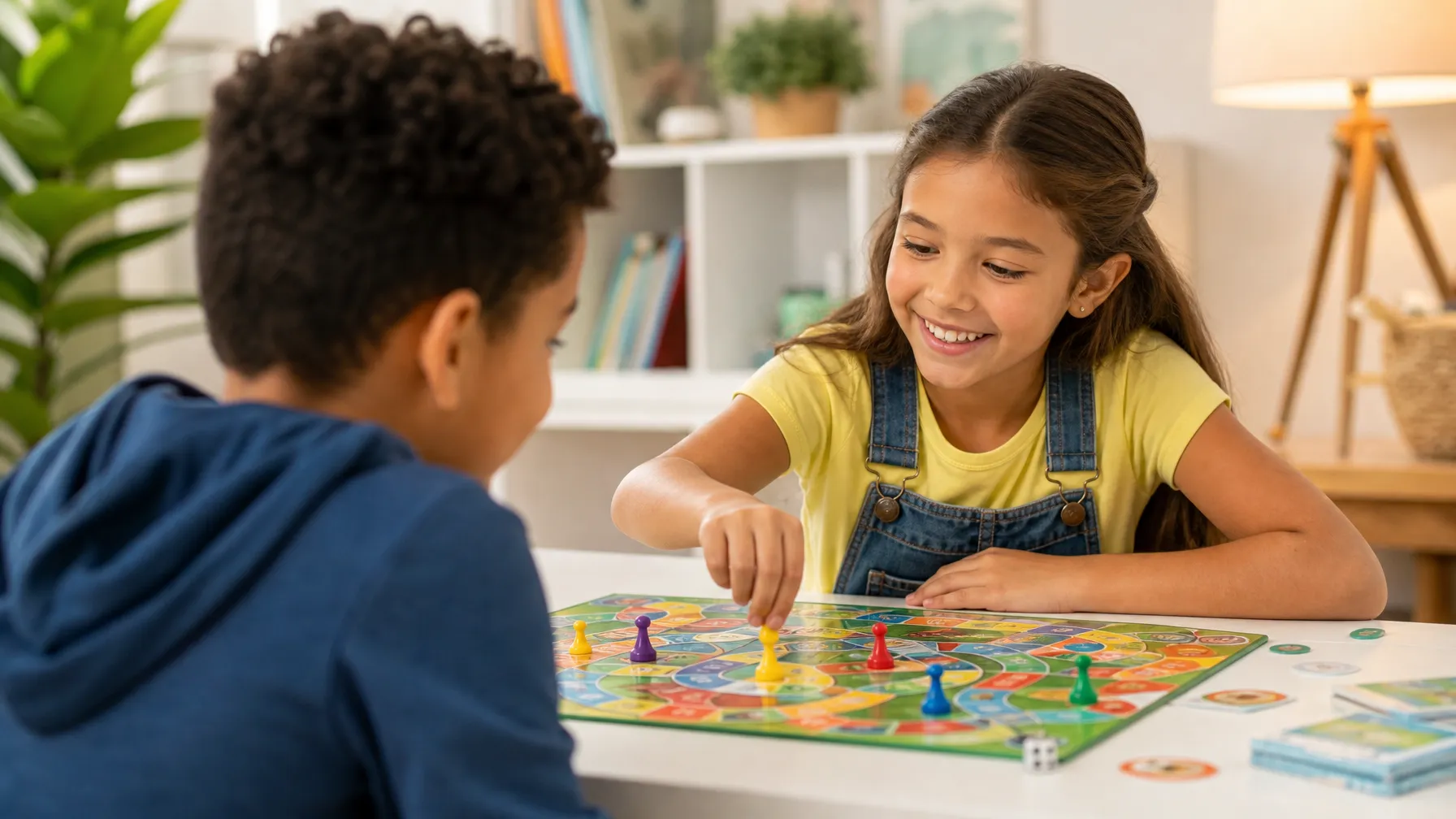
Turn-taking is the structural backbone of most social interaction. Board games, card games, and structured play all practice it in low-stakes ways.
Try:
- Two-player board games with clear your-turn/my-turn structure (Uno, Connect Four, Sequence for Kids). The turn-taking is externalized by the game's rules, which reduces the ambiguity.
- Role-swapping in imaginative play. If your child has a preferred play scenario (trains, superheroes, a specific video game world), ask to be assigned a role and follow their direction. Then gradually introduce a turn where you make a creative choice and they respond.
- Social stories about turn-taking in conversation, not just games. Brief illustrated stories that walk through a specific scenario. You can write these yourself using your child's actual contexts. Carol Gray's Social Stories framework is the most researched model.
Conversation initiation
Knowing how to start a conversation, and feeling confident doing it, is a concrete skill, not a personality trait.
Try:
- Script-building: work with your child to develop two or three reliable conversation openers for specific contexts (meeting a new kid at a class, seeing a relative at a family event). Rehearsed language that the child has ownership of performs better than improvised conversation for many autistic kids.
- Interest-sharing practice: structured conversations where your child teaches you something they know deeply (a video game, an animal species, a historical event). This builds the experience of successful communication and models the bidirectional structure of conversation.
- Video modeling: short videos that show same-age peers initiating conversations in realistic settings. Research from the UC Davis MIND Institute supports video modeling as one of the more effective tools for social skill acquisition in autistic kids.
$20 off your first class WITH promo code: blog
Build the Education your Kid Deserves
Discover thousands of live classes taught by expert teachers, across academics and enrichment.
Browse classesEmotional recognition and regulation
Social connection depends on being able to identify what you're feeling and what others might be feeling, and to manage emotional responses in real time.
Try:
- Emotion card games (Feelings Uno, Zones of Regulation card decks). These externalize emotion recognition into a low-pressure game format.
- Body-based regulation practices: many autistic kids are more aware of bodily sensations than abstract emotional states. Naming what the body feels (my chest feels tight, my hands feel clenched) before the emotion label can make the connection more accessible.
- Co-watching shows or movies your child already loves, pausing to briefly name what a character might be feeling. Familiar contexts make the emotion-reading task easier.
Group play and collaborative projects
Group interaction adds layers: multiple conversational threads, shifting dynamics, different personalities. Starting with highly structured group contexts reduces the cognitive load.
Try:
- Structured classes or clubs with a shared task focus (coding, drawing, Lego robotics, drama). When everyone is focused on a shared activity, social interaction happens as a byproduct rather than the point. This sidesteps the most ambiguous parts of unstructured peer interaction.
- Cooperative board games (Forbidden Island Junior, Outfoxed, Hoot Owl Hoot) where players work together against the game rather than against each other. Cooperation without competition removes a layer of social complexity.
- Small group online classes: the text chat alongside video interaction gives autistic kids an additional modality to participate through, and the structured learning context provides a clear shared focus. Outschool's social skills classes include options specifically oriented toward collaborative peer learning.
Strategies for parents
Be explicit about what you're practicing and why
Autistic kids generally do better with named, explicit learning than implicit social absorption. Telling your child we're going to practice how to start a conversation today, rather than just creating a situation and hoping it happens, isn't condescending. It's respectful of how their brain processes learning.
Find the interest-based entry point
Social skill practice that connects to a deep interest has better engagement and retention. If your child is passionate about a topic, build the practice scenario around that topic. A child who lights up about marine biology will have an easier time practicing conversation initiation in that context than in a generic role-play.
Practice in private before performing in public
Running through a social scenario at home before it happens in the real world reduces the cognitive load in the actual moment. Social rehearsal isn't a crutch. It's how many strong adult communicators prepare for important conversations.
Celebrate specifics, not generalities
You did a great job today is too abstract to reinforce learning. You waited for Mia to finish her sentence before you responded, and that was really good listening. That gives your child a concrete picture of what success looks like.
When to involve a professional
Speech-language pathologists who specialize in social communication, and board-certified behavior analysts (BCBAs) with autism experience, can provide more individualized assessment and intervention than any article can. If your child's social anxiety is significant, affecting daily functioning, or causing distress, a professional evaluation is the right next step.
Social skills groups, offered through many therapy practices and learning centers, provide structured peer practice in a supportive setting. These are particularly valuable during middle school, when social complexity spikes considerably.
The goal, through all of it, is to help your child build connections that feel real and satisfying to them. That looks different for every autistic kid, and that's as it should be.


.svg)
.svg)