When writing becomes the battle you dread
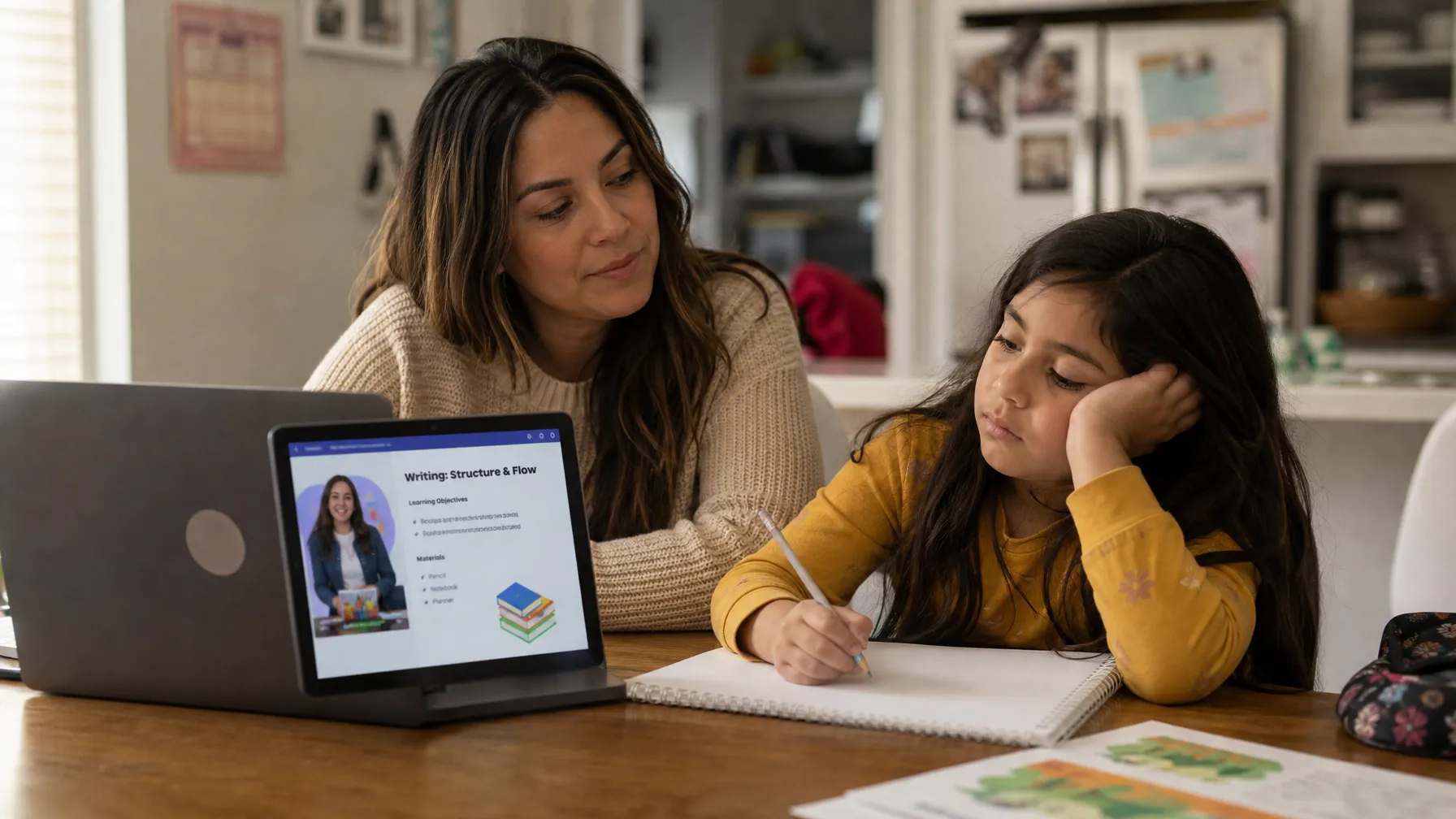
You sit down for language arts. You ask your kid to write three sentences. They groan. Then they stare at the blank page for 15 minutes. Then they tell you they can't think of anything. Then they cry, or shut down, or start an argument about something completely unrelated.
If any version of this sounds familiar, you're in good company. Writing resistance is one of the most commonly reported frustrations in homeschool communities — and one of the least talked about honestly, because it can feel like a reflection of your teaching rather than a very normal stage of learning.
It isn't. Writing is cognitively hard in ways that other subjects aren't, and the avoidance behavior kids show around it is almost always purposeful, even when it doesn't look like it. Understanding why your child is resisting — not just how to get them to comply — is where the real breakthrough happens.
Why writing is harder than it looks
Writing requires a child to do several cognitively demanding things simultaneously: generate an idea, organize their thoughts, translate those thoughts into language, hold that language in working memory, physically produce letters or type, monitor spelling and grammar, and maintain the thread of what they were saying — all at once, continuously, until the piece is done.
For many kids, especially those with ADHD, dysgraphia, or slow processing speed, the cognitive load is genuinely overwhelming. The resistance isn't laziness. It's the brain hitting its limit and protecting itself the only way it knows how: refusal.
Even kids without specific learning differences often struggle with writing because the gap between their spoken language ability and their written output is frustrating. A child who can tell you a vivid, funny story about the frog they found in the backyard often produces "I found a frog. It was green. It jumped." on paper — and that gap feels humiliating, even if they can't articulate why.
The three most common types of writing resistance
Understanding which type your child shows helps you choose the right strategy:
- Idea block: "I don't know what to write about." The child isn't resisting writing itself — they're resisting the blank page. Solution: remove the blank page.
- Physical resistance: Writing hurts, is tiring, or the mechanics feel overwhelming. This is common in younger kids and kids with dysgraphia. Solution: reduce or temporarily remove the physical writing requirement.
- Perfectionism: The child won't start because they're afraid of producing something bad. Solution: explicitly lower the stakes and normalize messy first drafts.
Strategy 1: separate idea generation from writing
One of the most effective things you can do for a reluctant writer is split the writing process into stages — and do the idea generation stage in a completely different way than traditional writing.
Talk it out first. Have your child tell you their ideas out loud before they write a single word. Ask follow-up questions. Get them animated and engaged. Then say: "Okay, now just write that. Exactly what you just said." For many kids, the gap between their spoken language ability and their written output closes significantly when they've already worked through their ideas verbally.
Voice-to-text tools — built into most tablets and laptops — are a legitimate and underused bridge. Have your child dictate their piece, then review the transcript together and decide what to keep, cut, or change. This preserves the thinking and idea-development work of writing while temporarily removing the physical and cognitive burden of transcription. It's not cheating. It's scaffolding — and scaffolding is what good instruction looks like.
Strategy 2: use interest-led writing topics
The fastest way to end writing resistance is to let your child write about something they actually care about.
This sounds obvious, but most homeschool writing curriculum — and most parents when they're stuck for ideas — defaults to generic prompts: "Write about your favorite season." "Describe your pet." "Tell me what you would do if you found $100." These prompts feel like writing exercises, and kids know it. There's no real stake, no real audience, no real reason to try.
Interest-led writing prompts look completely different. A kid obsessed with Minecraft writes a guide to surviving their first night in hardcore mode. A kid who loves horses writes a fact sheet about their favorite breed. A kid who's into gaming writes a review of the last game they played, addressed to a friend who might want to try it.
The topic is almost beside the point. What matters is that the child has something they actually want to say — and an imagined audience they want to say it to. That changes the entire dynamic. Use the 50 creative writing prompts on Outschool as a starting library, but let your child pick and modify freely.
Strategy 3: reduce the writing output requirement temporarily
If your child is in active resistance, the worst thing you can do is increase the output demand. "You have to write a paragraph" becoming "you have to write three paragraphs" will not resolve the underlying problem. It will entrench it.
Instead, go smaller — much smaller. One sentence. One really good sentence. A sentence that actually says something specific, that your child is willing to stand behind. Then celebrate that one sentence genuinely.
The goal at this stage isn't volume. It's re-establishing a positive association with the act of producing written language. That re-association is what makes it possible to increase output later. Try to build writing confidence gradually rather than demanding it all at once — confidence comes from small wins accumulated over time, not from pushing through resistance.
Strategy 4: give the writing a real audience and purpose
Much of school writing is performative — the only person who will ever read it is the teacher, and the only purpose is to demonstrate that the assignment was completed. Kids know this, and it's deflating.
Real writing has an audience and a purpose. A letter to a grandparent. A review posted in a family chat. A story shared with a younger sibling. Instructions for how to do something, written for a friend who's never tried it. A family blog where your child has their own section.
When writing has a real reader and a real reason to exist, the motivation to communicate clearly kicks in naturally. Kids who struggle with five-paragraph essays sometimes write unprompted paragraphs about topics they care about when they have someone to write to. Lean into that. The skills transfer.
Strategy 5: try a live writing class
This is the strategy that surprises many parents: for reluctant writers, writing in a group with a skilled teacher is often dramatically easier than writing one-on-one with a parent.
The reasons make sense once you think about them. The parent-child dynamic around academic struggle can become loaded very quickly — there's history, there are emotions, and the child knows exactly how to trigger a reaction. A teacher, particularly one they've chosen and signed up for, starts from a neutral baseline. The group setting creates gentle social motivation (other kids are writing; not writing feels conspicuous). And a great writing teacher has techniques for reducing resistance that take years of experience to develop.
Outschool's live online writing classes come in a huge range of formats — creative writing, storytelling, essay writing, journaling, game-based writing, and more. Many teachers specialize specifically in reluctant or anxious writers. A small group of 3–6 kids working through writing activities together, guided by a teacher who actually enjoys this age group, often breaks through resistance that months of at-home effort couldn't touch. Browse writing classes for kids on Outschool to find a format that fits your child's personality and interests.
What to do about dysgraphia and other physical writing challenges
If your child's resistance seems specifically tied to the physical act of writing — they avoid it, their hands tire quickly, their handwriting is consistently difficult to read despite effort, or they show significant anxiety around handwriting tasks — it's worth considering whether dysgraphia is a factor.
Dysgraphia is a learning difference that affects the physical production of written language. It has nothing to do with intelligence or creativity. Kids with dysgraphia often have excellent verbal language skills and excellent ideas — the breakdown is in translating those ideas to paper.
Practical accommodations for suspected dysgraphia: allow typing instead of handwriting whenever possible; use speech-to-text for first drafts; reduce the volume of written output required; and focus writing practice on quality and content rather than mechanics. If you're seeing significant physical writing challenges, read more about supporting dysgraphia in kids — understanding the profile helps you build a writing program that works with your child's brain.
How to teach the writing process (not just writing)
One of the most useful shifts you can make as a homeschool parent is teaching writing as a process — brainstorming, drafting, revising, editing — rather than as a single event that should produce a finished product in one sitting.
Separating these stages explicitly, and making each stage feel different and manageable, removes a lot of the overwhelm. Brainstorming is messy and doesn't count as a draft. A draft is supposed to be rough and is never the final version. Revision is about ideas, not spelling. Editing is about spelling and punctuation, and it happens last.
When kids understand that a first draft is supposed to be imperfect, the blank page becomes less threatening. When they understand that revision is a separate step with a different goal, they don't feel like every word they write has to be perfect before they can write the next one. This framing, alone, changes the experience for many reluctant writers. Pair it with creative writing strategies that emphasize the joy of drafting freely, and you'll often see resistance begin to lift.
When to consider outside support
If writing resistance has persisted for several months despite trying multiple approaches, and it's accompanied by strong emotional responses (crying, anger, complete shutdown), it's worth considering whether there's an underlying learning difference that's making writing genuinely harder for your child than typical.
A private evaluation by a psychologist or educational specialist can identify dysgraphia, dyslexia, ADHD-related processing challenges, or other factors that would change how you approach writing instruction. Many families find that getting a clear diagnosis — and the specific accommodations it suggests — is what finally allows their child to make real progress.
In the meantime, 10 ways to help a struggling young writer is worth a read for any parent in the thick of this.
Frequently asked questions about teaching reluctant writers
Is it okay to let my reluctant writer use speech-to-text tools?
Yes. Speech-to-text is a legitimate writing tool and an excellent scaffold for kids who struggle with the physical or cognitive burden of transcription. Using it doesn't mean your child isn't learning to write — it means they can separate idea generation and organization from mechanical output. Over time, as confidence and fluency build, many kids naturally start typing or writing more without the speech-to-text bridge.
My child writes fine when they want to, but refuses school writing. What's going on?
This is extremely common and actually a good sign. It means the resistance is about the dynamic around school writing, not about writing ability. The fix is usually about changing the context: different topics, different audience, lower stakes, or a teacher other than a parent. Try a live writing class or a writing pen pal — anything that changes the relationship between your child and the act of writing.
How much should a child write each day?
There's no universal answer — it depends on age, learning profile, and where your child is in their relationship with writing. For early elementary kids (6–8), 5–10 minutes of actual writing practice is often enough. For middle schoolers, 20–30 minutes of writing across multiple stages of the process is a reasonable target. Volume matters much less than consistency and positive association. A child who writes 2 sentences willingly every day is making more progress than one who writes a forced paragraph once a week.
My child is a great storyteller but hates writing. How do I bridge the gap?
Use dictation as a bridge. Have them tell you their story out loud while you type or record it, then show them the transcript and say: that's your story, in your words. Read it back together. Let them feel the connection between what they said and what exists on the page. Then ask if there's anything they want to change. Many kids make this transition naturally once they see that what they produce verbally can become written language.


.svg)
.svg)