What most "teach your child to read" advice gets wrong
A lot of parents start exactly the same way: they pick up a phonics workbook, spend a few weeks drilling letter sounds, and then wonder why their 5-year-old still can't decode the word "ship." The workbook said to start with consonants, then vowels, then blends. They followed the steps. So what happened?
What the workbook probably didn't explain is that reading isn't one skill. It's five distinct skills, and most kids stall because one of the five is lagging while the others are moving forward. A child who can't hear the individual sounds inside the word "ship" before you ever introduce a letter won't decode "sh" and "ip" no matter how many flashcards you run through.
This is the core insight behind what researchers and policymakers now call the Science of Reading, a body of evidence that has been building since the 1970s and that 40 or more states have written into law. If you've seen the phrase in the news and had no idea what it meant in practice, this guide is for you. We'll break down the five pillars, show you what each one looks like with a real preschooler or early elementary kid, and give you a realistic progression you can actually follow at home, without a boxed curriculum and without a teaching degree.
Quick takeaways
- Reading is built from five skills: phonemic awareness, phonics, fluency, vocabulary, and comprehension. Most kids who stall are struggling with one specific skill, not all five.
- Phonemic awareness (hearing sounds in spoken words) needs to come before phonics. This is the step most parents skip.
- You don't need a curriculum. You need a sequence and about 15 to 25 minutes per day.
- Read-alouds are not the same as reading instruction. Both matter, and neither replaces the other.
- If consistent instruction over 6 or more months isn't moving the needle, it's worth getting a closer look, not pushing harder.
What is the Science of Reading?
The Science of Reading (often shortened to SOR) is a research consensus, not a single program or curriculum. It pulls together decades of cognitive science, linguistics, and reading development research to explain how the brain learns to decode written language. The key finding: reading doesn't develop naturally the way spoken language does. Kids pick up spoken language by being immersed in it. Reading has to be explicitly taught, in a specific sequence, targeting specific skills.
One of the most useful frameworks to come out of this research is something called Scarborough's Reading Rope, which shows reading comprehension as the interweaving of two major strands: word recognition and language comprehension. Word recognition covers phonological awareness, decoding (phonics), and sight word recognition. Language comprehension covers background knowledge, vocabulary, language structures, verbal reasoning, and literacy knowledge.
For most beginning readers, word recognition is where instruction needs to start. A child can't comprehend a text they can't yet decode. And decoding depends on a skill that often gets skipped entirely: phonemic awareness, the ability to hear and manipulate individual sounds in spoken words before any letters are introduced.
The five pillars that reading researchers have consistently identified are:
- Phonemic awareness (hearing and manipulating sounds)
- Phonics (connecting sounds to letters and letter patterns)
- Fluency (reading accurately, automatically, and with expression)
- Vocabulary (knowing what words mean)
- Comprehension (understanding and making meaning from text)
We'll look at each one in depth below, with specific activities for the 4-to-7-year-old range and a rough sequence for how to build them over time.
Pillar 1: Phonemic awareness (start here, before any letters)
Phonemic awareness is purely auditory. It has nothing to do with print. You can practice it in a dark room or on a walk to the park. It's the ability to hear that the word "cat" has three separate sounds: /k/ /ae/ /t/. And then to do things with those sounds: blend them, segment them, delete one, swap one out.
This is the skill most parents skip because it feels too simple. "Of course my kid can hear that 'cat' has sounds in it." But phonemic awareness runs on a continuum, and a lot of kids who struggle with early reading are stuck somewhere in the middle of it.
The phonemic awareness continuum
- Rhyme recognition: "Do 'cat' and 'hat' rhyme?" (easiest)
- Rhyme production: "Tell me a word that rhymes with 'cat.'"
- Syllable segmentation: "Clap the parts of 'butter.'" (two claps)
- Onset-rime: "What sound does 'cat' start with?" (/k/)
- Phoneme isolation: "What is the first sound in 'ship'?" (/sh/)
- Phoneme segmentation: "Say each sound in 'dog.'" (/d/ /oh/ /g/)
- Phoneme blending: "What word is /f/ /i/ /sh/?" ("fish")
- Phoneme manipulation: "Say 'slip.' Now say it without the /s/." ("lip") (hardest)
A child who is solid through phoneme segmentation and blending is ready to start phonics instruction. If they're still shaky on phoneme isolation, it's worth spending more time at the auditory level before introducing letters.
How to practice phonemic awareness at home
These activities work for ages 3 through 6 and require no materials whatsoever.
- Sound sorting games: "I'm thinking of something that starts with /b/. Can you guess what it is?" Go back and forth.
- Elkonin boxes (say it, push it): Draw 3 boxes on paper. Say a word. Have your child push a penny into each box for each sound they hear. "Dog": one penny for /d/, one for /oh/, one for /g/.
- The slow-it-down game: Stretch words out like rubber bands while driving: "/mmmmm/ /aaaa/ /p/. What word is that?" ("map")
- Silly switch: "Say 'bat.' Now change the /b/ to /s/. What do you get?" ("sat") Kids find this genuinely funny when you mix in nonsense words.
- Nursery rhymes and rhyming books: Classics like "Hop on Pop" and "The Cat in the Hat" are phonemic awareness tools. Read them repeatedly and pause before a rhyming word so your child can predict it.
Target 5 to 10 minutes per day. This doesn't need to be a sit-down lesson. Kitchen table, car ride, backyard, bath time. The more casual the better.
Pillar 2: Phonics (connecting sounds to the written code)

Once a child can segment and blend phonemes fluently, phonics makes sense because phonics is just the written version of what they already know how to do with their ears. Phonics instruction maps the sounds (/k/, /ae/, /t/) to the letters (c, a, t) and letter patterns (sh, igh, -tion) that represent them in print.
The Science of Reading strongly favors systematic, explicit phonics instruction, which means teaching letter-sound correspondences in a planned, cumulative sequence, not waiting for kids to "discover" the patterns on their own. Research on structured literacy and the Orton-Gillingham approach has consistently shown that this works better than the "look-say" or whole language methods that dominated classrooms for decades. If you want to go deeper on the how-to, our guide on how to teach phonics at home walks through the same principles with additional activity ideas.
A basic phonics sequence for beginners
You don't need a curriculum to follow a logical sequence. Here's a rough order that reflects what most structured literacy programs use:
- Single consonants (s, a, t, p, i, n are common first letters because they combine to make dozens of three-letter words)
- Short vowels (a, i, o, u, e)
- Simple CVC words (consonant-vowel-consonant: "sit," "nap," "fog")
- Consonant digraphs (sh, ch, th, wh)
- Consonant blends (bl, cr, str)
- Long vowel patterns (silent e: "cake," "bike"; vowel teams: "rain," "boat")
- R-controlled vowels (ar, or, er, ir, ur)
- Diphthongs and other vowel patterns (oi, oy, ou, ow)
- Multisyllabic words and syllable types
Move through the sequence only as fast as your child is confident. If they're inconsistently decoding CVC words, stay there. Rushing to blends before CVC words are solid is one of the most common mistakes families make when teaching reading at home.
What phonics practice looks like at home
- Word building with letter tiles: Magnetic letters on the fridge, letter cards on the table, or a whiteboard. Have your child build a word, then change one letter: "cat" becomes "bat" becomes "bad" becomes "bed." This is called word chaining and it's highly effective.
- Decodable books: These are books written specifically to use only the phonics patterns a beginning reader has already been taught. They're different from typical picture books. Look for decodable readers from publishers like Bob Books, Flyleaf Publishing, or Little Stories for Little Learners. Don't move past CVC decodables until your child is consistently accurate with them.
- Dictation: Say a word out loud and ask your child to write it. Start with three-letter words they've practiced. This builds the sound-to-print mapping in the other direction (encoding, not just decoding), which reinforces both phonics and spelling at the same time.
- Sound boxes with letters: The same Elkonin box activity from phonemic awareness, but now your child writes or places the actual letter(s) in each box instead of a penny.
A note on sight words
Traditional "sight words" lists (like Dolch or Fry) were built on the assumption that some words are irregular and must be memorized by sight. The Science of Reading reframes this. Most "irregular" words are only partly irregular. The word "said" is unusual because "ai" says /e/, but the s, a (mapped to /e/ here), i, and d are still phonemically predictable once a child knows what to do with them. The SOR approach teaches these words explicitly, connecting each part to what the reader already knows, rather than drilling pure visual memory. The practical takeaway: your child doesn't need 220 flashcards. They need a strong phonics base and explicit teaching of the parts of high-frequency words that deviate from expected patterns. Our guide on sight words and how to make them fun goes deeper on this if you want practical games to try.
Pillar 3: Fluency (reading accurately, automatically, and with expression)
Fluency is the bridge between decoding and comprehension. A reader who has to think hard about every single word can't also be thinking about what the sentence means. Fluency develops when decoding becomes automatic enough to free up mental bandwidth for meaning-making.
A rough home benchmark: if your child is reading at around 60 correct words per minute by the end of first grade, they're on a fluency trajectory that supports comprehension. But that number is a guide, not a pass/fail test. Every kid's timeline is a little different.
What fluency is not
Fluency is sometimes misunderstood as reading fast. Speed isn't the goal. Accuracy and automaticity are. A child who reads slowly but correctly, self-corrects errors, and sounds natural rather than robotic is developing fluency on a healthy timeline. A child who reads quickly but makes constant errors without noticing isn't fluent; they're guessing.
How to build fluency at home
- Repeated reading: Have your child read the same short decodable text three times in a row. Timed repeated reading, where you track how many words they read correctly in one minute each time, shows kids their own growth in real time. The improvement across three reads is usually visible and motivating.
- Partner reading: You read a sentence, they read the same sentence back. Or you read a sentence together (echo reading). Hearing a fluent model before reading independently helps kids internalize rhythm and phrasing.
- Audiobooks alongside text: Have your child follow along in a physical book or an e-book while listening to a professionally read audiobook at normal pace. This isn't cheating; it's a fluency scaffold. (Don't use this as a replacement for decoding practice, though. Pair it with, not instead of, phonics work.)
- Reader's theater: Short scripts where each person plays a character. Kids rehearse their lines, which makes repeated reading feel purposeful rather than mechanical. Search for free reader's theater scripts online or adapt simple picture book dialogue.
Pillar 4: Vocabulary (knowing what words mean)
A child can decode a sentence perfectly and still not understand it if they don't know what the words mean. Vocabulary is the comprehension variable that most parents underestimate because it develops slowly and invisibly over years of rich language exposure.
The vocabulary gap between kids from language-rich environments and those from language-poor environments is measurable by age 3. By kindergarten, that gap is already affecting reading readiness. The good news is that you don't need a special program to address it. You need consistent, intentional conversation and wide reading aloud.
Three kinds of words worth knowing about
A distinction that's been genuinely useful for a lot of parents is thinking about words in three tiers:
- Everyday words that most kids pick up naturally ("table," "run," "happy"). Don't explicitly teach these; just use them.
- General academic words that show up across lots of different subjects and situations ("describe," "predict," "compare," "remarkable," "consequence"). These are the highest-priority words to teach intentionally because they're the ones that help kids make sense of complex books, conversations, and ideas.
- Subject-specific terms ("photosynthesis," "legislature," "coda"). Teach these in context when you're studying that subject.
Vocabulary practices that actually move the needle
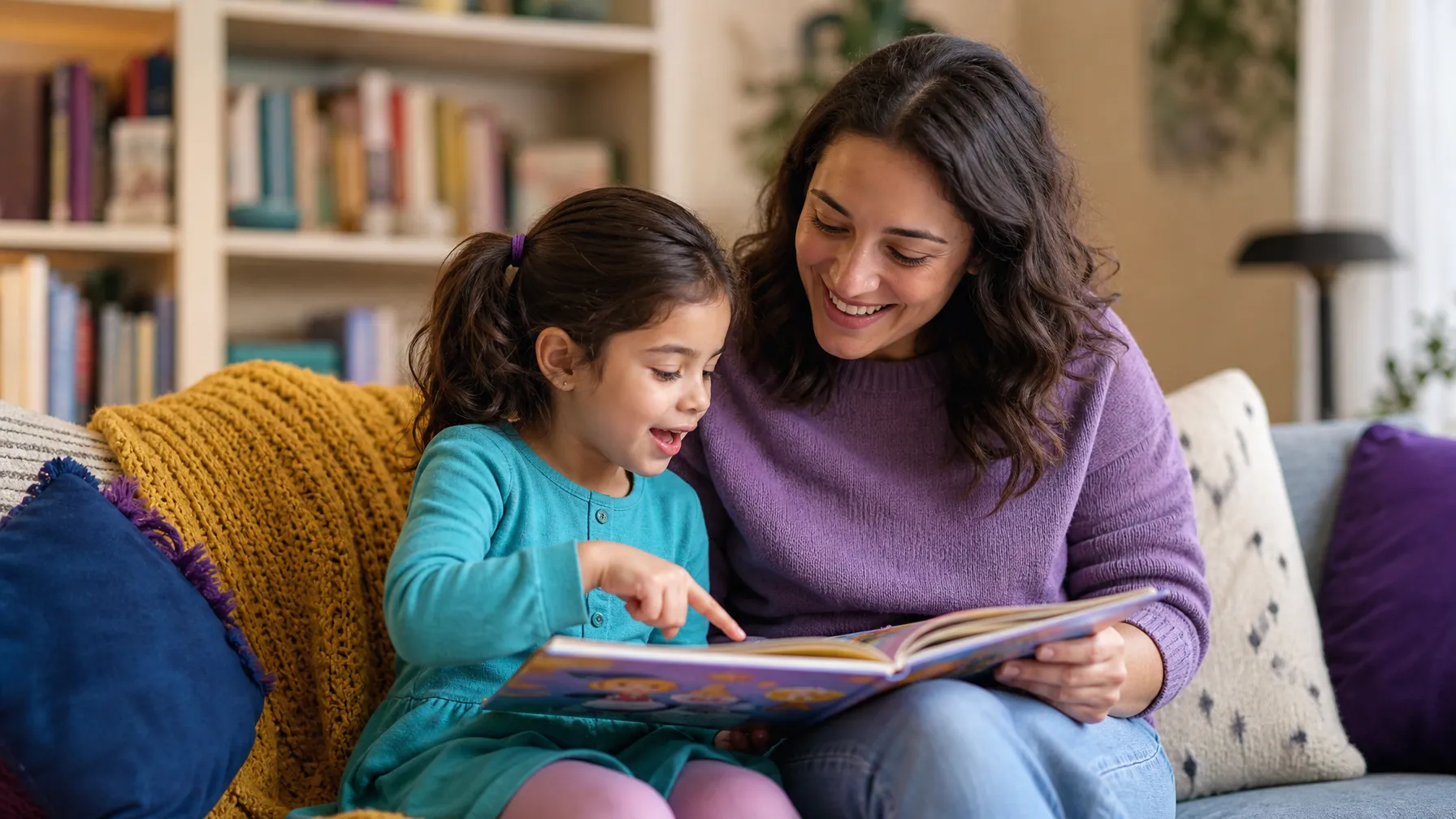
- Read aloud daily, and go above your child's reading level: Read books to your child that are more complex than what they can read independently. This is where vocabulary grows fastest. Stop and explain unfamiliar words in kid-friendly terms, then come back to the word later in conversation.
- Word of the day (done casually): Introduce one new word per day at breakfast. Use it in a sentence. Have your child use it. Look for chances to use it again during the day. Kids need to encounter a word 4 to 12 times in varied contexts before it sticks.
- Semantic mapping: When you teach a new word, map it out: what is it similar to? What's the opposite? Give an example. Use it in a sentence. This takes about 3 minutes and is dramatically more effective than looking a word up in a dictionary.
- Rich conversation: Dinner table discussion, narration (ask your child to retell what happened in their book), explaining things to you in detail. Spoken language complexity predicts written vocabulary growth.
Pillar 5: Comprehension (making meaning from text)
Comprehension is the goal of reading, and it's the pillar that phonics-heavy instruction sometimes neglects. A child who can decode fluently and has a strong vocabulary still needs to be shown how to think about what they're reading.
Comprehension doesn't automatically follow from decoding. It requires active strategies: monitoring for understanding, making inferences, finding the main idea, connecting new information to what they already know, and noticing when something doesn't make sense. Our guide on how to teach reading comprehension goes much deeper on these strategies if you want a full breakdown by age and reading stage.
Comprehension strategies worth teaching at home
- Visualizing: "Close your eyes. What do you picture when I read that paragraph?" This is especially useful with descriptive text and narrative writing.
- Making connections: "Does this remind you of anything that happened to you? Anything we've read before?" Connecting new text to existing knowledge is a core comprehension move.
- Questioning: Before reading, ask "What do you think this will be about?" During reading: "Why do you think the character did that?" After reading: "What was the most surprising thing you learned?"
- Summarizing: Ask your child to tell you what happened in the chapter in three sentences or less. This pushes them to sort main ideas from details.
- Monitoring comprehension: Teach your child to notice when they're confused and to do something about it: reread, ask a question, slow down. The goal is a kid who knows whether they understood what they just read, not one who reads to the end of the page and has no idea what happened.
For early readers, comprehension work happens mostly through read-alouds, not through the decodable texts your child reads independently. The books your child can decode at age 5 or 6 probably aren't complex enough to require inference or main-idea work. Build comprehension skills through rich books you read to them, and trust that those skills will carry over when their independent reading catches up.
A realistic week-by-week progression for home reading instruction
The question families ask most often is: "How much time should we spend on this, and in what order?" Here's a practical progression that fits into a real day without turning reading into a full-time job.
Phase 1 (roughly ages 4-5, or wherever your child is on the phonemic awareness continuum)
Daily focus (10-15 minutes total):
- 5 minutes of phonemic awareness games (rhyming, segmenting, blending at the oral level)
- 5-10 minutes of read-aloud with vocabulary discussion
- No formal phonics yet unless your child is already asking about letters and is solid on rhyme and syllable awareness
What you're building: Auditory discrimination, phonemic sensitivity, love of books and stories, vocabulary through exposure.
Phase 2 (when phonemic awareness through phoneme segmentation is solid, often ages 5-6)
Daily focus (20-25 minutes total):
- 5 minutes of phonemic awareness practice (phoneme manipulation, the harder end of the continuum)
- 10 minutes of phonics instruction (letter-sound introduction and word building)
- 5 minutes of decodable text reading
- Continue daily read-alouds for vocabulary and comprehension (this can happen separately, at bedtime)
What you're building: Decoding accuracy with simple phonics patterns, beginning to connect print and sound reliably.
Phase 3 (when CVC words are solid and your child is moving into blends and digraphs, often ages 6-7)
Daily focus (25-30 minutes total):
- You can let the isolated phonemic awareness games go; that work is now embedded in phonics practice
- 10 minutes of phonics instruction (new pattern introduction, word chaining, dictation)
- 10 minutes of decodable reader practice
- 5 minutes of fluency work (repeated reading, partner reading)
- Continue daily read-alouds; start adding comprehension questions
What you're building: Decoding automaticity, early fluency, beginning comprehension strategy use.
Phase 4 (when decoding is largely automatic and fluency is developing, often approaching or in second grade)
Daily focus (30-35 minutes total):
- 10 minutes of phonics or spelling instruction (multisyllabic words, morphology)
- 15 minutes of independent reading in appropriately leveled books
- 5-10 minutes of comprehension discussion
- Continue read-alouds with books well above their independent reading level
What you're building: Reading for meaning, vocabulary through independent text, fluency solidification, comprehension strategy independence.
Signs your child is on track, and signs worth paying attention to
Developmental timelines for reading are wide. A 6-year-old who is still in Phase 2 is not behind in a meaningful clinical sense. That said, there are patterns worth noticing.
On track:
- By end of kindergarten: can segment and blend 3-phoneme words, knows most single letter sounds, can decode simple CVC words
- By end of first grade: decodes CVC words automatically, can handle digraphs and simple blends, reads at roughly 60 words per minute with good accuracy
- By end of second grade: decodes multisyllabic words, reads familiar text fluently, makes reasonable inferences from text
Worth paying closer attention to:
- Consistent difficulty distinguishing rhyming words past age 5
- Unable to segment 3-phoneme words after months of practice
- Consistently guessing at words from the first letter or from pictures rather than decoding
- Reading accuracy that doesn't improve with repeated reading of the same text
- Significant letter reversals (b/d, p/q) past age 7
- History of speech and language delays (a known risk factor for reading difficulty)
If you're seeing several of these together and consistent instruction hasn't moved the needle, it's worth looking into whether your child might be showing early signs of dyslexia or another reading difference. Early support, before reading difficulty becomes a deeply ingrained pattern, is significantly more effective than waiting. Our guide on homeschool curricula for struggling readers covers some of the most family-friendly approaches to structured literacy support.
What to use at home: tools without a boxed curriculum
You don't need to spend hundreds of dollars on a packaged reading program to follow the Science of Reading at home. Here's a practical toolkit.
Free and low-cost resources
- Elkonin box templates: Printable for free from Teachers Pay Teachers or draw them on any paper.
- Magnetic letter sets: Around $10-$15. Use for word building, word chains, and sound-to-letter mapping.
- Bob Books (Set 1): The classic decodable reader set. Around $20 for a set of 12 books that cover CVC patterns systematically.
- Starfall.com: Free phonics games online that follow a structured sequence.
- Reading Rockets (readingrockets.org): The parent section has printable word lists, activity guides, and plain-language explanations of each pillar.
When to consider a live class or tutor
Home instruction works well for building phonemic awareness and introducing early phonics. Where many families find they want support is in the diagnosis and response phase: figuring out exactly where a child is stalling and why, and then adjusting the sequence accordingly. A skilled reading teacher or tutor who uses structured literacy methods can do an informal assessment in a single session and give you a clear picture of where to focus. If you're looking for one, our guide on how to choose an elementary school reading tutor covers what to look for and the questions worth asking before you commit.
Live classes also give struggling readers something that workbooks and apps can't: real-time feedback on their decoding, a teacher who can hear when they're guessing versus truly applying a phonics rule, and a low-stakes social context that makes reading feel like less of a performance. For kids who resist reading practice with a parent, in particular, a neutral third party can completely change the dynamic. Outschool's live phonics and reading classes range from one-on-one tutoring to small groups, so you can find the format that fits your child's learning style and your family's schedule.
FAQ: what parents actually want to know
What age should a child start learning to read?
There's no single correct age, and research doesn't support starting formal phonics instruction before a child has sufficient phonemic awareness, regardless of age. Some kids are ready for phonics at 4.5. Others aren't ready until 6 or 6.5. The readiness signal isn't the birthday; it's the phonemic awareness milestone. A child who can segment and blend 3-phoneme words reliably is ready for phonics. A child who is still working on rhyme and syllables isn't there yet, and starting phonics instruction before they're ready tends to produce frustration on both sides without meaningful progress.
What is the Science of Reading, exactly?
The Science of Reading is a research consensus, not a branded curriculum or program. It's the body of evidence from cognitive science, linguistics, and developmental psychology that explains how the brain learns to decode written language. The key conclusions: phonemic awareness needs to come before phonics; phonics should be systematic and explicit; fluency develops through repeated practice with decodable text; vocabulary and comprehension need direct instruction, not just exposure. More than 40 states had incorporated SOR principles into their literacy standards as of 2026.
How long does it take to teach phonics?
For a typically developing reader starting phonics instruction around age 5 or 5.5, solid basic decoding (through long vowel patterns and common digraphs) usually takes 12 to 18 months of consistent instruction at about 15 to 20 minutes per day. Multisyllabic words and more complex spelling patterns take another year or two beyond that. "Finished phonics" isn't really the goal. The goal is automaticity, where decoding becomes so fast and accurate that it no longer requires conscious effort. That usually happens somewhere in second or third grade for kids who started instruction around kindergarten age.
My child resists reading practice. What do I do?
First, check the level. Resistance often means the material is too hard. If your child is making more than 1 error per 10 words on a decodable text, it's too difficult. Drop back to something easier. Second, check the format. Drilling the same phonics sheet every day will produce resistance in any child. Rotate through games, building, reading, and writing. Keep sessions short. End before they're done. Third, separate decoding practice from reading for pleasure. If every book interaction becomes an instructional moment, kids learn to avoid books. Maintain daily read-alouds where they get to simply enjoy a story without being asked to decode anything.
Is my child dyslexic, or are they just a late reader?
Dyslexia is a specific learning difference that affects phonological processing, not intelligence or effort. It isn't diagnosed by speed of reading progress alone, but rather by a pattern of difficulty with phonemic awareness, decoding accuracy, and spelling that persists despite appropriate instruction. If your child has had consistent, structured phonics instruction for 6 or more months and isn't making progress, that's a meaningful signal. A school psychologist or a private educational psychologist can conduct a formal evaluation. You can also look for a structured literacy specialist or an Orton-Gillingham trained tutor who can do an informal assessment and give you specific guidance before going the formal evaluation route.
Does reading to my child count as reading instruction?
Yes and no. Reading aloud to your child builds vocabulary, comprehension, love of books, and background knowledge, all of which are critical for reading development. But it doesn't teach decoding. Phonemic awareness and phonics have to be explicitly taught; they don't develop from listening to stories, no matter how many books you read together. Both matter. Neither substitutes for the other.
The bigger picture: what you're really building
Teaching a child to read is a multi-year project. There will be weeks when it feels like nothing is sticking. There will be weeks when they suddenly read something you didn't expect them to be able to read, and it will surprise both of you. That moment, wherever it happens in the sequence, is real evidence of a brain that has been quietly building a system that now works.
The Science of Reading gives you the map. Your child gives you the pace. The combination of consistent, short, game-like practice sessions at home and, when you want it, the live feedback of a skilled reading teacher who can hear what's actually happening in your child's decoding, is what moves a beginning reader forward reliably over time.
The parents who get the best results aren't the ones who push hardest. They're the ones who stay curious, adjust when something isn't working, and keep the relationship around reading positive enough that their child still wants to try tomorrow.


.svg)
.svg)