New York has a more structured approach to homeschooling, but with a little guidance, families often find it easier than they expect. With clear guidelines and a well-defined process, families can create rich, personalized learning experiences while meeting state requirements. Once you understand the paperwork and reporting schedule, homeschooling in New York becomes a manageable and rewarding endeavor.
This guide walks you through everything you need to know to start homeschooling in the Empire State. Along the way, you can explore Outschool's live, interactive classes to supplement your curriculum or get expert support with challenging subjects.
Homeschooling options in New York
New York provides one legal pathway for families who want to educate their children at home. While this means less flexibility in how you register, it also offers clarity about what's expected and how to stay compliant throughout the school year.
Home instruction program
New York requires homeschooling families to provide instruction that is "substantially equivalent" to what public schools offer. You'll file annual paperwork with your local school district, submit quarterly progress reports, and complete a yearly assessment to demonstrate your child's academic growth.
This pathway requires more documentation than many other states, but it gives families complete freedom over curriculum choices, teaching methods, and daily schedules. You can use any materials you choose, traditional textbooks, online programs, unit studies, or a mix of approaches, as long as you cover the required subjects for your child's grade level.
Requirements for homeschooling in New York
Understanding New York's documentation requirements is essential for a smooth homeschool experience. While the paperwork may seem substantial at first, most families find it becomes routine once they establish their system.
Letter of intent
Before you begin homeschooling, you must submit a Letter of Intent to your local school district superintendent. This notice is due by July 1 each year, or within 14 days if you start homeschooling mid-year. The letter should include basic information such as your child's name, age, and your intent to provide home instruction.
For families in New York City, submit your Letter of Intent via email to LetterofIntent@schools.nyc.gov. Outside NYC, contact your local district superintendent's office.
Individualized Home Instruction Plan (IHIP)
Within four weeks of submitting your Letter of Intent (or by August 15, whichever is later), you must file an Individualized Home Instruction Plan for each child. The IHIP outlines your educational plan for the year and includes:
- Your child's name, age, and grade level
- A list of syllabi, curriculum materials, textbooks, or plan of instruction for each required subject
- Dates for submitting quarterly reports
- The name of the person providing instruction
Your school district will review the IHIP and notify you if it meets requirements or if changes are needed.
Attendance and instruction
New York requires 180 days of instruction per school year with specific hourly minimums:
- Grades 1–6: 900 hours per year
- Grades 7–12: 990 hours per year
You have flexibility in how you schedule these hours. Field trips, co-op classes, and extracurricular learning activities can all count toward your instructional time.
Required subjects
New York specifies subjects that must be taught at each grade level. The requirements become more detailed as students advance:
Grades 1–6: Arithmetic, reading, spelling, writing, English, geography, U.S. history, science, health education, music, visual arts, physical education, and bilingual education or ESL where needed.
Grades 7–8: English, history and geography, science, mathematics, physical education, health, art, music, practical arts, and library skills.
Grades 9–12: English, social studies (including American history and participation in government), mathematics, science, art or music, health, physical education, and electives.
All grades K–12 must also include instruction in patriotism and citizenship, health education regarding alcohol, drug and tobacco misuse, highway safety and traffic regulations (including bicycle safety), and fire and arson prevention.
Quarterly reports
You'll submit four quarterly reports throughout the school year on dates you specify in your IHIP. Each report must include:
- Number of hours of instruction during that quarter
- Description of material covered in each subject
- A grade or written narrative evaluation for each subject
Annual assessment
Every homeschooled student from grades 1–12 must complete an annual assessment. The type of assessment varies by grade:
- Grades 1–3: Standardized test OR written narrative evaluation
- Grades 4, 6, 8: Standardized test required
- Grade 5, 7: Standardized test OR written narrative evaluation
- Grades 9–12: Standardized test required annually
Standardized test scores must show the student performing at or above the 33rd percentile. Acceptable tests include the California Achievement Test (CAT), the Iowa Tests, the Stanford Achievement Test, and others approved by the state. Written narratives can be prepared by a certified teacher, a homeschool peer review panel, or another person with the superintendent's consent.
Recordkeeping
Maintain attendance records for each child and keep copies of all submitted paperwork, including your Letter of Intent, IHIP, quarterly reports, and annual assessments. While you only submit attendance records upon request, having organized documentation protects you and demonstrates compliance.
Diplomas and graduation
New York does not issue state diplomas to homeschooled students. Parents can issue their own homeschool diploma upon completion of graduation requirements. Alternatively, students can:
- Request a "Letter of Substantial Equivalency" from their school district
- Earn a High School Equivalency Diploma by passing the TASC (formerly GED)
- Complete a sequence of 24 college credits
Many colleges accept homeschool transcripts and diplomas, but requirements vary by institution.
Public funding options for homeschoolers in New York
New York currently offers limited public funding options for homeschooling families, but there are still some resources worth exploring:
- Special education services: In New York, homeschooled students with disabilities are eligible to receive special education services from their school district. Parents must request services in writing by June 1. Services are provided at public school facilities, not in the home, and students must meet immunization requirements to access services on school grounds.
- Textbook and material loans: While not required, school districts may loan instructional items such as library books, computer software, and other educational materials to homeschooling families. Contact your local district to ask about availability.
- Summer school programs: These programs are open to all district residents, including homeschooled students, providing opportunities for enrichment or credit recovery.
- Club activities: Homeschooled students may participate in school-sponsored club activities at the discretion of the local school board. Districts are encouraged to establish policies allowing this participation.
- Music programs: If your district considers band, orchestra, or music lessons extracurricular activities, homeschooled students may be allowed to participate. Check with your local board of education about their specific policies.
- No ESA program: New York does not currently have an Education Savings Account program for homeschoolers. Families bear the full cost of curriculum, materials, and other educational expenses.
Note on interscholastic sports: Current New York regulations require students to be enrolled in public school to participate in interscholastic athletics. Homeschooled students are generally not eligible for public school sports teams, though legislation has been proposed to change this. Contact your district to ask about any local policies that may provide access.
Homeschool with Outschool
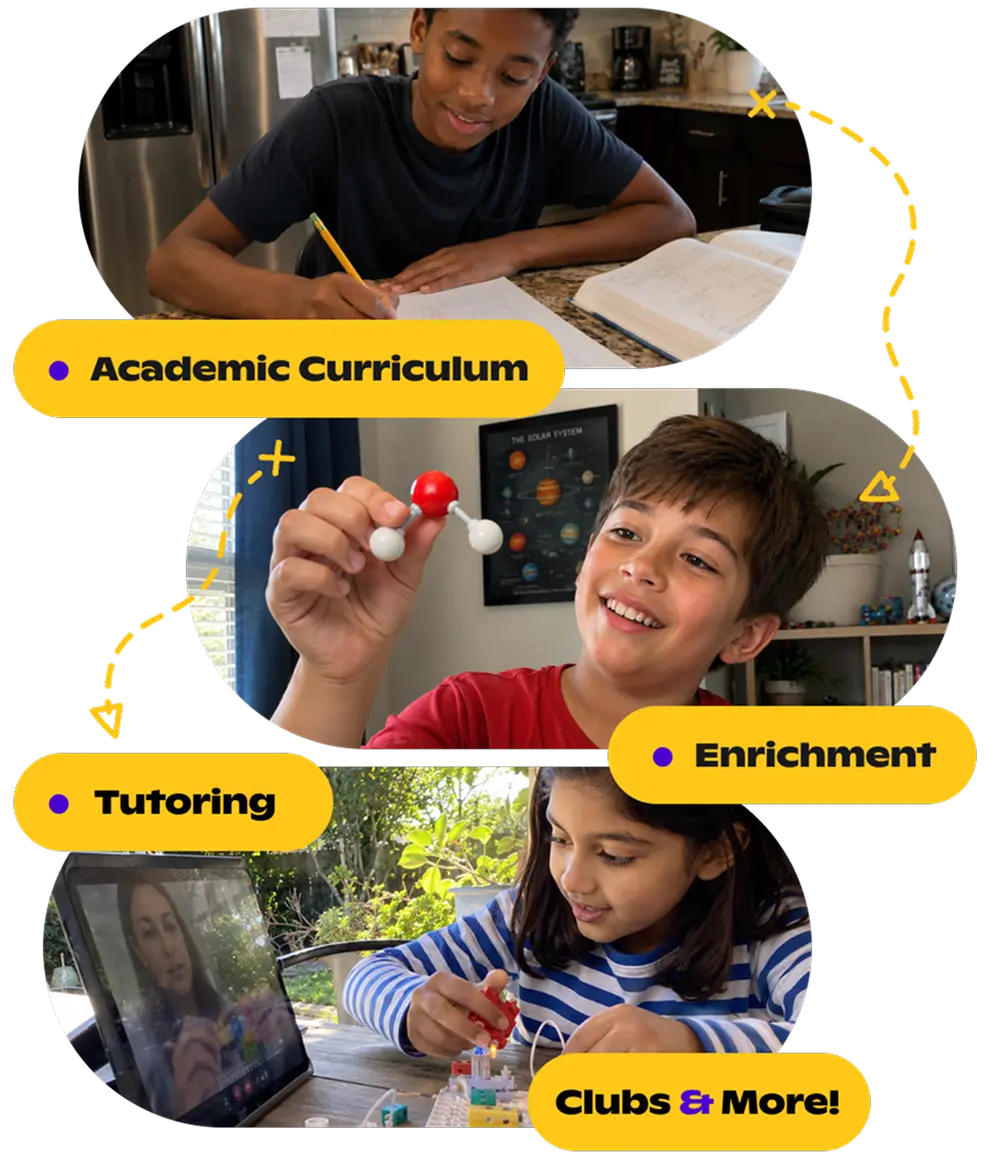
New York's detailed requirements mean you'll want resources that help you cover required subjects thoroughly while keeping learning engaging. Outschool makes it easy to supplement your curriculum with live, expert-led instruction.
- Cover New York's required subjects with interactive classes in English, math, science, social studies, art, music, health, and physical education.
- Meet hourly requirements with documented class time that counts toward your 900 or 990 annual hours.
- Simplify quarterly reporting with class records, assignments, and teacher feedback that help you document progress in each subject area.
- Access specialized instruction for subjects like foreign languages, advanced math, or lab sciences that may be challenging to teach at home.
- Support diverse learning needs with courses designed for different learning styles and abilities.
- Build flexibility into your schedule with classes offered throughout the day and across time zones.
Whether you need help with a specific subject or want to expand your child's educational horizons, Outschool gives you tools to create a comprehensive homeschool program that meets New York's standards.
How to get started
Ready to begin homeschooling in New York? Follow these steps to set up your program and stay compliant with state requirements.
- Submit your Letter of Intent to your local school district superintendent by July 1 (or within 14 days of starting mid-year). Include your name, address, and your child's name and age.
- Wait for the district's response. Within 10 business days, the district will send you a copy of the home instruction regulations and an IHIP form.
- Prepare your Individualized Home Instruction Plan outlining curriculum, materials, and your quarterly report schedule. Submit it within four weeks of receiving the form (or by August 15, whichever is later).
- Begin instruction once your Letter of Intent is submitted. You can start teaching while your IHIP is being reviewed.
- Keep attendance records documenting your instructional hours. You'll report total hours on each quarterly report.
- Submit quarterly reports on the dates specified in your IHIP, including hours, material covered, and grades or evaluations for each subject.
- Complete your annual assessment using a standardized test (in required years) or written narrative evaluation. Submit results with your fourth quarterly report.
- File your Letter of Intent again by July 1 each year to continue homeschooling.
Find support through homeschool communities in New York
Connecting with other homeschooling families makes navigating New York's requirements easier and provides valuable social and learning opportunities for your children.
Statewide organizations
Local groups and co-ops
- New York City Home Educators Alliance (NYCHEA): One of the largest homeschool groups in New York City, welcoming families of all backgrounds and homeschooling approaches. Members gain access to discussion groups, a monthly newsletter, field trips, and community events throughout the five boroughs.
- Tri-State Homeschoolers: An active, inclusive group serving families in the Hudson Valley region, including Orange, Dutchess, Putnam, Rockland, and Westchester Counties in New York, plus Bergen County in New Jersey and Fairfield County in Connecticut. They offer events, activities, and a newsletter for members.
- LIGHT (Long Islanders Growing at Home Together): Long Island's oldest inclusive homeschool support organization, welcoming families from all backgrounds. They provide information, activities, classes, and community connections for Nassau, Suffolk, and Queens County families.
- Home Learners Association of Central New York (HLACNY): An inclusive organization serving the Syracuse and Central New York region. Members share resources, organize activities, and support each other in their homeschool journeys.
- FEAST (Finding Educational Alternatives in the Southern Tier): An open, inclusive homeschooling cooperative based in New York's Southern Tier. They welcome families of all backgrounds and homeschooling philosophies.
Homeschooling in New York: Frequently asked questions (FAQs)
Starting your homeschool journey often comes with a few questions. Here are answers to some of the most common ones New York families ask.
What paperwork do I need to file to homeschool in New York?
You'll need to submit a Letter of Intent annually by July 1 (or within 14 days of starting mid-year), an Individualized Home Instruction Plan within four weeks, quarterly progress reports throughout the year, and an annual assessment with your final quarterly report. The NYSED website provides detailed guidance on each requirement.
Do I need teaching credentials to homeschool in New York?
No. New York does not require parents to hold a teaching certificate or specific degree. The law requires that the person providing instruction be "competent," which is demonstrated by submitting proper paperwork and meeting assessment requirements.
Can my homeschooled child participate in public school sports?
Currently, New York regulations require students to be enrolled in public school to participate in interscholastic athletics. Homeschooled students are generally not eligible for sports teams, though they may participate in school-sponsored clubs at the district's discretion. Legislation to change this has been proposed but not yet passed.
What happens if my child doesn't score at the 33rd percentile on standardized tests?
If a student's annual assessment shows inadequate progress, the homeschool program is placed on probation for up to two years. Parents must submit a remediation plan addressing the deficiencies. If progress improves, probation is lifted. The district works with families to ensure students receive appropriate instruction.
Can homeschoolers access special education services?
Yes. Under New York law, homeschooled students with disabilities are eligible to receive special education services from their school district. Parents must submit a written request by June 1. Services are provided at public school facilities, and students must meet immunization requirements to access services on school grounds.
Do homeschoolers receive a New York State diploma?
No. New York does not issue state diplomas to homeschooled students. Parents can issue their own diploma, or students can earn a High School Equivalency Diploma by passing the TASC exam. Many colleges accept homeschool transcripts and parent-issued diplomas.
Create an education that fits your family
Homeschooling in New York requires more documentation than many other states, but the structure also provides clear expectations and a defined path to compliance. Once you understand the paperwork cycle, you can focus on what matters most: creating a meaningful, personalized education for your child.
The key to success is staying organized, connecting with your local homeschool community, and choosing curriculum and resources that cover required subjects while keeping your child engaged. With a solid plan in place, New York's requirements become a framework that supports rather than restricts your homeschool journey.
When you need extra support along the way, Outschool offers live classes taught by passionate educators who can help you cover required subjects, document progress, and bring fresh perspectives to your homeschool program.


.svg)
.svg)