The Waldorf approach to education is celebrated for treating children as “whole persons”’ by seamlessly integrating the head, heart, and hands. This philosophy is built upon three distinct, seven-year developmental stages that align with a child’s physical, emotional, and cognitive growth (Steiner, Education 24). While children from birth to age seven learn primarily through play and imitation in a warm, sensory-rich environment, the latter part of the second stage (ages 7–14) brings a shift in which subjects like science, math, and history are brought to life through music, painting, and storytelling (Steiner, Kingdom 128).
A 7th grade homeschool Waldorf curriculum provides a holistic approach that’s tailored to the ‘Inner Revolution’ going on with typical 13-year-olds. It uses science experiments, literature of the Renaissance, and the history of the time to foster independent thinking and a grounded, hands-on connection to the modern world. Through this article, you’ll gain an understanding of the difference between Waldorf at home and at school, the topics typically covered, and the types of Waldorf 7th grade curriculum available. You’ll also learn what to look for when choosing a curriculum and how to make it come to life in your own home.
Overview: Teaching 7th Grade at Home Using the Waldorf Method
In 7th grade, the curriculum shifts from “what” to “how” and “why,” which is a perfect fit for a child developmentally. The thematic focus for the year is the Renaissance, which mirrors their internal experience: discovering new possibilities, questioning old authorities, and recognizing their own agency. The usual 7th grade subject matter, including inorganic chemistry, perspective geometry, introductory algebra, and history, helps kids develop essential critical thinking skills (Association of Waldorf Schools of North America, Chart 7).
Implementing a Waldorf curriculum at home provides several advantages. One is flexible scheduling. Kids this age often deal with “brain fog” due to the rapid physical growth they experience. But that’s okay because you can adjust the schedule by starting later in the morning or shortening a lesson when your child is exhausted, without the pressure of a school bell. Similarly, you can also spend six weeks instead of three on a unit of study that really piques your child’s interest. Also, thirteen-year-olds may face challenges in relating to peers in a school setting, but homeschooling allows them to develop their own sense of identity without social pressures.
Of course, every approach has its challenges too. Social dynamics at this age can cause distractions, but developing healthy peer relationships is still important at this age, so parents need to seek out opportunities for interaction. Also, the role of the parent as teacher shifts in 7th grade. The content becomes more challenging, so parents sometimes need to put in extra time to prepare lessons involving complex material they may have long forgotten. Also, the parent needs to navigate a shift from being the primary teacher to being more of a coach or guide (Steiner, Education 42). Fortunately, there are easy ways to mitigate these challenges. For instance, high-quality, live online classes provide great opportunities for kids to interact with peers while learning complex material from educational experts, giving parents an opportunity to serve as more of a mentor.
Using the Waldorf method at home vs. in a school setting
Whether learning at home or in a traditional classroom, the Waldorf curriculum includes hands-on activities, opportunities for creative interpretation, and the integration of the arts throughout. But there are some key differences between Waldorf at home and at school.
- Peer interaction: In school, social development comes through both positive and negative peer interactions. The friction kids often experience in making friends and setting boundaries can promote growth, but it can also lead to social anxiety and distractions that can interfere with learning. Homeschooling can provide kids a “safe harbor” as they deal with the awkwardness of puberty and their own developing sense of identity (Steiner, Spirit 36).
- Daily rhythm: In a traditional classroom, Waldorf lessons mimic breathing. Activities alternate between those that require intense focus, the in-breath, and those that allow for play or creative expression, the out-breath (Steiner, Foundations 154). In the classroom, all the students are “breathing in” and “breathing out” at the same time. But at home, you can create your own “flow.” You can intentionally schedule “in-breath” activities when you know your child is at their sharpest, and you can extend units of study when they become obsessed with a new topic.
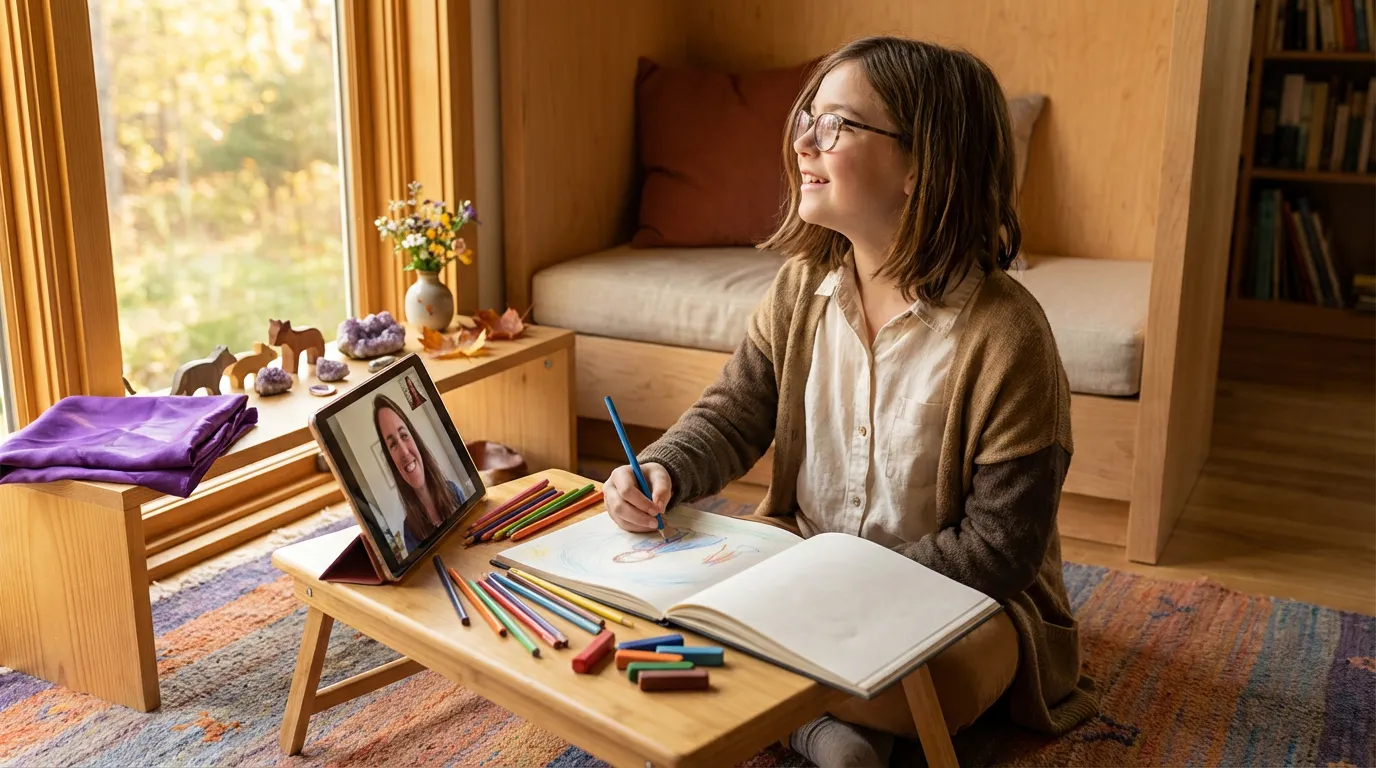
- Environment: Waldorf classrooms are known for their aesthetic features: natural light, painted walls, avoidance of plastic, and desks made of wood. At home, specific kinds of paint or furniture aren’t necessary, but there’s still a focus on the quality of materials. Using fountain pens, wool yarn, and authentic beeswax crayons can create a Waldorf-inspired setting without having to make it look like its classroom counterpart (Steiner, Arts 113).
Topics Covered in 7th Grade Waldorf Curricula for Homeschool Learners
It’s no accident that 7th grade Waldorf education is known as “The Year of the Renaissance.” This historical period is defined by exploration, the questioning of authority, and the birth of modern science, which mirrors the “inner revolution” 13-year-olds embark upon in their physical, emotional, and cognitive growth. “Main Lesson Books” are the student-created textbooks that kids create for each unit of study. They continue to be a key feature, but once kids reach 7th grade, these Main Lesson Books shift from artistically designed storybooks to portfolios that document scientific and historical analysis (Steiner, Foundations 154).
History
The core of the curriculum moves from the ordered Middle Ages previously studied to the more expansive Renaissance. Kids typically read biographies of key Renaissance figures (for example, Da Vinci, Michelangelo, Joan of Arc, Elizabeth I) to illustrate how one person can change the world (Steiner, Kingdom 102).
They usually study exploration, including the voyages of Columbus and Magellan, which aligns with the child’s own journey away from the harbor of childhood into the “choppy waters” of adolescence. They also study the Reformation, which helps kids process their own developing critical thinking skills as they learn how old systems were challenged.
Science
Waldorf science in 7th grade usually focuses on the observation of phenomena in inorganic chemistry and mechanics. Students typically observe the properties of fire, charcoal, sulfur, and acids and bases.
And since a 13-year-old can be “fiery” and reactive, studying these forces provides a grounded way to understand their own intensity (Steiner, Kingdom 128). They often take a deep dive into mechanics (levers, pulleys, and simple machines). This helps the student understand how the human body and the physical world leverage force. And the study of physiology, especially of the respiratory and circulatory systems, helps begin to understand the inner organization of complex systems (Steiner, Education 36).
Math
Math becomes more abstract as the child’s cognitive abilities sharpen. This is generally the year that introduces the use of variables in algebra. The idea that a value can be “hidden” or “unknown” resonates deeply with the adolescent psyche (AWSNA, Chart 7). Geometry study is also usually included and moves from freehand circles to using precise tools, like a compass and straightedge, to create 3D drawings with vanishing points. This builds a literal and figurative “new perspective” on the world (Steiner, Foundations 154).
Language arts
Usually, the creative writing curriculum during this year focuses on the nuances of human emotion. Kids explore various poetic forms to express their internal “landscape” (Steiner, Kingdom 122).
Literature study often involves an epic or other novel that centers on a protagonist finding their way through a world in transition. Again, the Waldorf approach parallels the inner dynamics of kids at this age (AWSNA, Chart 7).
Types of 7th Grade Homeschool Waldorf Curricula
Waldorf isn’t a one-size-fits-all approach. Depending on how much time you have to prepare lessons, your comfort level with the content, and your budget, there are several paths you could take.
- All-in-one boxed set: This comprehensive set of materials can provide everything you need for the entire year. It includes a master schedule outlining 3–4-week units of study along with daily guidance on sequencing “in-breath” and “out-breath” activities. It also includes subject-specific teacher guides for history, science, math, and language arts. Student workbooks and reading materials are included along with fine art supplies, geometry tools, and science kits. This kind of curriculum ensures that a parent doesn’t miss covering any key skills, but it doesn’t make it easy for kids to take deep dives into areas of interest they may encounter, which is the kind of flexibility homeschool parents often value.
- Subject-specific “block” guides: Instead of purchasing materials for a whole year, parents could buy individual guides for 7th grade chemistry or “The Age of Discovery” in history. This approach is customizable, but it does require time and effort on the part of the parent to supplement these guides and sequences when they are taught in a way that builds on previous learning (Rawson and Richter 14-16).
- Project-based approach: In this approach, the parent sets the theme, like “The Renaissance,” and the child then completes a multi-disciplinary project to demonstrate their learning. For instance, they might build a working model of a Da Vinci catapult that explains the physics involved and includes a written biographical sketch of the inventor. This approach can appeal to a 7th grader’s desire for independence, but it’s harder to track progress on standard content and skills this way (Ray 12-15).
- Video-based Programs: Purchasing a license for an on-demand video program allows kids to watch pre-recorded lessons delivered by a teacher and then do their own work in their Main Lesson Books. This can help parents who may not be comfortable teaching particular content areas, but it’s also possible for the learning to feel passive when kids watch a lot of videos.
- Live virtual or online classes: Unlike pre-recorded videos, these classes take place in real time, usually 2-4 times per week over the course of a year, semester, or unit. This approach relieves parents who may be concerned about their own subject-matter expertise, and it also provides virtual peer interaction that promotes social development, something that homeschool parents can’t always provide on their own (AWSNA, Introduction 23).
What to Consider Before Choosing a 7th Grade Homeschool Waldorf Curriculum
Sure, there are lots of different 7th grade Waldorf curriculum options available, but which one is best for your child? There are several factors worth considering.
Alignment with the Renaissance theme
When using a Waldorf approach, the Renaissance isn’t just a unit of study in history; it’s a thematic frame for the entire year’s curriculum. Look for a curriculum that weaves the concepts of “individual agency” and “scientific inquiry” through all subjects and choose materials or classes that emphasize biographies of figures who challenged the status quo (Rawson and Richter 146).
Emphasis on the parent as a guide
Seventh graders usually have a growing desire for independence, so look for curriculum options that allow you to be more of a guide than a lecturer. Also, by this age, the subject matter content, especially in math and science, is something that many parents don’t feel completely comfortable with. Therefore, video-based programs or live virtual classes can help keep the parent in the “guide on the side” mode (AWSNA, Introduction 18).
Appropriate physiology content
The Waldorf approach encourages explicitly addressing puberty and your 7th grader’s changing body. Consider curriculum materials that include the study of the respiratory and circulatory systems so that kids come to understand their physical development as part of a natural process (Rawson and Richter 152).
Depth of subject expertise
By the time kids get to this age, general knowledge no longer cuts it. The 7th grade curriculum usually includes inorganic chemistry, algebra, and perspective geometry through the lens of Renaissance history and culture. At this stage, homeschool parents often seek out materials or classes that provide this kind of rigor (AWSNA, Chart 7).
Quality of materials
No matter the age of the child, in a Waldorf approach, the quality of the materials matters a great deal. Check out the kinds of materials suggested by any curricular option you consider. Waldorf favors those that ask kids to use fountain pens, metal compasses, and quality paper for artistic expression (Rawson and Richter 24).
How to Plan a 7th Grade Homeschool Waldorf Curriculum
Implementing a 7th grade homeschool Waldorf curriculum may seem daunting at first, but there’s no need for stress. By following these straightforward steps, your child’s heart, head, and hands will soon be engaged in high-quality learning activities.
Step 1: Understand the 7th grade themes
This year focuses on outward exploration and inner reflection. The historical transition from the Middle Ages to the Renaissance mirrors the personal transition kids go through at this age.
Key themes include:
- The Renaissance Itself: The shift from faith-based to scientific thinking
- Exploration: The great voyages and the mix of cultures that resulted
- The Human Body: The physical changes during puberty, anatomy, and nutrition.
- Order and Chaos: Introductory algebra and perspective drawing (Rawson and Richter 124-126).
Step 2: Structure your Main Lesson Blocks
The Waldorf approach organizes learning by blocks, which means that one subject is the focus for 3-4 weeks.
While there’s a lot of flexibility in planning these blocks in a homeschool setting, a typical sequence could look like this:
- History: Renaissance, Reformation, and Age of Discovery
- Geography: world geography (usually Asia or Africa) and navigation
- Science: Inorganic chemistry (combustion, acids/bases, salts); physics (levels, pulleys); and anatomy (senses, systems, digestion, reproduction)
- Language Arts: Biography, fiction, poetry, creative writing
- Math: Introductory algebra and business math (taxes, interest) (Stockmeyer 165-168)
Step 3: Integrate the arts
Waldorf provides opportunities for kids to engage their feelings in the learning process, so look for ways to incorporate drawing, painting, drama, and music into your lessons.
A few possibilities might include:
- Creative Writing: Kids can keep a “voyage log” as though they were an explorer.
- Modeling: They can sculpt an ear or the human heart in clay.
- Perspective Drawing: They can use geometry to create depth in a sketch (Rawson and Richter 178).
Step 4: Schedule for rhythm
Even though the lesson topics will change from day to day, a consistent daily flow can be helpful for kids.
A typical 7th grade day might look like this:
- Morning start: Thirty minutes of singing, reciting poetry, or some form of movement can “wake up” the body in preparation for learning.
- Main lesson: You might want to devote 90-120 minutes to work that involves intense focus, like a science experiment or researching the differences between two explorers.
- Skills practice: It’s helpful to have 45 minutes of consistent, daily practice in language arts and math, apart from what is covered in the main lesson.
- Specialty subjects: Often, the afternoon is devoted to studying a world language, music, physical education, and/or handiwork, like sewing or woodcarving (24-27).
Step 5: Access resources
The Waldorf approach uses “living books,” which are narrative works written by authors who are passionate about their subject matter. A traditional textbook might have a diagram that illustrates the stages in the Water Cycle, but a “living book” would tell the story of a single drop’s epic journey through clouds and soil. It would have rich language and beautiful imagery and prompt the reader to feel a sense of curiosity, wonder, or empathy (Avison 68-72).
Additionally, you’ll most likely want to get high-quality paper that kids will use to create their Main Lesson Book, their self-created text that compiles their work. Science kits and art supplies are other typical materials.
Weekly and Daily Routines for 7th Grade Waldorf Curricula
You may have felt confident and successful when your child was in the early elementary years, but now that they are in middle school, you might feel a little anxious making it all work at home from day to day and week to week.
But there’s no need to be concerned. By using these scheduling tips, you’ll be just as confident as you were when your child was first learning about how to add sums or tell a simple story.
Weekly scheduling
A lot of homeschool parents find the four-day approach to work well with a Waldorf curriculum. This approach involves scheduling the intensive main lesson work and core skills four days per week and leaving the fifth day for field research, like nature hikes, community service, or museum tours. This aligns with the 7th grade theme of exploration.
For instance, on Monday, you might introduce a new concept and ask your child to do a sketch or charcoal drawing of it. On Tuesday, you might engage in discussion and move to painting or modeling as a way of expressing new perspectives gained. On Wednesday, you could plan a science lab related to the material, and on Thursday, you might review what was covered so far and have your child do some creative writing about the week’s insights. Then on Friday, you and your child can apply what’s been learned out in the world.
Daily scheduling
A Waldorf education seeks to mimic the human process of respiration. Breathing in, or an intellectually focused learning activity, is balanced by breathing out, or physical or creative activities. While there are many ways to plan lessons, you might consider a sequence like we discussed in “Step 4” above.
Preparing to teach
Many homeschool parents find the “three-day cycle” to be a great way to ensure that their child has time to process the new material learned.
Day 1 can be a day to “present,” whether by telling a story or doing a demonstration where your child takes rough notes. Day 2 can shift to recall where they recite yesterday’s material from memory and then begin to create their Main Lesson Book page, including a rough draft of their summary of what was learned with an illustration. Then, on Day 3, they can write their final summary in ink, which cements the knowledge (Richards 34-38).
Popular Homeschool Waldorf Curricula for 7th Graders
Even when you have the blueprint, it’s helpful to have a professional architect on retainer to help build a strong foundation for your child’s 7th grade education. Check out these easy-to-access materials.
Outschool’s online curricula and classes
A popular choice for parents looking for content expertise, engaging lessons, and social interaction is Outschool’s online curricula and classes. They provide everything from complete, year-long seventh-grade classes to multi-week units to one-on-one tutoring.
In addition to live classes, they also offer self-paced options. Parents love that the classes are taught by professional educators, and kids love the fun activities.
Open-access options
You can also find some free materials online. The Online Waldorf Library (OLF) is a repository of PDF versions of classic curriculum guides, and Waldorf Teacher Resources provides lesson plans and Main Lesson Pages through grade 9.
Additionally, Kennedy Center Education offers lesson plans and activities along with video and audio stories produced by artists who have performed at the Kennedy Center (Waldorf Education Resources).
Frequently Asked Questions: 7th Grade Homeschool Waldorf Curricula
Still have questions about making 7th grade Waldorf curricula come to life in your homeschool setting? We’ve got you covered.
Can I use a 7th grade Waldorf homeschool curriculum if I’m new to Waldorf education?
Absolutely! In fact, 7th grade can be a great entry point into Waldorf because the curriculum aligns so well with the searching and rebellious nature of early adolescence. Just as the blind faith of the Middle Ages gave way to the scientific method during the Renaissance, your child’s former willingness to take your word for something turns into a need to prove things for themselves.
That said, there are a couple of things to be aware of if this is your first foray into Waldorf. The parent-as-guide can’t just hand a child a workbook to complete. They need to spend time with the material themselves to make it come alive. Also, kids create their own textbook, called the Main Lesson Book, as part of the Waldorf approach, so it helps to prioritize quality over quantity. One beautifully written and illustrated summary of the circulatory system is more valuable than 15 pages of completed worksheets.
Also, Waldorf science begins with observation, not a scientific law or the definition of a term, which requires a good deal of preparation. Many parents who are new to Waldorf find Outschool’s classes to be a valuable resource for these very reasons.
How do I document progress when using a 7th grade Waldorf homeschool curriculum?
Since your child is gaining deeper critical thinking skills, it makes sense that your documentation of their learning will reflect their ability to observe, analyze, and synthesize information. The primary record for this will be the Main Lesson Book. It’s helpful to look for the “three C’s” in their work: clarity (is it accurate?), composition (is the layout balanced?), and calligraphy (is the handwriting legible?).
Another strategy for documenting progress is to keep track of what your child produces during the “three-day cycle.” Observational notes or rough sketches might come from Day 1. Drafts of math problems they struggled with, or an initial outline for a biography, might come from Day 2. And the polished entry in the Main Lesson Book would come from Day 3.
Waldorf avoids the use of letter grades in favor of narrative reports. You might jot down things like how well your child transitions from arithmetic to algebra, how they developed their voice in creative writing projects, and how they managed the physical challenge of complex handiwork. You can also use a portfolio that includes various “final products” (Mitchell 12).
Can a 7th grade Waldorf homeschool curriculum prepare students for high school?
Yes! In fact, the 7th grade Waldorf homeschool curriculum builds a unique set of thinking skills that some traditional curricula sometimes skip. Its focus on inorganic chemistry and the Renaissance facilitates the child’s shift from being a passive receptacle for information to an active investigator. Specifically, this curriculum develops the ability to think objectively through its emphasis on the scientific study of things as they appear.
By doing experiments to derive the scientific laws at work, kids develop important deductive reasoning skills, which are needed in high school. Also, by focusing for 3-4 weeks on a single Main Lesson Block, the 7th grade Waldorf curriculum prepares kids for the sustained focus on complex projects they’ll need in the future as well. Waldorf-educated kids often excel in high school because they are already intellectually curious and have experience with creative problem-solving (52-54).
Head, Heart, Hands… Hooray!
The Waldorf approach when homeschooling for seventh grade is more than just a curriculum; it’s a support system for developing adolescents into whole persons. By engaging the head through the logic of algebra and the laws of physics, the heart through the biographies of Renaissance explorers, and the hands through precise drafting and complex handwork, kids receive a balanced foundation.
This holistic integration ensures they are able to question the world around them, develop the intellectual confidence to find their own place within it, and do so with a sense of wonder. In the Waldorf home, 7th grade isn’t just about preparing for the last year of middle school; it’s about the growth of a free and independent thinker.
Sources
Association of Waldorf Schools of North America. Waldorf Curriculum Chart. AWSNA Publications, 2011.
---. Waldorf Education: An Introduction. AWSNA Publications, 2016.
Avison, Kevin. A Handbook for Waldorf Class Teachers. 2nd ed., Steiner Schools Fellowship Publications, 2004.
Mitchell, David, editor. Assessment and Evaluation in Waldorf Schools. Research Institute for Waldorf Education, 2002.
Rawson, Martyn, and Tobias Richter. The Waldorf Curriculum: A Survey for Waldorf Schools. 3rd ed., Steiner Schools Fellowship, 2016.
Ray, Brian D. “Portals to Learning: A Case Study of Teacher Training for Literature and Project-based Learning.” Home School Researcher, vol. 38, no. 4, 25 Mar. 2024. National Home Education Research Institute, www.nheri.org/portals-to-learning-a-case-study-of-teacher-training-for-literature-and-project-based-learning/.
Richards, Mary Caroline. The Crossing Points: Guidance for our Endeavors as People and Teachers. Anthroposophic Press, 1973.
Steiner, Rudolf. The Arts and Their Mission. Translated by Lisa D. Monges and Virginia Moore, Anthroposophic Press, 1964.
Stockmeyer, Karl. Rudolf Steiner’s Curriculum for Waldorf Schools. 4th ed., Steiner Schools Fellowship Publications, 2015.
___. The Education of the Child in the Light of Anthroposophy. Translated by George Adams, Rudolf Steiner Press, 1975.
---. The Foundations of Human Experience. Translated by Robert Lathe and Nancy Whittaker, Anthroposophic Press, 1996.
---. The Kingdom of Childhood: Seven Lectures and Answers to Questions Given in Torquay, August 12-20, 1924. Anthroposophic Press, 1995.
---. The Spirit of the Waldorf School. Translated by Robert Lathe and Nancy Whittaker, Anthroposophic Press, 1995.
Waldorf Education Resources for Homeschoolers and Families. Online Waldorf Library, 2024, www.waldorflibrary.org.


.svg)
.svg)