Choosing a 6th grade homeschool science curriculum can raise many questions. You might be wondering what equipment you need and how to incorporate experiments without a science lab. The reassuring news is that 6th grade science at home is less about formal labs and more about curiosity, observation, and exploration. With a few simple planning steps, you can cover life, earth, and physical science in a way that feels manageable and even fun.
This article will guide you through what topics are typically taught in 6th grade as well as what benefits you will experience at home versus traditional school. We will also help you choose the program that fits your child’s learning style, and give you simple steps to integrate labs without the added stress.
What Is a Science Curriculum for Homeschool 6th Graders?
A 6th grade homeschool science curriculum is typically an introduction to the three branches of science. Your learner will likely explore life science, earth science, and physical science over the course of the year. The focus is on learning how science works through observation, simple experiments, and record keeping. Students are typically looking for patterns and systems that connect our world, and they are learning to be amateur or future ecologists, biologists, and chemists.
This year can also focus on engineering design and mathematical reasoning, meaning they are the problem-solvers every step of the way, from identifying the problem to proving a theory. Students can use the scientific method as a framework to identify the problem and test hypotheses. They may learn that “failure” is just another piece of information.
Learning 6th grade science at home vs. in a school environment
According to the National Assessment of Educational Progress (NAEP), there has been a recent decline in average science scores among middle schoolers, particularly in the ability to engage in inquiry-based learning, which is using evidence from an experiment to explain a "why."
In a traditional classroom, a teacher may have only 45 minutes to guide a class through a lab, and students often follow steps without understanding the logic. At home, you have the luxury of time to let an experiment fail, analyze the data, and try again, which is the very heart of true scientific inquiry.
Here are some common benefits of learning science at home:
- One-on-one Socratic questioning: Students thrive when prompted by high-level questioning. For example, at home, a parent can pause a lesson to ask, "Why do you think the reaction changed when we increased the temperature?"
- Tailored scientific interests: If a student struggles with a specific concept, like molecular biology, the homeschool schedule allows them to slow down until they feel comfortable with the material. On the other hand, if they excel in astronomy, you can incorporate high-school-level material, ensuring that they are challenged and learning at their level. Once learning is aligned with a student’s pace and interests, the next step is bringing science off the page and into daily life.
- Real-world application: The home environment can turn the kitchen, garden, or local park into a laboratory. This can help students see science not as a school subject, but as a practical tool for understanding the world.
Alongside experiential learning, a well-planned scope of topics ensures that your child’s hands-on discoveries are connected to core 6th grade science concepts.
Subjects or Topics Taught in 6th Grade Homeschool Science
A quality 6th grade homeschool science curriculum may cover several "Disciplinary Core Ideas" as outlined by Next Generation Science Standards:
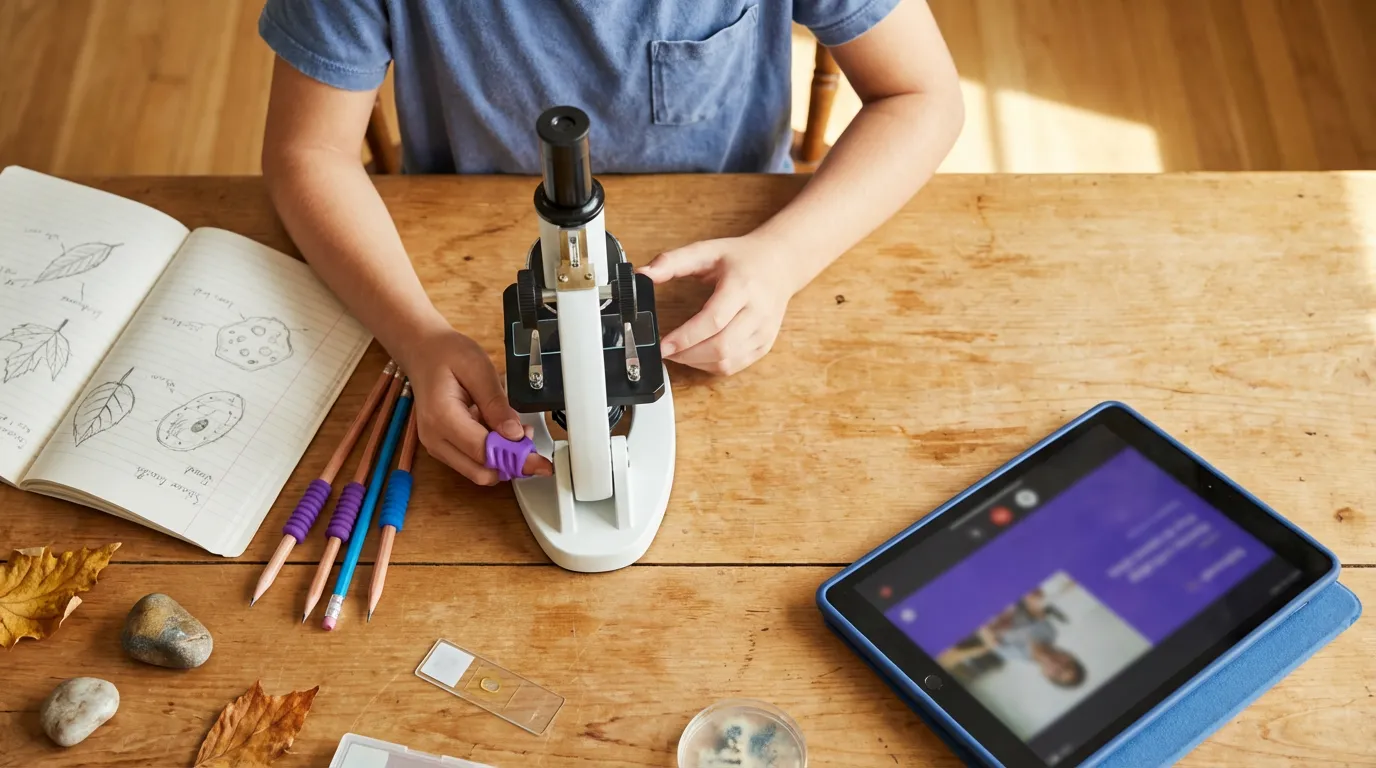
- Life science: Students study cells as the building blocks of life, explore how the body systems interact, and investigate genetic traits. At home, you might use a microscope to observe onion cells, build a model of the digestive system, or track genetic traits within your family.
- Earth and space science: Learners study the Earth’s place in the solar system, analyze weather and climate patterns, and explore the water cycle. Homeschool activities might be tracking daily weather, creating a scale model of the solar system in the backyard, or testing your soil to discover how well it absorbs water.
- Physical science: Students investigate energy transfer, forces and motion, and the basic properties of matter through observation. At home, you could design and build a simple roller coaster, use magnets to explore force, or compare states of matter with everyday pantry supplies.
- Engineering design: This is the process of defining problems and developing possible solutions through a "test and refine" process. You may design a bridge from recycled materials or build a device that protects an egg from breaking when dropped from your roof.
Common Types of 6th Grade Science Curricula
Science programs for homeschoolers come in several formats. The best choice depends on how your learner engages with the material and how much teaching support you want built in.
- All-in-one general science programs: These provide a full year of lessons, including readings, experiments, and review questions. They are helpful if you want a clear sequence and a checklist of what to cover each week. At home, you can shorten the readings and spend more time on the experiments without losing the overall structure.
- Hands-on experiment-focused programs: These emphasize experiments and have less focus on texts. They work well if you want to focus on the “doing” rather than the reading. Many families schedule one longer “lab day” each week, so experiments become a part of the routine.
- Online or video-based science courses: These include demonstrations, visuals, and guided explanations of topics. They are useful if you want support with subjects like cells or astronomy, and can serve as your main instruction with discussions and activities as supplements.
- Unit study or project-based science: These programs explore one theme at a time, such as ecosystems or space, and integrate reading, writing, and experiments. Homeschoolers often pair unit studies with field trips, nature walks, or documentaries to deepen understanding.
- Nature study-based science: This approach uses outdoor observation as the primary learning tool. Learners track seasonal changes, identify plants and animals, and record findings in a journal. It is especially effective for life science topics and requires minimal materials.
- Online learning platforms or live virtual classes: These programs deliver science instruction through recorded lessons or live online teaching. They often include guided explanations, visual demonstrations, and built-in quizzes or assignments. This format can be helpful if you want outside instruction for complex topics while still keeping hands-on activities or experiments as part of your homeschool routine.
What to Look for in a 6th Grade Science Curriculum
When selecting a 6th grade homeschool science curriculum, you are choosing more than just a textbook. You are selecting a framework for how your child interprets the scientific world. Here are some elements to consider.
Alignment with inquiry-based learning
Research suggests that middle schoolers retain information significantly better when they are "doing" rather than just reading. You can ask yourself, does the curriculum start with a question before providing the answer? At this age, you may want to move beyond simple memorization and into deeper thinking.
Integration of literacy and math
A quality 6th grade science curriculum can incorporate “writing to learn” strategies, such as lab journals and lab reports. Your student can learn how to communicate their steps and findings.
Sixth grade science may also require a basic understanding of statistics. Many experiment results include ratios, percentages, and calculations. Integration of subjects not only makes sense in a homeschool setting, but may be necessary for success.
Adaptability of “deep dives”
Some children are naturally fascinated by scientific exploration of topics such as black holes, deep-sea creatures, and robotics. You can choose a program that lets you incorporate what your child is drawn to. You may also choose to spend extra time on units that spark curiosity and choose a program that will allow this.
Requirements and documentation
Homeschool laws will vary from state to state. It is important to check the laws in your state to clarify what is required of you regarding recordkeeping and documentation. If your state requires a portfolio review, your organized lab log and work samples will provide a clear picture of your child’s growth in science over the year.
How to Plan a 6th Grade Homeschool Science Curriculum
Once you have considered the topics and elements of a quality program, you are ready to start planning. Follow the simple steps below to create a solid framework for your year.
Step one: Map out your year
Decide on your "big ideas." Most 6th grade frameworks combine Life, Earth, and Physical sciences.
The National Science Standards outline what 6th-8th graders are expected to master. However, you have the freedom to decide the topics within the standards due to the grade range. Think about what your child would enjoy and what they are ready for. Having the larger topics planned out will help you with the next steps.
Step two: Choose your anchor resources
Choose one core curriculum, either textbook-based or online, and then supplement it with real-world connections.
The National Assessment of Educational Progress (NAEP) notes that students perform better when they see the real-world application of their studies. For example, during a weather unit, you may use Library of Congress historical weather data and ask, "Why was the 'Great Blizzard of 1888' so much worse than modern storms?"
Step three: Plan for labs
Instead of reading every day and "doing" science once a month. Research shows that frequent, small-scale investigations are more effective. You can designate a "Lab Day" each week, you can plan ahead to ensure that you have the materials ready to go.
If a lab fails, use it as a teaching moment for iteration, a key component of the engineering design process.
Step four: Build in assessments
In 6th grade, moving away from simple quizzes and toward performance-based assessments may be important. This ensures the student isn't just memorizing definitions but can apply the scientific method.
For example, at the end of each quarter, you may have your student give a "Science Talk" to your family, explaining a project. You can use a rubric to grade them on their use of evidence, data visualization, and claim-making, which aligns with professional scientific peer reviews.
What Teaching 6th Grade Science at Home Can Look Like
A typical week of 6th grade science at home doesn't have to be complicated. On the first day, you might read a short section about cells and look at a labeled diagram together. You might use the diagram in their science notebook, write two or three key facts, and define new vocabulary.
On the second day, the focus shifts to observation. Using a prepared slide image or a detailed model, your child compares plant and animal cells and records similarities and differences in a simple chart. You discuss why each structure matters; you are not trying to memorize all the parts of the cell, you are trying to build comfort with this new concept.
Later in the week, you can complete a hands-on activity such as building a cell model from household materials or food items. Your learner labels the model, writes a short conclusion about what they learned, and asks one question they still have. This keeps the emphasis on thinking like a scientist.
Over time, this routine of reading, observing, recording, and discussing builds both scientific knowledge and confidence.
Popular Homeschool Science Curricula for 6th Graders
Most homeschool families use a mix of structured content and hands-on exploration rather than relying on a single resource for everything. The goal is to have a clear guide for topics while keeping science active and inquiry-based.
Outschool’s online curricula and classes
For families concerned about teaching science at home, Outschool online science classes offer a solution.
Outchool’s instructors lead live, interactive experiments, which range from building electrical circuits to performing virtual dissections. Homeschoolers can engage in "science talks" to debate hypotheses and share data with peers. Whether it’s a semester-long deep dive into Earth Science or a one-time "escape room" challenge focused on physics, these classes are highly engaging and your 6th grader will love them.
High-quality free resources
If you are looking for free or low-cost supplemental materials, the list below is a great place to start.
- Core Knowledge Science: Core Knowledge offers free downloadable teacher guides and student readers. They have 6th grade units covering energy, Earth’s systems, and ecosystems.
- PhET Interactive Simulations: Developed by the University of Colorado Boulder, these are free, research-based science simulations. They are perfect for 6th-grade topics, especially when lab supplies might be too expensive or difficult to manage at home.
- Nova Labs by PBS: This platform allows students to participate in real-world investigations, using actual scientific data.
- NASA STEM: NASA provides a large collection of free 6th grade lesson plans and DIY projects, such as building launch structures or mapping lunar craters.
- Library of Congress Primary Source Sets: For no cost, you can download documents and data sets to help students analyze how scientific thought has evolved.
Frequently Asked Questions: 6th Grade Homeschool Science Curricula
Homeschool parents often feel confident reading science with their child, but may feel less certain about experiments, pacing, and coverage. These common questions come up often and have simple, practical solutions.
Can I teach middle school science effectively without a science background?
Yes. Most 6th grade programs are designed to guide both the parent and the learner. Your role is to learn alongside your child, help them set up simple investigations, and discuss what they observe. You do not need to explain every concept from memory. Asking good questions and encouraging careful observation are far more important than having all the answers.
Should 6th grade science be general science or focused on one discipline?
When choosing between a "General Science" (Integrated) approach and a "Discipline-Specific" (focused) approach, most educational experts recommend General Science for the 6th-grade year.
According to the NAEP, students at this age benefit most from seeing the "big picture" of how different scientific fields are connected, for example, how the physical properties of water (Physical Science) affect weather patterns (Earth Science) and sustain local ecosystems (Life Science).
Is it better to follow state standards or design a customized science plan?
Choosing between a standards-aligned path and a fully customized plan depends on your long-term goals. While most homeschoolers aren’t legally required to follow specific state science standards, using them as a guideline can prevent academic gaps. However, the NAEP highlights that middle schoolers who engage in specific "scientific practices" show higher proficiency later in life.
Building Confidence Through Science
Sixth grade science is a bridge year between “learning about” science and “doing” science. The ultimate goal is for your child to have the scientific thinking processes of asking questions, designing tests, and defending an answer using evidence. By implementing a quality program, you are laying the foundation for your child to tackle the world of science and technology with confidence.
Beyond the academic milestones, science should be one of the most engaging and exciting parts of your homeschool week. The flexibility of learning at home allows you to move beyond the kitchen table and into the world. When a child is given the space to test their own ideas and learn from their mistakes, they don't just learn science, they become scientists.
Sources
Association for Supervision and Curriculum Development (ASCD). "The Case for Inquiry-Based Science." Educational Leadership, vol. 72, no. 4, 2014, www.ascd.org.
Association for Supervision and Curriculum Development. “Inquiry-Based Learning.” ASCD, https://files.ascd.org/pdfs/onlinelearning/webinars/webinar-handout2-10-8-2012.pdf. Accessed 14 Feb. 2026.
Library of Congress. “Science Primary Source Sets.” Library of Congress, https://www.loc.gov/search/?in=&q=science&new=true Accessed 14 Feb. 2026.
NASA. "NASA STEM @ Home for Students Grades 5-8." Learning Resources, 2024, www.nasa.gov.
National Assessment of Educational Progress (NAEP). "2019 Science Report Card: Grade 8 National Results." The Nation's Report Card, 2019, www.nationsreportcard.gov.
National Assessment of Educational Progress. Science Framework for the 2018 National Assessment of Educational Progress. National Center for Education Statistics, U.S. Department ofEducation,https://www.nagb.gov/content/dam/nagb/en/documents/publications/frameworks/science/2028-naep-science-framework.pdf
National Research Council. A Framework for K-12 Science Education: Practices, Crosscutting Concepts, and Core Ideas. National Academies Press, 2012.
NGSS Lead States. Next Generation Science Standards: Parent Guides. 2013, www.nextgenscience.org.
Minner, Daphne D., Abigail J. Levy, and Jeanne Century. “Inquiry-Based Science Instruction—What Is It and Does It Matter? Results from a Research Synthesis Years 1984 to 2002.” Journal of Research in Science Teaching, vol. 47, no. 4, 2010, pp. 474–496
"STEM Is Not a Four-Letter Word." ASCD Express, vol. 9, no. 15, 2014, www.ascd.org.
"Teaching Smarter with Learning Science." Educational Leadership, vol. 77, no. 8, 2020, www.ascd.org.
University of Colorado Boulder. "PhET Interactive Simulations." PhET Project, 2024, phet.colorado.edu.


.svg)
.svg)