Most parents have tried the dinner-table version. Everyone goes around and names something they're thankful for, one kid says "pizza," another says "nothing," and the moment is over in 40 seconds. It isn't a failure. Gratitude is a habit, and habits need small, repeatable reps that don't depend on anyone being in a good mood.
This is a 28-day set of gratitude activities for kids, each one sized for about five minutes. They work for kids roughly ages 5 to 12, with notes for adjusting up or down. Start any Monday, or start tomorrow. If you're building a Thanksgiving week, these pair well with a Thanksgiving unit study, but nothing here is tied to November.
Why short daily prompts beat one big gratitude talk
Researchers who study gratitude have mostly tested a simple practice: write down a few specific things you're grateful for, on a regular schedule. In a well-known 2003 experiment, adults who listed things they were grateful for each week reported more optimism about the coming week than people who listed daily hassles or neutral events. A 2008 study of kids ages 11 to 13 found that counting blessings for two weeks was linked to more gratitude and a better outlook on school than a comparison group. The samples were small, and younger kids are studied far less, so we'd treat this as a promising habit and not a guaranteed fix.
One detail from that research is worth borrowing: specific beats general. "I'm thankful for my family" fades fast. "I'm thankful my brother saved me the last strawberry" sticks. Many of the prompts below push kids toward the specific.
How to use this checklist
Pick one time of day and keep it there, such as breakfast, the car ride, or bedtime. Younger kids can answer out loud while you jot it down. Older kids can keep a small notebook. Tick each day off on the fridge so the streak is visible.
Skip a day and nothing breaks. Just do the next one. If you're a homeschool family, Day 1 of each week also works as a morning basket opener.
Week 1: Notice the small stuff
The first week is about training attention. Kids can't feel grateful for what they haven't noticed.
Day 1. Three good things. Ask each person to name three good things from today, and one detail about each. "The bus was warm" counts.
Day 2. Gratitude scavenger hunt. Walk through your home or yard for five minutes and find five things that make your day easier. Think of the kettle, the porch light, or the dog bed.
Day 3. Five senses check. Name one thing you're glad you can see, hear, smell, taste, and touch right now. This one is easy to do on a walk.
Day 4. Thank the invisible helpers. Talk about who made your breakfast possible, from the person who drove the delivery truck to the farmer. Younger kids can draw the chain.
Day 5. Something that went wrong, then okay. Name a small problem that turned out fine, like the rainy day that led to a blanket fort. Many kids find this easier than listing pure positives.
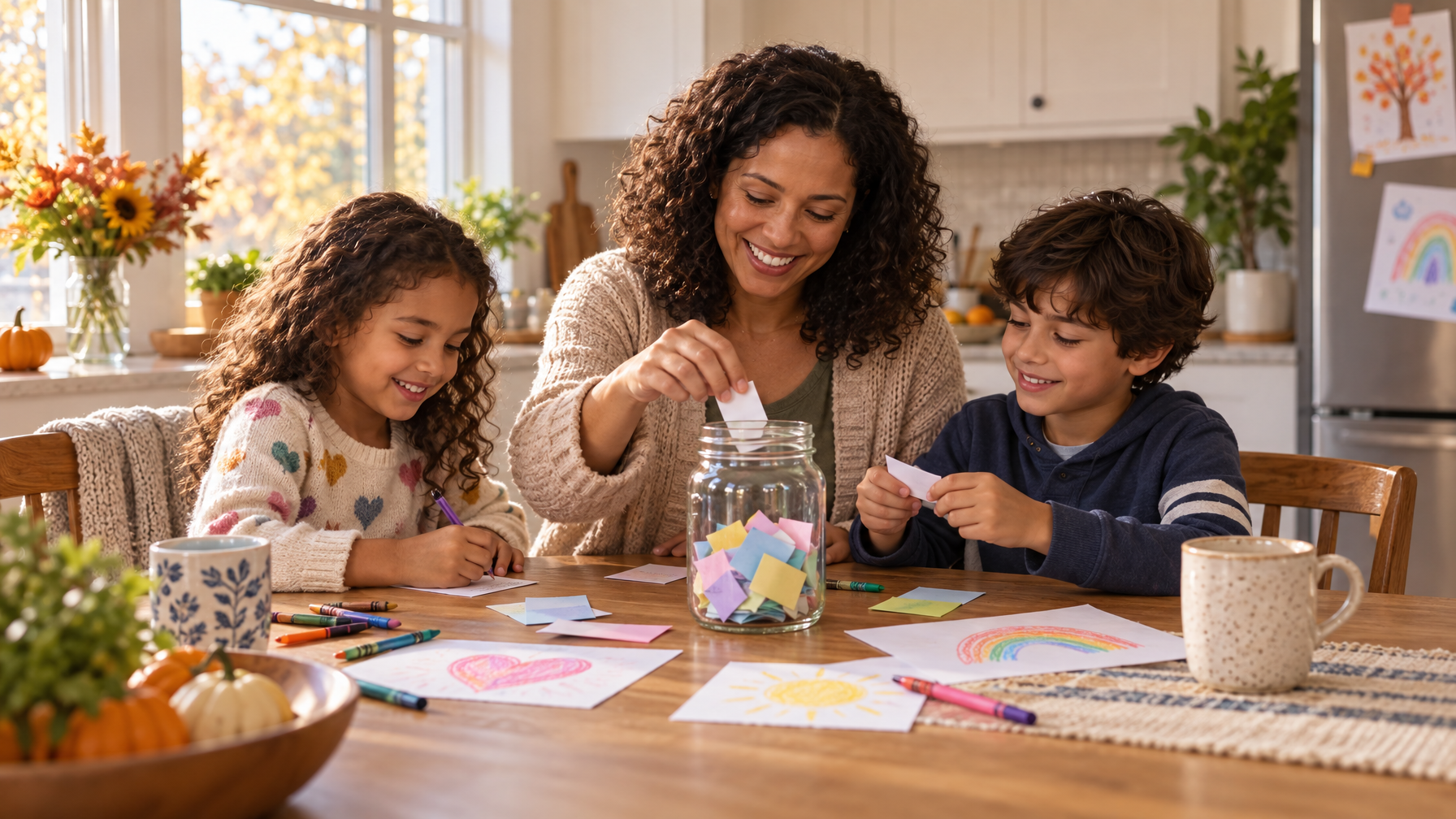
Day 6. Gratitude jar start. Write one thankful note on a scrap of paper and drop it in a jar. Keep adding for the rest of the month.
Day 7. Read one note back. Pull a note out of the jar and talk about it for a minute. Notice how a small thing can still feel good days later.
Week 2: Say it to someone
Gratitude lands harder when it's directed at a person. This week moves from private noticing to saying thanks out loud.
Day 8. Thank-you note, two sentences. Write a short note to someone who helped your family this month. Older kids can name exactly what the person did and how it helped.
Day 9. Thank a teacher. If your child takes classes with a teacher, a kid-written message about one thing they learned is a gift on its own. Keep it to what they remember, not what they think the teacher wants to hear.
Day 10. Compliment relay. Each person at the table gives one specific compliment to the person on their left. "You explained that so patiently" beats "you're nice."
Day 11. Grandparent or faraway friend call. Have your child tell them one thing they appreciate about them. Keep it under three minutes so it doesn't feel like homework.
Day 12. Gratitude for a hard thing. Ask what your child learned from something difficult, like a tough math unit or a missed goal. Validate the frustration first. Gratitude shouldn't mean pretending a hard thing wasn't hard.
Day 13. Thank someone who isn't expecting it. Pick a mail carrier, librarian, crossing guard, or neighbor. A drawing taped to the door works.
Day 14. Family appreciation circle. Everyone shares one thing they appreciated about each family member this week. Go slowly, and let silly answers happen.
Week 3: Gratitude in action
By now kids are practiced at noticing and saying thanks. This week turns the feeling into something they do.
Day 15. Pay it forward snack. Bake or assemble something simple and deliver it to a neighbor. Have your child choose who gets it and why.
Day 16. Donate three things. Let your child pick three toys, books, or clothes in good shape to give away. Talk about who might enjoy them.
Day 17. Gratitude walk. Take a 15-minute walk where everyone points out something they're thankful for in the neighborhood, like a tree, a mural, or the corner store.
Day 18. Cook together and name the ingredients. Make a simple meal and trace one ingredient back to where it grew. Our mindfulness guide has slow-eating ideas that fit well here.
Day 19. Gratitude letter to future you. Older kids write three things they're glad about now, seal the letter, and open it in six months. Younger kids can dictate theirs.
Day 20. Thankful art. Draw, paint, or collage something your child is grateful for. Display it for a few days.
Day 21. Volunteer minute. Do one small helping task together, like picking up litter at a park or sorting pantry items for a food drive.
Week 4: Make it part of everyday life
The last week is about keeping the habit going without a printed list.
Day 22. Best part, hardest part, thankful part. Use this three-part check-in at dinner. It gives kids room for a rough day without skipping gratitude.
Day 23. Gratitude story swap. Tell each other about a time someone did something kind for you when you were your child's age. Kids love hearing that adults were once kids.
Day 24. Open the jar. Read all the notes from the jar aloud and let your child pick a favorite to keep.
Day 25. Gratitude and screens. Talk about one app, show, or game your child enjoys and why. It's an easy way to link gratitude and media habits without a lecture.
Day 26. Pick a family ritual. Choose one gratitude habit from the month to keep, such as the three-part check-in or the Sunday jar note. Calming routines like these can also support emotional regulation.
Day 27. Teach it to someone younger. Have your child explain one gratitude activity to a younger sibling or cousin. Teaching it cements it.
Day 28. Look back. Ask what your child noticed about themselves over the month, and what they want to keep doing. Write down what they say.
Adjusting for different ages and kids
Kindergarteners and first graders do best with spoken answers, drawing, and physical objects like the jar. Many younger kids also need a model first, so say your own answer before asking for theirs. Second and third graders can start short written lines.
Fourth through sixth graders can handle journaling, letters, and the reflection prompts. Some kids, including many neurodivergent kids, find open-ended prompts stressful. Offer two or three choices ("Do you want to draw it or say it?") instead of a blank page.
For more on the social and emotional side of this, see our guide to building your child's social-emotional skills. If your family likes slower evenings, daily quiet time makes a natural slot for the jar notes.
Watch for
Forced gratitude can backfire. Many kids resist when they're told to feel thankful, especially right after a disappointment. If a prompt gets eye rolls, switch to a more concrete one, like Day 2 or Day 10, and let it go for the day.
Comparison framing can also hurt. Saying "be grateful, other kids have it worse" often leaves kids feeling guilty without feeling thankful. Stick to what your child notices in their own life.
Rewards for gratitude, like sticker charts tied to thank-yous, tend to turn it into a performance. A visible streak on the fridge is plenty.
FAQ
What is the best age to start gratitude activities? Kids can start as soon as they can talk about their day, usually around age 3 or 4. Younger kids do best with concrete prompts such as favorite foods, people, and places.
How long should each activity take? About five minutes. Longer sessions tend to turn into chores, and the habit matters more than the length.
What if my child says they have nothing to be grateful for? Take it seriously and don't push. Try the "something that went wrong, then okay" prompt on Day 5, or ask about one small physical thing, like a favorite blanket.
Can I use this with more than one kid? Yes. Let older kids write and younger kids draw or dictate, and share at the end. It's a good fit for families homeschooling multiple kids.
Sources
[1] Emmons, R. A., and McCullough, M. E. (2003). Counting blessings versus burdens: An experimental investigation of gratitude and subjective well-being in daily life. Journal of Personality and Social Psychology, 84(2), 377-389. doi.org/10.1037/0022-3514.84.2.377
[2] Froh, J. J., Sefick, W. J., and Emmons, R. A. (2008). Counting blessings in early adolescents: An experimental study of gratitude and subjective well-being. Journal of School Psychology, 46(2), 213-233. doi.org/10.1016/j.jsp.2007.03.005
Keep the habit going with teacher-led classes
Kids often build social-emotional skills best when they practice with other kids and a caring teacher. Browse Outschool's social-emotional classes to find a live class that fits your family.