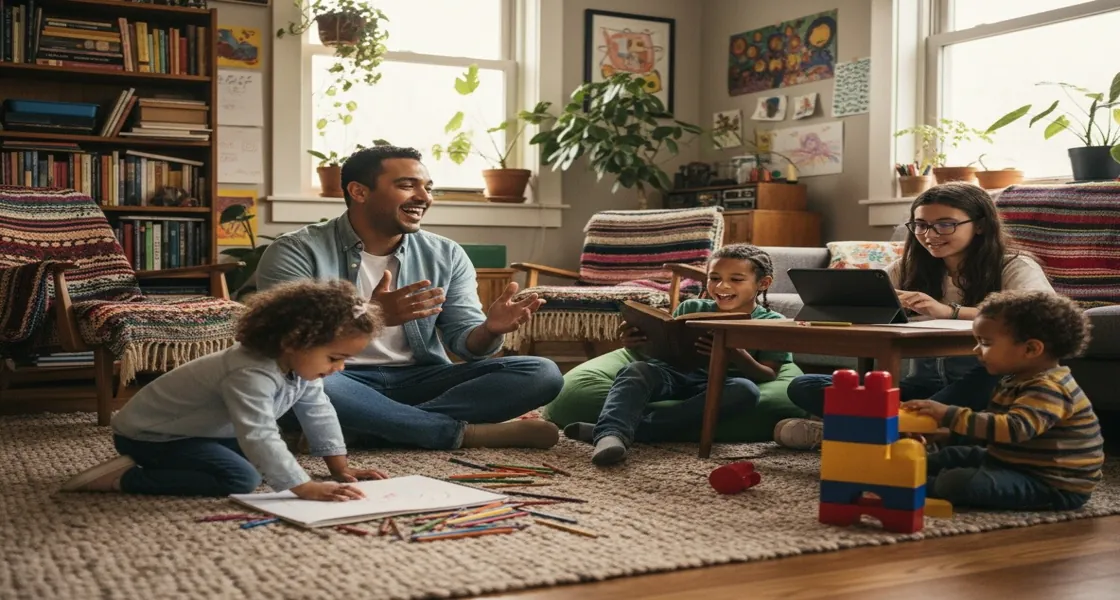
Teaching multiple kids at home can feel like spinning plates. Just when one child settles into their math lesson, another needs help with reading, while the youngest is pulling books off the shelf. The good news? Homeschooling multiple children is absolutely doable once you find systems that fit your family.
The key isn't perfection or keeping everyone on the same page at the same time. It's about building routines that create pockets of focused learning, independent work, and together time. Understanding how to start homeschooling becomes more manageable when you have clear systems in place. At Outschool, we help families simplify their days with live online classes that engage kids at different levels, giving you breathing room to work with each child.
Why homeschooling multiple kids is different
Homeschooling one child and homeschooling three or four requires completely different approaches. With multiple kids, you're not just teaching different subjects; you're managing different developmental stages, attention spans, and personalities all at once. A kindergartener needs constant redirection while your middle schooler craves independence, and somehow you're supposed to help both learn effectively.
The challenge isn't just academic. It's logistical, emotional, and often exhausting. You might feel guilty that the older kids don't get as much one-on-one time, or worry that the youngest is missing out on your full attention. Some days, keeping everyone fed and relatively on task feels like a real victory.
But here's what makes it work: accepting that your homeschool won't look like a single-child household, and that's perfectly fine. Multi-child homeschooling has its own rhythm, with built-in benefits like peer learning, natural collaboration, and kids who learn to work independently earlier. Research shows that when children spend quality time learning together, they develop stronger problem-solving skills and emotional intelligence. Once you stop trying to replicate a traditional classroom or a picture-perfect homeschool Instagram account, you can build something that actually serves your family.
Practical strategies for teaching different ages at once
When you're juggling a second grader, a fifth grader, and a preschooler, the idea of teaching them all simultaneously can feel impossible. The reality is that you won't always teach everyone at the same time, and trying to force it creates more stress than structure. Instead, focus on creating a flexible system where some learning happens together, some happens independently, and some gets your direct attention.
Family-style teaching is the number one recommendation from experienced homeschool parents for managing multiple levels. Here's how to make it work:
- Combine ages for certain subjects: History, science, art, and read-alouds work beautifully across age groups. A unit on the solar system might mean your kindergartener colors planets, while your fourth grader researches moon phases, and your seventh grader calculates orbital distances.
- Rotate one-on-one time strategically: Identify which subjects require your direct teaching, usually math and language arts for younger kids. Work with one child while others complete independent work, read, or participate in an online class. Rotate every 20-30 minutes.
- Stock up on independent activities: Audiobooks, educational apps, building sets, art supplies, and science kits give kids meaningful learning time while you work with another child.
- Set up anchor activities: Reading, journaling, educational games, or creative projects give kids automatic go-to tasks when they finish their work or are waiting for your help.
- Create predictable blocks: Mornings for core academics with rotated one-on-one time, midday for group learning or online classes, afternoons for projects or outdoor time. Consistency helps everyone stay on track.
- Focus on what matters most: Some days, not every child will complete every assignment. Ensure your struggling reader gets extra practice or let your advanced learner dive deep into their passion project, even if it means less time on other subjects.
Managing attention spans and keeping everyone engaged
One of the biggest challenges in teaching multiple kids is that attention spans vary wildly by age and temperament. Your eight-year-old might hyperfocus on a science experiment for an hour while your five-year-old needs to move every ten minutes. Fighting against these natural rhythms creates frustration for everyone.
Match lesson length to developmental needs
Younger kids (ages 4-7) generally need 10-15-minute focused sessions followed by breaks. Elementary ages (8-10) can handle 20-30 minutes, while middle schoolers might work independently for 45 minutes or longer. Structure your day around these realities instead of forcing everyone into the same timeframe.
Use movement and timers strategically
Physical movement actually supports learning by increasing oxygen flow to the brain, so incorporate movement breaks between subjects. A quick dance party, jumping jacks, or trip around the backyard helps reset attention spans. Visual timers give kids concrete endpoints, reducing the "Are we almost done?" questions. Pair timers with clear expectations about what needs to be accomplished in that time block.
Adjust when something isn't working
If a child consistently struggles to focus during a certain time or subject, adjust rather than power through. Maybe they need a snack, a sensory break, or a completely different learning method. Being responsive to individual needs prevents daily battles. Older children especially benefit from having input on when they tackle challenging subjects. Some kids prefer getting hard work done first; others need an easier warm-up task. Giving them ownership over their schedule often improves follow-through.
Build in shared learning experiences
Having shared learning experiences helps balance the constant splitting of your attention. Whether it's a group read-aloud, a nature walk, or a hands-on project, these moments remind everyone they're on the same team.
Using independent learning to create breathing room
If you're trying to be present for every single learning moment with every single child, you'll burn out fast. The truth is, independent learning isn't just helpful for managing multiple kids; it's actually beneficial for their development. Kids who learn to work on their own build problem-solving skills, confidence, and the ability to self-direct their education.
Start with age-appropriate independence
Even young children can complete simple tasks without constant oversight. A five-year-old might practice letter tracing while you work with an older sibling. A seven-year-old can read independently or complete a math worksheet they've already been taught. The key is setting them up for success with clear instructions and accessible materials.
Choose curriculum strategically
Look for programs that allow kids to move through lessons with minimal parent involvement, especially for subjects you're teaching to multiple grade levels. Video lessons, workbook-based programs, and self-checking materials give kids tools to learn without waiting for you. Help your kids understand the difference between "I don't know what to do" and "I haven't tried yet." Encourage them to attempt a problem, reread instructions, or check an example before interrupting. This isn't about making them struggle; it's about building resourcefulness.
Use online classes as core learning time
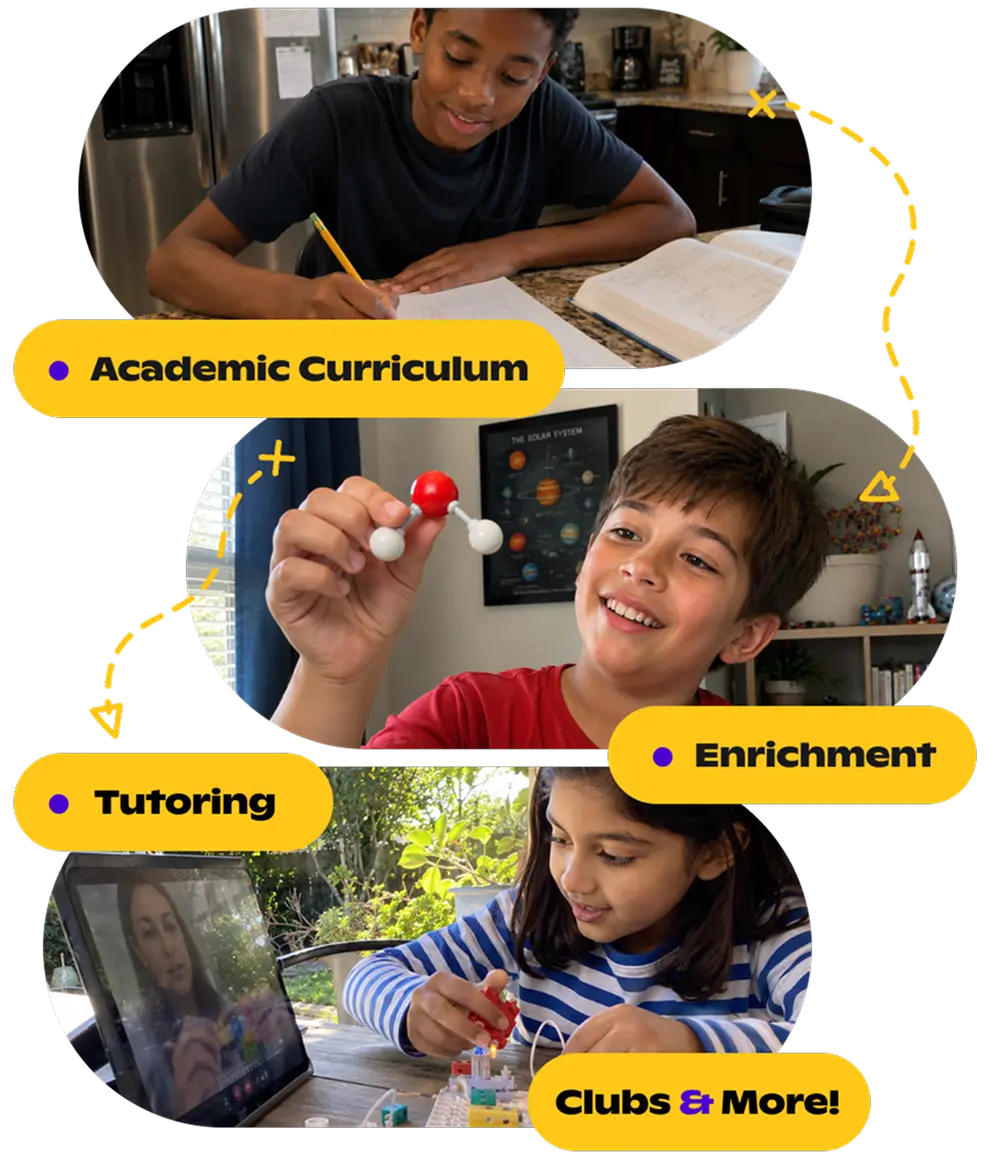
Platforms like Outschool offer live classes where teachers engage directly with students, giving you genuine free time to work with another child, handle household tasks, or simply catch your breath. These aren't just supplemental; they can be core parts of your homeschool week. Teach older siblings to answer simple questions from younger ones when appropriate. This benefits everyone: the older child reinforces their own learning by explaining concepts, the younger child gets immediate help, and you get a moment to focus without constant interruptions.
Making the most of group learning opportunities
Not everything needs to be taught separately. Some of your best homeschool moments will happen when everyone learns together, each engaging at their own level. Group learning builds family culture, encourages discussion, and honestly makes your life easier by consolidating preparation time.
Choose topics that scale across ages
A study of ancient Egypt can engage a first grader building pyramids with blocks, a fourth grader reading mythology, and a seventh grader analyzing historical texts. The same base topic becomes differentiated naturally through age-appropriate activities and expectations. Reading aloud as a family is one of the simplest yet most powerful group activities. Choose engaging books slightly above your youngest capable reader's level. Everyone benefits from exposure to quality literature, complex vocabulary, and shared stories that spark conversation.
Make hands-on learning a family activity
Science experiments, art projects, cooking, gardening, and building activities work beautifully across ages. A baking project teaches measurement to younger kids while older ones calculate ratios or discuss chemical reactions. Everyone participates meaningfully without separate lesson plans. Museums, historical sites, nature centers, and parks offer natural opportunities for multi-age learning. Each child will notice and absorb different things based on their developmental stage, and that's the beauty of it.
Turn everyday moments into learning
Use dinner or afternoon snack time for open-ended conversations about current events, ethical questions, or topics you're studying. Older kids can share insights while younger ones learn to listen and contribute their perspectives. These shared experiences can become highlights of your week and topics for ongoing family conversations.
Handling meltdowns, sibling conflicts, and tough days
Let's be honest: some days will be hard. Someone will cry (maybe you), siblings will argue over whose turn it is to use the microscope, and your carefully planned schedule will completely fall apart by 10 a.m. This isn't a sign you're failing; it's a sign you're homeschooling real children with real emotions.
Know when to pivot
When kids start bickering more than usual, when focus evaporates, or when everyone's feeling tense, it's time to pivot. Pushing through rarely works. Instead, call a break, go outside, put on music, or switch to a completely different activity. Keep a list of low-pressure activities you can pull out when things go sideways: educational videos, audiobooks, board games, art projects, or even just declaring a field trip to the park. Permission to flex your plans reduces pressure for everyone.
Manage conflicts quickly
Sometimes siblings need space from each other. One child can work in the living room while another sets up at the kitchen table. Giving everyone their own zone can prevent conflicts and help them refocus without the distraction of a sibling. When arguments happen, address them quickly and move on. Teach kids basic conflict resolution phrases and expectations for working near each other. Save longer character conversations for after school hours when you're not also trying to teach fractions.
Give yourself permission to adjust
If you're feeling overwhelmed, exhausted, or tapped out, it's okay to lean more heavily on independent work, online classes, or educational screen time. Sustainability matters more than any single perfect day. One chaotic morning doesn't undo months of good work. One skipped subject doesn't destroy your child's education. Homeschooling is measured in years, not days. Give yourself the same grace you'd extend to a friend in your situation.
Homeschooling multiple kids: Frequently asked questions (FAQs)
Managing multiple learners at home raises questions that single-child families never have to consider. These practical answers address the real concerns parents face when teaching siblings.
How do I give each child individual attention when there are so many of them?
Focus on quality over quantity. Each child doesn't need hours of one-on-one time daily, but they do need focused moments where you're fully present. Rotate through 15-20 minute blocks where you work directly with each child on their most challenging subject, and use independent work, online classes, or quiet activities for others during that time.
What if my kids are at very different academic levels?
This is completely normal and doesn't mean you're doing anything wrong. Teach core skills like math and reading separately since these build sequentially, but combine ages for content-rich subjects like history, science, and art. Choose topics everyone can explore at their developmental level, adjusting expectations and activities rather than the curriculum.
Should I use the same curriculum for all my kids?
Sometimes yes, sometimes no. For subjects like math that build step-by-step, each child likely needs their own grade-level materials. For history, science, and literature, you can often use the same curriculum but differentiate activities and expectations. The goal is to simplify your planning without forcing kids into one-size-fits-all learning.
How do I keep younger kids occupied while working with older ones?
Set up engaging independent activities before you start teaching, such as audiobooks with quiet toys, simple art projects, educational apps on a tablet, building sets, or sensory bins. Rotate these materials regularly to keep them interesting. Consider the time you spend with older kids as an investment; younger siblings often benefit from learning to play independently.
What do I do when everyone needs me at the same time?
Triage the situation. Who has an immediate need versus who can wait five minutes? Teach older kids to attempt solving problems independently first. Use phrases like "I'll be with you in five minutes" and actually follow through. Sometimes you'll need to put one child's work on pause to address an urgent need, and that's okay.
How do I prevent older kids from feeling shortchanged?
Be intentional about creating special time with older children, whether through their advanced coursework, letting them stay up later for one-on-one conversations, or taking them on solo outings occasionally. Acknowledge that they're being patient when you're helping younger siblings, and find ways to give them challenging, engaging work that recognizes their growing capabilities.
Create a homeschool that works for your whole family
Teaching multiple kids at home will always have its challenging moments, but it doesn't have to feel impossible. The families who thrive aren't the ones with perfect systems or unlimited patience; they're the ones who stay flexible, adjust expectations, and focus on what matters most for their unique crew.
Building routines that honor different ages, creating space for both independence and together time, and knowing when to pivot on tough days, you can create a homeschool where every child feels seen, and learning actually happens. At Outschool, we support multi-child families with classes that fit different interests and levels, helping you build a rhythm that works without burning out. Your homeschool doesn't have to look like anyone else's to be exactly what your family needs.


.svg)
.svg)