The thing about a homeschool schedule is that the one you plan over the summer almost never survives contact with your actual school year. Kids resist certain blocks. You realize morning is better for math than you thought. The online class you booked on Tuesdays turns out to feel rushed.
That's not a failure — that's the process. But having a strong starting framework makes it much easier to adjust as you go than starting from scratch every week.
Here's how to build a fall homeschool schedule that's realistic, sustainable, and flexible enough to actually last the year.
Start with constraints, not subjects
Before you open a planner, list the things that can't move:
- Online class times already booked
- Extracurricular activities (sports, music, co-op days)
- Work hours or commitments for the parent doing the teaching
- Any appointments or recurring obligations
Everything else fits around these. Filling in around fixed commitments is much easier than trying to rearrange your whole week because you forgot about Tuesday soccer practice.
Choose a school week structure
Most homeschool families do either 4 or 5 days of structured school per week.
5-day weeks work well when you have a full course load, older kids who need more academic time, or subjects that benefit from daily practice (math, reading).
4-day weeks work well for families who want a designated day for co-ops, field trips, or longer projects. Many families school Monday through Thursday and keep Friday lighter — catch-up, experiments, art, or free learning.
Flexible weeks don't follow a fixed pattern. Instead, you track subjects completed and make sure each gets its time across the week. This works well for some families and creates chaos for others — know yourself before trying it.
Decide what gets done every day vs. a few times per week
Not every subject needs daily attention. A general rule:
Daily subjects (for most families): math, reading, writing or language arts practice.
3x per week: science, social studies or history, foreign language.
1 to 2x per week (or as needed): art, music, or electives, online enrichment classes, larger projects or presentations.
Sample schedules by age
Early elementary (grades K–2)
Kids in this age range do their best work in shorter bursts. A 2 to 2.5 hour school day is plenty.
Sample daily structure:
- 9:00 to 9:30am — Math
- 9:30 to 10:00am — Reading practice or phonics
- 10:00 to 10:15am — Break
- 10:15 to 10:45am — Read-aloud, science, or social studies (rotating)
- 10:45 to 11:00am — Writing or journaling
Afternoons can include free play, art, outdoor time, and any online classes or enrichment activities.
Upper elementary (grades 3–5)
Kids at this stage can handle longer work sessions and more subjects. A 3 to 4 hour structured school day is typical.
Sample daily structure:
- 8:30 to 9:15am — Math
- 9:15 to 10:00am — Reading and language arts
- 10:00 to 10:15am — Break
- 10:15 to 11:00am — Writing or grammar
- 11:00 to 11:45am — Science (Mon/Wed/Fri) or Social Studies (Tue/Thu)
- Afternoon — Online classes, electives, or independent projects
Middle school (grades 6–8)
Students at this level often have more subjects and need more time for each. 4 to 5 hours of structured work is common.
Sample structure:
- Morning block (2 hours): Math and language arts
- Midday block (1.5 hours): Science and social studies or history
- Afternoon: Online classes, electives, independent study, or writing projects
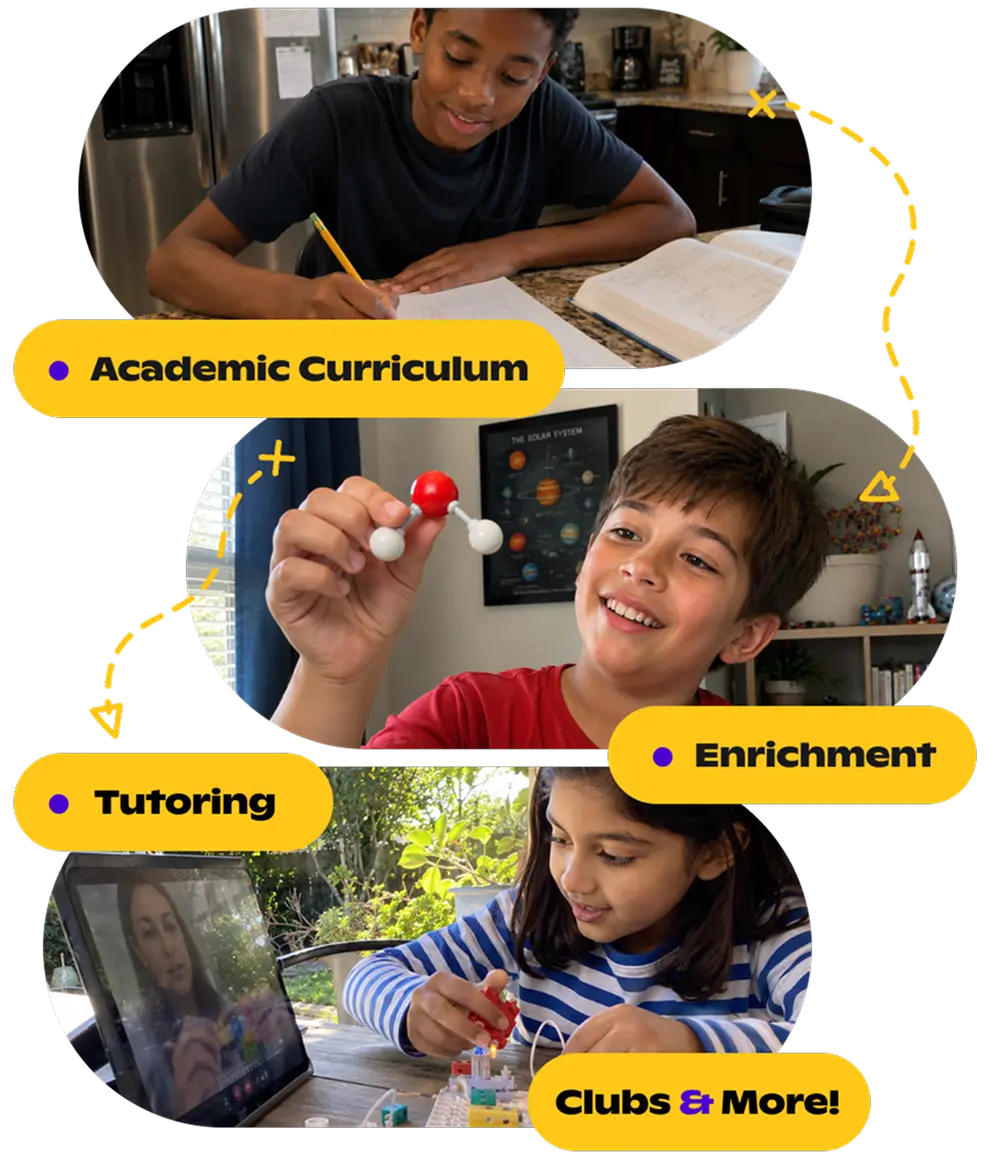
$20 off your first class WITH promo code: blog
Build the Education your Kid Deserves
Discover thousands of live classes taught by expert teachers, across academics and enrichment.
Browse classesBuilding in online classes
Online classes work best when they're anchored to your schedule as fixed commitments rather than optional add-ons. If you treat them like appointments, they hold. If you treat them as flexible, they're the first thing to get dropped when the week gets hard.
Practical tips for integrating online classes:
- Book classes at your kid's best learning time. A class at 3pm when your kid is done for the day is a setup for a bad experience.
- Leave 15 to 20 minutes before and after for transitions. Rushing in and out of Outschool classes kills the benefit of live instruction.
- Use class days to lighten your teaching load. If your kid has a writing class on Tuesday, that's your window to not have to do a full writing lesson yourself.
- Mix live group classes with 1-on-1 tutoring. Group classes build social connection and expose kids to peers. 1-on-1 tutoring on Outschool gives targeted support for subjects where your kid needs more individualized help.
Browse online homeschool classes on Outschool to find options that fit your fall schedule.
Multi-kid household scheduling
If you're homeschooling more than one child, the schedule becomes more complicated — but also more manageable than most people expect once you get past week two.
A few approaches that work:
- Independent work time for older kids. While you work directly with a younger child, older kids work independently on subjects they can do without you. Math drills, independent reading, and writing practice are all good candidates.
- Shared subjects. History, science, and read-alouds can often be done together across age ranges. A 3rd and 5th grader can listen to the same historical novel, then do separate follow-up work at their own levels.
- Staggered school days. Some families start younger kids first (they often need more direct attention but fewer hours), then switch to older kids while younger ones have free time.
Adjusting the schedule as you go
Build in a schedule review every 4 to 6 weeks in the fall. Ask:
- Which subjects are consistently getting skipped or rushed?
- Where does the day tend to fall apart, and why?
- What's working better than expected?
- Does the current structure match where each kid actually is, or where you thought they'd be in August?
A schedule that starts strong in September and gets quietly modified by November to better fit your real life is a success. That's not inconsistency — that's a schedule doing its job.
For more on how much time to plan across subjects and grade levels, check out our homeschool hours by grade guide. And if you're building out your fall curriculum at the same time, our 3rd grade, 4th grade, and 5th grade curriculum guides have what you need to fill in the subjects.


.svg)
.svg)