Your kid can talk for hours about history, fill notebooks with stories, and remember every detail of a book they read once. But ask them to count back change, read an analog clock, or remember what 7 × 8 is — and everything falls apart.
If this sounds familiar, your child may have dyscalculia. And you're not alone in trying to figure out what to do next.
What is dyscalculia?
Dyscalculia is a learning difference that affects how the brain processes numbers and mathematical concepts. It's not a reflection of intelligence or effort. Kids with dyscalculia often struggle with number sense, recalling math facts, understanding place value, and spatial reasoning in ways that more practice and harder worksheets can't fix.
It's estimated that dyscalculia affects between 3% and 7% of kids — roughly as common as dyslexia, though far less recognized. Many kids go years without identification because they've found workarounds, because adults chalk it up to "not being a math person," or because their strengths in other areas mask the difficulty.
Homeschooling a child with dyscalculia isn't just possible — for many families, it's the best educational decision they make. Without the pressure of keeping pace with a class, you can go slowly, use different tools, and build a math experience that works with your child's brain rather than against it.
Signs your child might have dyscalculia
Dyscalculia looks different at different ages, but some patterns show up consistently:
- Difficulty connecting numerals to quantities (the symbol "5" doesn't automatically feel like five things)
- Trouble retaining math facts even after lots of practice
- Struggles with telling time, counting money, or understanding sequences
- Difficulty estimating or comparing ("which pile has more?")
- Confusion with directional concepts like left/right or above/below
- Still counting on fingers well past the age peers have stopped
- Strong anxiety or avoidance specifically around math tasks
It's also worth knowing that dyscalculia frequently overlaps with other learning differences. Kids with ADHD, dyslexia, or dysgraphia are more likely to also have dyscalculia — so if your child already has one of those diagnoses, it's worth looking at the math picture carefully too. If you're homeschooling a child with ADHD or supporting a child with dyslexia, specific math observation is a reasonable next step.
Getting an evaluation
If you suspect dyscalculia, a formal evaluation can provide clarity, documentation, and direction. A few starting points:
- Neuropsychologists can evaluate for learning differences including dyscalculia; ask your pediatrician for a referral
- The International Dyslexia Association (dyslexiaida.org) has resources specifically on dyscalculia screening
- Understood.org offers detailed guides on the evaluation process and what to expect
- Your state's Department of Education may offer assessments through the public school system even if you homeschool
A diagnosis isn't required to start supporting your child effectively. But it can open doors to accommodations and resources — especially if your child plans to take standardized tests or attend school in the future.
Teaching strategies that work at home
The most effective approaches for dyscalculia share a common thread: they slow down, make abstract numbers physical, and remove the pressure to perform quickly. Speed is one of the biggest barriers for kids with dyscalculia — timed drills do more harm than good.
Use manipulatives consistently — not just at the start
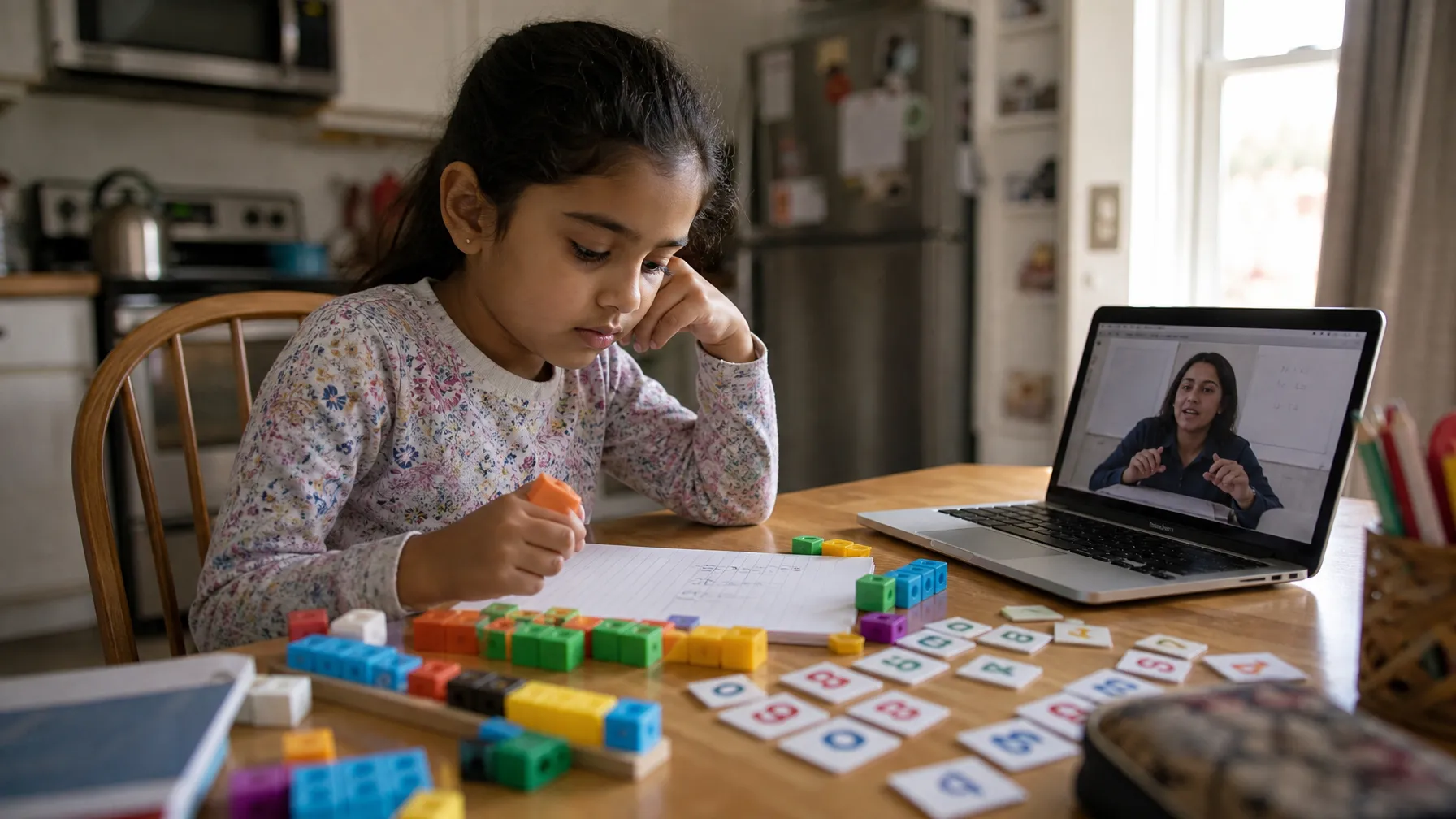
Counting blocks, base-ten rods, fraction tiles, and even everyday objects give kids something real to hold while working through number concepts. The goal is to build a physical, sensory memory of what quantities feel like before the brain is asked to work with abstract symbols. Many kids with dyscalculia need manipulatives longer than neurotypical peers, and that's okay.
Anchor math to stories and context
"What's 14 minus 6?" is much harder for many dyscalculic kids than "You had 14 grapes and ate 6 — how many are left?" Framing problems in narrative form activates different cognitive pathways and gives numbers somewhere to live. The more familiar the context, the better.
Separate understanding from memorization
Kids with dyscalculia can often understand a concept thoroughly while still being unable to retrieve number facts quickly. Keep those two tracks separate in your teaching. Don't let slow fact recall become evidence that your child doesn't understand — they probably do. The goal is comprehension first, fluency later.
Use spaced repetition, not massed practice
Instead of 30 math problems in one sitting, short and frequent revisits to the same concept over days and weeks will build retention far more effectively. Ten focused minutes daily beats an hour once a week every time.
Move slowly through the progression
Resist the urge to push forward when something "mostly" clicks. With dyscalculia, partial mastery tends to collapse under new material. Solid foundations pay off enormously over time — and going back to fill gaps is always harder than filling them the first time around.
$20 off your first class WITH promo code: blog
Build the Education your Kid Deserves
Discover thousands of live classes taught by expert teachers, across academics and enrichment.
Browse classesWhat to look for in online math support
One-on-one or small-group online support can be a genuine turning point for kids with dyscalculia — especially when it comes from a teacher who understands how dyscalculia actually works, not just one who’s good at math.
When evaluating any online class or tutoring option, look for:
- Explicit instruction — the teacher explains the concept directly rather than assuming discovery will happen
- Patience with pace — no rushing through material, no penalty for slow retrieval
- Multisensory approach — using visual models, verbal explanations, and hands-on elements even in a virtual setting
- Small class sizes — ideally 1-to-1 or groups of 3 or fewer, where your child gets real attention
- A teacher with experience in learning differences — ideally someone with specific training in dyscalculia or math intervention
A teacher’s profile matters more than the class listing. A tutor who has built their practice around dyscalculia support will teach very differently from one who just knows math well. Outschool’s dyscalculia classes include teachers who specialize in exactly this kind of support.
Finding a dyscalculia specialist on Outschool
Outschool has teachers with specific training in dyscalculia — and that training matters. One to know is Brigid Pérez, a specialist in learning differences who works with students with both dyslexia and dyscalculia. Her background in structured, multisensory teaching — developed through her dyslexia work — translates well to number sense intervention, where the same principles of explicit instruction and reduced cognitive load matter just as much.
You can find Brigid and other dyscalculia-specialist teachers through Outschool’s dyscalculia classes page. Filtering by “1-on-1” classes will show you private tutoring options if that’s a better fit for your child right now.
What progress actually looks like
Progress with dyscalculia is rarely linear, and it rarely looks like test scores. What you’re actually watching for:
- Reduced math anxiety — your child approaches problems with less dread
- Greater fluency with manipulatives before moving to abstract notation
- The ability to explain their reasoning, even if slowly
- Fewer shutdowns or shutdowns that recover faster
- Small skills that consolidate and hold over time
The goal isn’t to make your child love math. It’s to remove the shame and panic that have built up around it, and give them reliable tools they can use — at their own pace, in their own way.
If you’re building a broader curriculum for neurodiverse learners, dyscalculia support fits naturally alongside language arts interventions and executive function strategies. One piece at a time is enough.
Try a class — no commitment required. Browse dyscalculia classes on Outschool →


.svg)
.svg)