Parents looking for a high-quality homeschool curriculum usually have Waldorf on their list of curricula to explore. Its focus on integrating subject areas studied and the role of imagination and creativity in learning makes it a popular choice.
Rudolf Steiner, an Austrian philosopher and educator, first developed this curriculum in 1919 for the children of employees at the Waldorf-Astoria factory in Stuttgart, Germany. His belief in a spiritual philosophy he called anthroposophy guided his work in education. Based on his belief that humans can access reality’s spiritual realm, he felt education needed to nurture three parts of a student: body, soul, and spirit. This belief was the foundation of his “head, heart, hands” approach to education.
Below, we’ll explain the four key principles of the Waldorf approach, how it’s used in homeschooling, and the subjects that are usually part of this curriculum. We’ll also share a step-by-step guide for implementing a Waldorf homeschooling curriculum in your own home, the different types available today, and some answers to frequently asked questions.
Overview of the Waldorf Method
Waldorf education looks quite a bit different from traditional schooling. While traditional approaches emphasize academic achievement measured through standardized testing, Waldorf focuses on the development of the whole person.
Traditional schooling approaches often divide learning into separate subjects, like language arts, science, and math, but the Waldorf curriculum integrates them around individual topics and allows the arts to take on a central role. Other, more traditional forms of education often introduce technology early, while Waldorf delays its use in favor of natural materials designed to spark a child’s imagination.
Four core principles
Four core principles make up the foundation of the Waldorf approach.
1. Developmental readiness
The Waldorf curriculum is tailored to a child’s developmental readiness. A student doesn’t move on to algebra because of their age or the date on the calendar. They are introduced to new concepts whenever they are ready for them. Waldorf revolves around three main developmental stages: early childhood, elementary, and secondary.
2. Arts and creativity
A unique characteristic of the Waldorf curriculum is its intense focus on the arts. But art, music, and drama aren’t key features for their own sake. Instead, they are tools for both academic and personal development. Steiner believed that an emphasis on creativity helps students develop critical thinking and problem-solving skills.
3. Multi-disciplinary approach
Instead of learning language arts separately from history and science separately from math, the Waldorf approach integrates disciplines. It uses a block system where children study a single subject for three to four weeks, with the block usually occurring in the morning when they are most alert. For example, a child might spend a month learning about geology, followed by a month on ratios and fractions. Within each unit, other subject areas are connected, especially the arts.
This block generally follows a three-day sequence that aligns with the Waldorf emphasis on head, heart, and hands. On the first day, new material is introduced through storytelling or demonstration. Rather than taking notes right away, the child’s goal is to absorb the information. On the second day, they revisit material from the previous day and engage with it creatively through painting, modeling, or drama. Then, on the third day, the child summarizes the concepts learned and records them in their lesson book log, which becomes a personal record and their handmade “textbook.”
4. Social and emotional learning
The Waldorf curriculum also focuses on helping students develop skills for social interaction and emotional regulation. With a preference for practical living activities over textbooks, the Waldorf method fosters the development of interpersonal skills by encouraging collaboration over competition.
The Waldorf method and homeschooling
The Waldorf curriculum and homeschooling are often natural partners because of their shared goals and areas of focus. One reason many parents choose homeschooling is the desire for their children to make choices for themselves rather than be driven by a rigid schedule, restrictive testing, or social pressures. This aligns well with the Waldorf goal of helping children become self-determining. In fact, Rudolf Steiner wrote, “Our highest endeavor must be to develop free human beings who are able of themselves to impart purpose and direction to their lives” (Carlgren 7).
Another area of harmony deals with the way the teacher structures learning activities. Homeschooling often makes use of unit studies, which are part of a thematic approach to education where students learn about one topic through multiple subjects at the same time. Many parents like this approach because it mirrors how information exists in the real world, not in isolated subjects like in a traditional school setting. Waldorf’s block system provides a similar approach.
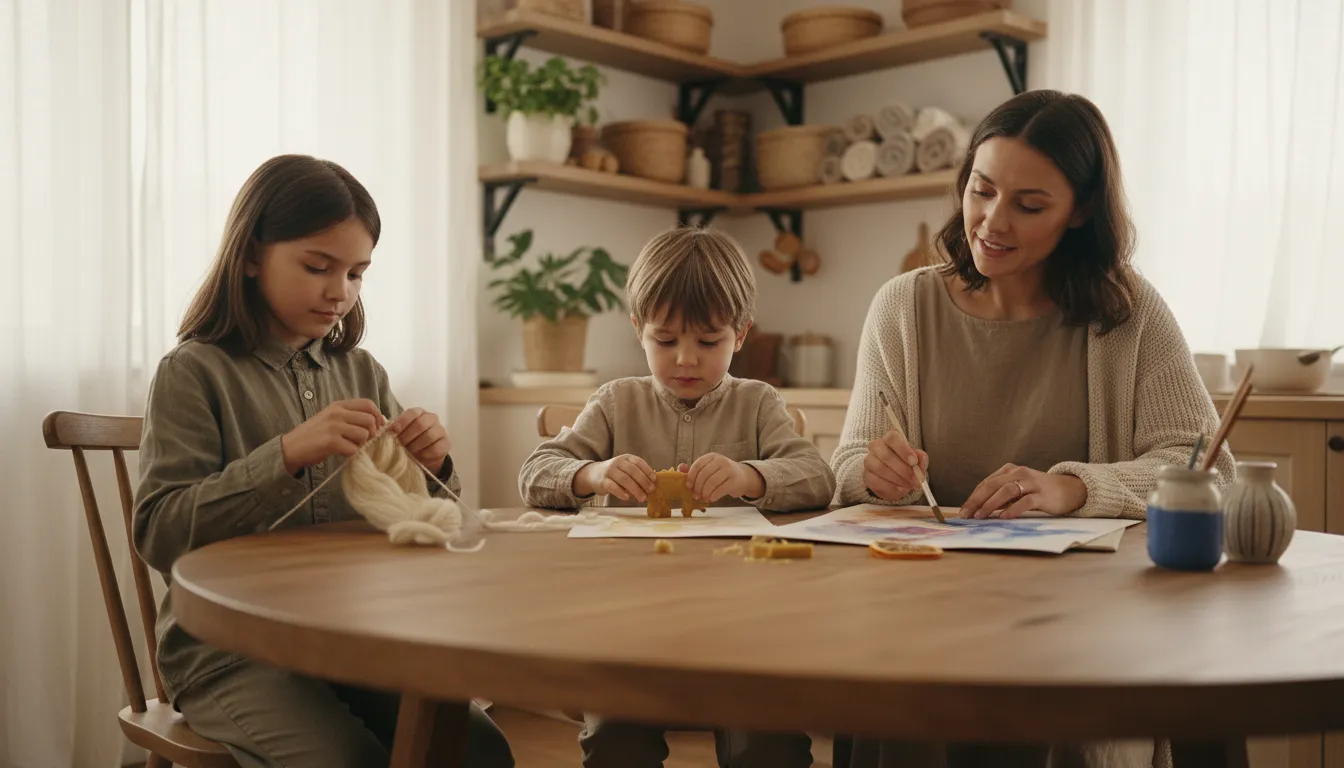
A key feature of the Waldorf approach in schools is that teachers often stay with the same students for years. In homeschooling, parents already provide the built-in long-term relationship that’s so valued. Also, Waldorf emphasizes“practical arts, like woodworking or knitting, which make a home setting work particularly well. And Waldorf’s preference for postponing the use of digital technology helps many parents who are interested in minimizing screen time.
Subjects Covered in Waldorf Homeschool Curricula
The Waldorf curriculum integrates disciplines by focusing on individual topics. For example, a study of the Roman Empire might include history, geography, physics, chemistry, botany, and literature, all woven together through creative arts. The curriculum targets students’ developmental readiness through three main levels.
Early childhood
The preschool and kindergarten years focus on sensory experiences and imitation of trusted adults. Instead of formal academic lessons on traditional subjects like phonics or math, the curriculum is drawn from daily life in four main areas.
- Core activities: Stories, songs, rhythms, and puppetry help children learn language and develop listening skills (Oppenheimer 17)
- Artistic expression: Teachers encourage creativity through watercolor painting, finger-knitting, drawing, role-playing, and modeling (112).
- Practical arts: Students develop fine motor skills through gardening, housecleaning, cooking, and baking.
- Creative play: Adults emphasize the importance of imaginative play, especially outdoors, using natural materials like stones, leaves, and wood (45-48).
Middle or lower school
During the time students are traditionally in grades one through eight, the focus shifts from sensory experiences to imagination and feelings. Teachers use “main lesson blocks” to create integrated instructional plans that allow students to immerse themselves in one topic for three to six weeks.
Waldorf divides the curriculum into several traditional subject areas.
- Language arts: Stories and art are used to introduce letters and vocabulary in the early grades. Literary forms are introduced and build on each other. For instance, the youngest students will read fairy tales, then move to fables, then Old Testament stories, mythology, and eventually classic literature (Clouder and Rawson 74-76)
- Math: Movement and concrete manipulatives are used to teach basic operations. From these early beginnings, students move into times tables and fractions, decimals and math for business, and then algebra and geometry.
- Science: A focus on nature starts early. More formal science usually covers the study of humans and animals, then botany, followed by geology, physics, chemistry, and physiology.
- Social studies: Young children begin with local history and geography before moving to the study of ancient civilizations and then the Middle Ages and the Renaissance (98).
High school
During the typical high school years, the instructional focus shifts to an emphasis on “phenomenology,” which refers to observing the world as it is.
For instance, instead of starting with a textbook definition or formula, students begin with a direct, sensory experience of a phenomenon (Staley 24). Lessons follow the Waldorf three-part structure, where Day 1 centers on an experiment. The teacher asks students simply to observe what happens without drawing conclusions. Then on Day 2, students recall the experiment and look for patterns. On Day 3, the teacher guides the students as they identify the underlying scientific laws or principles that explain what they observed. Waldorf teachers feel that this approach develops intellectual rigor.
A few key subject areas help to organize the instruction.
- Humanities: Students read world literature and learn about history through the lens of revolution and individual biography (88).
- Science, technology, engineering, and math (STEM): The academic focus moves to mechanics, optics, organic chemistry, and advanced calculus (142-144).
- Practical arts: With its continual focus on “real life,” the Waldorf curriculum includes specialized workshops in various trade skills, like blacksmithing, bookbinding, and stone carving (118).
How the Waldorf Method Can Work at Home
Don’t let terms like anthroposophy and phenomenology make you question your ability to implement a Waldorf curriculum at home! The philosophy behind the Waldorf approach might seem a bit intimidating at first glance, but the nuts and bolts of the curriculum revolve around the very same priorities that many parents have when they choose homeschooling in the first place.
One of these “nuts” is the emphasis on the child’s freedom through a sense of rhythm. The Waldorf approach describes it as inhaling and exhaling, so the teacher structures lessons to provide a balance between two types of activities. Inhaling refers to activities that require an internal focus, like listening to a story or painting. Exhaling refers to activities that are outward and active, like doing chores, gardening, or engaging in free play. This sense of rhythm is something homeschool parents actively seek (Baldwin 34).
Another central “nut” in using Waldorf at home is the focus on practical living. Again, this integration of academic learning with real-life experiences is another reason parents often opt for homeschooling. In early childhood, practical learning involves domestic tasks, like baking bread or folding laundry. During the middle school years, the main lesson allows children to spend three to four weeks on one topic and create their own main lesson book. This becomes a more practical resource for learning rather than the use of commercial textbooks or computer programs. And during the high school years, practical learning happens through labs at home and mentorship opportunities in the community. These experiences prepare students for the real world (Petrash 112).
A third “bolt” in using Waldorf at home is its focus on integration. Homeschool parents often want to avoid the way traditional schools divide learning into separate boxes. But students of all ages using the Waldorf curriculum experience deep learning by combining subject area content around a single topic (Mitchell 12). Also, many parents choose homeschooling to provide more opportunities for their children to experience the fine arts. Waldorf’s use of creative expression to integrate curriculum clearly meets this need (Petrash 85). So even if some of the philosophy behind Waldorf may be unfamiliar, its core tenets make a lot of sense.
How to Build the Best Waldorf Homeschool Curriculum for Your Child
Implementing the Waldorf curriculum at home doesn’t have to be a daunting task. By following these straightforward steps, you’ll be inhaling and exhaling with confidence in no time.
Step 1: Understand the developmental stages
Although Waldorf references grades, it doesn’t organize its curriculum around them. Instead, Waldorf presents new material to students when they are developmentally ready to master it, regardless of their age. The early childhood stage focuses on daily life as the core curriculum. The middle school years center on beauty and imagination through art and story. And the high school years focus on objective truth. Understanding a child’s needs at these stages is the most important first step (Clouder and Rawson 12-15).
Step 2: Create your rhythm
Instead of following a rigid daily schedule, plan learning activities to create an inhale/exhale balance. Prepare your main lesson or work time for the morning when children are fresh (inhale), and then schedule outdoor time, free play, or chores in the afternoon (exhale).
Consider a weekly rhythm where children can expect a certain experience, like painting on Mondays and baking on Tuesdays. This kind of repeatable structure creates a sense of security for kids (Baldwin 154-158).
Step 3: Plan main lesson blocks
Since the Waldorf curriculum immerses students in one topic at a time, you’ll want to do some careful planning for what your “main lessons” will be. You’ll need to make sure it’s developmentally appropriate and that you have a “story” or “biography” to use as an anchor for learning activities. You’ll also want to gather high-quality materials, like books, clay, paints, etc., related to the topic, and create a balance between times of internal focus and external expression.
For instance, children around age eight or nine might study “human shelters” in-depth for a month. In the first week, you might focus on why humans build shelters and tell stories of nomads who built temporary tents, and those who created permanent stone dwellings. During the second week, you might drill down to the various kinds of building materials, like wood, stone, straw, and clay, and allow students time for hands-on exploration. The third week could focus on the various trades needed in creating shelters, like architecture, masonry, carpentry, and roofing. Then, during the last week, you might shift the focus to finished shelters and study what makes a house a home. During the month, students could build a model house, tour a museum exhibit on human shelter through history, and visit a modern construction site (Petrash 102-105).
Step 4: Fill in the structure of the Main Lesson Block (MLB)
Once you know the topic that will guide all the learning activities during the month, you need to plan instruction and work time.
As an example, in the unit on shelter during the weeklong focus on trade skills, you’ll want to use a three-day approach. On Day 1, you can tell a story about how the job of a mason differs from that of a carpenter. On Day 2, you’d ask the child to recall the difference and engage with this new understanding in some creative fashion, perhaps through an illustration using beeswax crayons. On Day 3, the child might identify some famous architectural marvels and point out innovations in masonry and carpentry for each. By the end of the month-long unit, the child will have created high-quality materials for their handmade textbook that show deep learning (Petrash 112).
Step 5: Integrate the arts
Every Waldorf lesson involves head, heart, and hands. The head portion refers to the facts or intellectual content, and the hands part provides an opportunity for a practical activity, like building a model or cooking a meal. In the Waldorf approach, the heart portion is every bit as important as the other two. It involves weaving artistic elements into academic materials. Through singing a song, reciting a poem, painting, or enacting a scene, the child engages with the same kind of cognitive processes that also support critical thinking and problem-solving (Petrash 43-47).
Step 6: Continuously assess the learning environment
A Waldorf curriculum emphasizes the use of natural materials, like wooden blocks, stones, or fabrics. Periodically review the learning spaces to ensure that they haven’t become cluttered and that live elements, like plants, don’t need water or light.
Consider having a nature table in the space where children can place items found on nature walks. Regularly make sure that the items on this table reflect the current season (Oppenheimer 62-67).
Popular Waldorf Homeschool Curricula
Of course, many parents seeking to implement Waldorf at home don’t want to start from scratch. Fortunately, there are several high-quality resources available that can make implementing this kind of homeschool curriculum a relatively simple task.
Outschool’s online Waldorf curricula and classes
A popular one-stop shop for a wide variety of materials is Outschool, which provides live online classes, self-paced courses, and one-on-one tutoring.
Outschool has an entire catalog of Waldorf materials designed specifically for homeschool environments. All materials are created by Waldorf professionals with an intimate understanding of its philosophy and its application.
For example, one math course immerses students in the four basic mathematical operations by relating them to fictional gnomes with distinct personalities. Another provides a “nature club,” which uses songs, stories, and art to learn about the natural world. Yet another teaches social studies and history through drawing, writing, and painting. Parents appreciate the variety of subjects covered and the options for how often classes meet.
Comprehensive curriculum packages
For parents who want an all-in-one resource, full curriculum packages provide a viable option. They are usually organized by grade level and include detailed lesson plans, anthologies of developmentally appropriate fairy tales, legends, and myths, and lists of high-quality materials.
Naturally, any A-to-Z resource will be more expensive than its trimmed-down counterparts. However, despite the breadth of these complete packages, Waldorf encourages parents to use their own “flesh and blood” as a core element of the curriculum (Baldwin 275-276)
Teacher training programs
Since the parent is the primary model for a child in the Waldorf approach, some parents opt to invest in their own training. This can take the form of consulting or mentorship in which a veteran Waldorf teacher works with the parent one-on-one.
Bridge classes are another type of training in which experts teach parents key skills, like how to create a seasonal nature table, sing pentatonic songs, and tell captivating stories. Often, these programs also include intensive weekend retreats or workshops, which drill down on specific heart and hands skills, like doll-making or woodworking (Oppenheimer 222-225).
Co-ops and hybrid programs
Some families rely on homeschool cooperatives, which are groups of families that meet one or two days each week to do exhale activities together, like staging a play or gardening. This allows children opportunities for socialization and gives parents an opportunity to plan together.
Additionally, some private Waldorf schools offer homeschool days, where homeschool students can join the classroom for non-academic lessons like artistic movement or choir (Clouder and Rawson 118-121).
Frequently Asked Questions: Waldorf Homeschool Curricula
Fortunately, many parents have successfully implemented Waldorf in their own homes and have learned a lot along the way. Below are some of the most common questions we get, along with their answers.
When’s the best time to start homeschooling with the Waldorf method?
For Waldorf, the best time isn’t a specific age or grade but a developmental window. Since it’s built on three seven-year cycles, the best starting point will depend on which cycle your child needs. Many people believe it’s best to start with babies. Since young children are sensory sponges, Waldorf allows parents to encourage their child’s growing freedom since it focuses on the arts, rhythm, and play rather than early academic subjects (Oppenheimer 17). Others feel that beginning at age seven is the best place to start. By that time, a child can learn academic content easily learned through stories, art, and music (Clowder and Rawson 74).
Still, others argue that starting Waldorf at the high school level is an appropriate entry point because, at age 13 or 14, children move from a “feeling” to a “thinking” orientation. They are now capable of abstract thought and are deeply drawn to the ideals of young adulthood. The Waldorf curriculum’s focus on objective truth and the practical relevance of learning aligns with the primary concerns of teenagers (Staley 24-27, 142).
But the bottom line is that the best time to implement a Waldorf curriculum is when you and your child are ready to commit to the rhythm of their developmental age. Really, you can start at any age if the learning activities you use are appropriate for the child’s readiness.
What’s the difference between the Montessori and Waldorf approaches?
This is a common question since both are whole-child educational approaches that emphasize integrated learning and high-quality, hands-on materials. But there is a difference in their overall goals. Montessori emphasizes the child’s independence and mastery of real-world skills, while Waldorf prioritizes the child’s imagination and emotional life. Imitation is important for early learning in a Waldorf curriculum because the child is a developing being who needs a leader. In contrast, Montessori is based on the idea that a child’s own innate curiosity is what’s most needed for learning (Clouder and Rawson 118).
Montessori introduces reading, writing, and math by age three or four based on developmental readiness. Waldorf delays formal academics until age seven and prioritizes movement, play, and creative arts in the early years (Oppenheimer 17). Another difference involves the role of fantasy. Montessori focuses on practical life early on and prefers real tasks, like slicing fruit or dusting shelves, to pretend play. Waldorf, on the other hand, emphasizes fantasy and imagination through fairy tales and puppetry (Petrash 43).
Another major difference is in the learning environment. Montessori emphasizes a prepared environment, which is organized and logical. For Waldorf, the emphasis is on a home-like environment featuring natural materials designed to convey warmth (132-135).
What’s the Waldorf approach to preschool or early childhood education?
The Waldorf curriculum for the first seven years of life is unique because it doesn’t involve any traditional academic preparation. Instead, it’s a time of physical development and creative play. The young child is thought to be a sponge that absorbs everything in the environment. Therefore, the curriculum becomes daily life plus the character of the adult teacher they imitate. The Waldorf view is that children learn best through imitation, not instruction. That’s why engaging children in purposeful work alongside the adult teacher is so important (Baldwin 42). Also, unlike the Montessori approach, Waldorf delays instruction in reading and writing until around age seven in favor of physical development (Oppenheimer 19).
Another difference is in how time is managed. Unstructured free play is a necessary exhale in the Waldorf approach to balance inhaling activities, like listening to a story (Baldwin 154). And in contrast to Montessori, the Waldorf approach limits the use of screens and electronics (Oppenheimer 19-22).
Finding Your Own Rhythm
The Waldorf curriculum at all three levels of child development shares many of the same priorities as parents who choose homeschooling for their kids. Its focus on integrated learning, creativity, the arts, and social/emotional development makes it a common choice. By understanding Waldorf’s key principles and following the steps we’ve included here, you’ll be well on your way to Waldorf success at home in no time.
Sources
Association of Waldorf Schools of North America. What Is Waldorf Education? AWSNA. www.waldorfeducation.org/what-is-waldorf-education/.
Baldwin, Rahima. You Are Your Child’s First Teacher: Raising Confident, Healthy, Resilient Kids, from Birth to Age Seven. 3rd ed., Celestial Arts, 2012.
Britannica, The Editors of Encyclopedia. “Anthroposophy.” Encyclopedia Britannica, 13 Nov. 2025, www.britannica.com/topic/anthroposophy.
Carlgren, Frans. Education Towards Freedom: Rudolf Steiner Education: A Survey of the Work of Waldorf Schools Throughout the World. Translated by Joan Rudel and Siegfried Rudel, 3rd ed., Floris Books, 2008.
Clouder, Christopher, and Martyn Rawson. Waldorf Education. Floris Books, 1998.
Mitchell, David S., editor. The Wonders of Waldorf Chemistry. AWSNA Publications, 2001.
Oppenheimer, Sharifa. Heaven on Earth: A Handbook for Parents of Young Children. SteinerBooks, 2006.
Petrash, Jack. Understanding Waldorf Education: Teaching from the Inside Out. Nova Institute, 2002.
Staley, Betty. Between Form and Freedom: A Practical Guide to the Teenage Years. 2nd ed., Hawthorn Press, 1988.
Waldorf Families: Education for the Whole Child. AWSNA. www.waldorfeducation.org/waldorf-education/waldorf-families. Accessed 22 Dec. 2025.


.svg)
.svg)