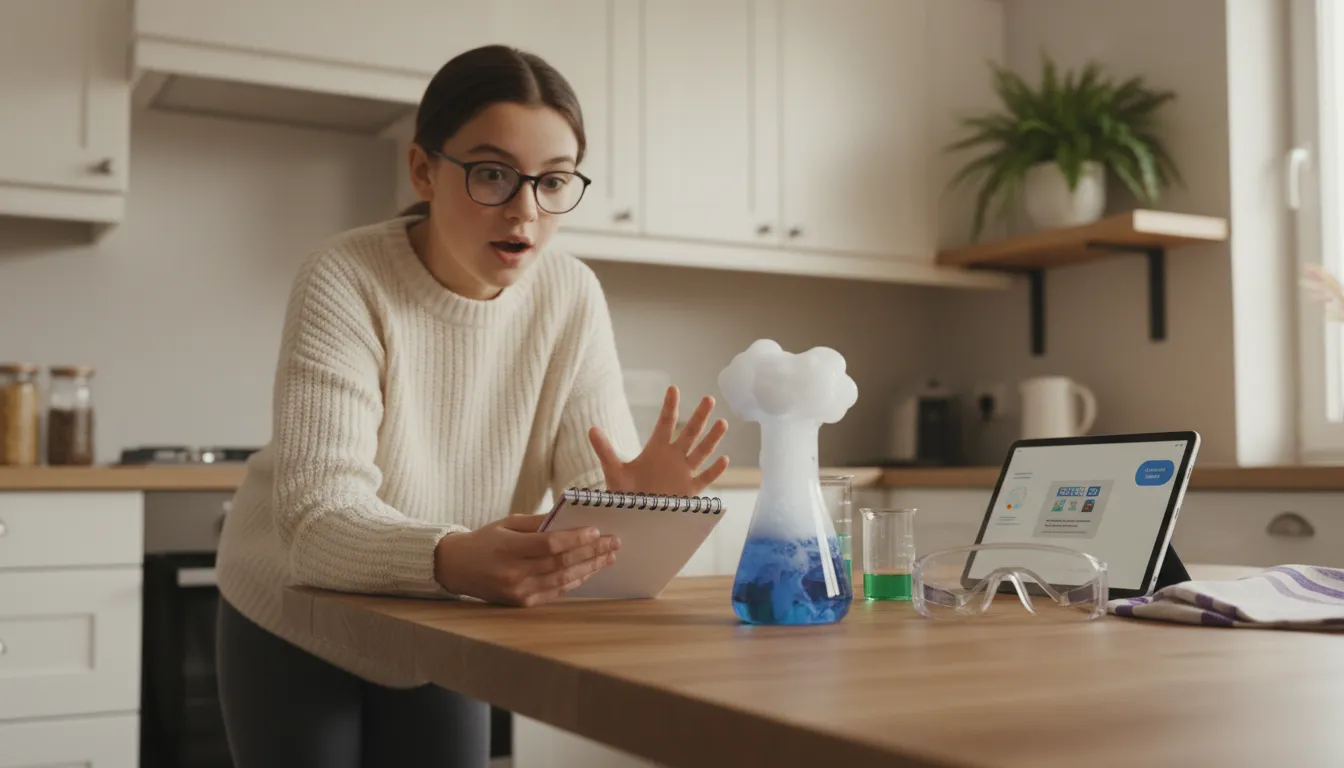
Seventh grade science can be a fun and fascinating subject for kids as they continue to develop cognitively. They go from the “cool facts” of elementary school science into more complex investigations of how living systems work. Homeschooling can be a great way to maximize this transition by turning the kitchen table into a laboratory that the whole family can use together.
Choosing the best 7th grade homeschool science curriculum may seem like a daunting task at first. But you’ll find it to be a straightforward task with the guidance in this article. Below, you’ll learn the difference between 7th grade science in school and at home, the common types of curricula available, and the elements to look for in your search. You’ll also learn how to implement your chosen curriculum at home and get answers to some common questions.
Overview: 7th Grade Homeschool Science
Science at this age can be an ideal blend of maturing intelligence and childlike wonder. Seventh graders are usually old enough to grapple with complex logic and handle tools appropriately, but still young enough to be fascinated by the natural world. Homeschool science capitalizes on both of these things. It’s an ideal time for outdoor exploration and field-based work. A trip to a local creek, nature center, zoo, or even hospital can become an observational lab experience.
Of course, there are challenges, too. 7th grade science can get technical and use lots of specialized vocabulary. But external resources, video-based lessons, and field trips can help to make even the most difficult vocabulary understandable. Mess from labs or projects can also be a factor. When your home becomes the lab, there may be a need for clean-up, but this can be a benefit in disguise as it teaches your child to be responsible for managing the space.
Teaching 7th grade science at home versus in school
Even if the topics covered in 7th grade science are typically the same, the learning experience can feel very different in school and at home in a few different areas:
- Safety: At school, a lot of time is spent on safety in the lab, and rightly so. Where else would we give up to 30 twelve-year-olds open flames, hot glassware, and sulfuric acid? This means that very strict procedures must be followed at school to minimize the chance of an accident. But at home, your child can be a bit freer to explore because you are right there with them, which makes for a more authentic experience.
- Discovery vs. demonstration: Many labs in school are really demonstrations where the teacher does the experiment, and the students observe to save time and minimize safety issues. But at home, kids have time for real discovery. There’s no bell that prompts kids to bolt from the room without completing the task at hand. Kids can spend weeks growing mold cultures at home, which more closely models actual science.
- Pacing: In a school setting, once the unit on DNA is over, it’s on to genetics. But at home, if your child has trouble understanding mitosis and meiosis, you can work together on it until it sticks. Homeschooling enables a mastery learning approach, which can reduce a child’s anxiety and promote retention. Similarly, if DNA is a piece of cake for your child, you can dive into genetics without waiting for anyone else to catch up.
- Integration: Science at school is often taught in isolation, but at home, it can be integrated with other subjects. For instance, a child learning about the Black Plague in history can study bacteria in science and the probability of inheriting a genetic resistance to the disease in math, all at the same time (Ray).
Main Topics Covered in 7th Grade Homeschool Science
Typically, the 7th grade focus is life science, but of course, homeschooling allows for a great deal of flexibility. Families often choose between three main paths depending on their child’s main interests.
Life science
This is the study of the “systems of life” and usually covers cell biology, including photosynthesis and cellular respiration. Genetics and heredity are often covered with an introduction to DNA, genes, and Punnet Squares. From there, human anatomy and its various systems are covered before moving to ecology, including food webs, energy pyramids, and the dynamics of ecosystems. The classification of kingdoms, phyla, and species is also a common topic. Nature lovers usually thrive when studying life sciences.
Earth and space science
Some families choose to cover Earth science in 7th grade, especially if biology is the plan for 9th grade. The topics usually covered here are plate tectonics, weather patterns, and the water cycle. Meteorology, the solar system, and the life cycle of stars is another area of study, along with geology, including the rock cycle and minerals.
Physical science
The focus of this discipline is on how things work and usually appeals to kids who love chemistry and physics. It typically includes chemistry basics, like the Periodic Table, atoms and molecules, and physical and chemical changes. Newton’s Laws of Motion and simple machines introduce kids to physics, and kinetic and potential energy, properties of sound and light waves, and basic magnetism and electricity are common topics.
The scientific method
This topic area isn’t an area of focus on its own like the other three. Instead, it’s part of all of them. Regardless of the topical focus, 7th graders may move from learning about scientific facts to working as scientists. In doing so, kids usually learn about identifying independent and dependent variables, how to create and interpret complex graphs, and how to write “claim, evidence, reasoning” (CER) reports explaining lab results.
Integrated science
Not sure how to choose between life science, earth and space science, or physical science? You don’t have to! Some families choose to weave parts of all three together into one integrated science class (NGSS Lead States).
Common Types of Homeschool Science Curricula for 7th Graders
Aside from the “what” of 7th grade science curricula covered above, it’s important to consider the “how” and “why.” There’s a great deal of variety in curricula based on educational philosophy.
Standard
This approach is the closest to replicating science in school and is designed to meet state or national benchmarks. The ultimate goal is college and career readiness through a focus on life science. It prioritizes scientific terms, standardized tests, and traditional lab reports (Rosenshine 12).
Classical
This approach seeks to train a child’s mind to think critically through a content-rich study of the liberal arts. At this age, kids may be naturally inquisitive and argumentative, and the classical model leans into this by teaching science as a series of logical connections. With a heavy focus on the history of science, its main goal is to teach kids to debate scientific arguments (Sayers 12-14).
Literature-based
Literature in science class? Yes, that’s a real possibility. Also called the “Charlotte Mason Philosophy,” this approach emphasizes reading and writing so that kids understand “living ideas,” not just memorize facts. Nature is the primary teacher here, and kids learn science by reading high-quality literature and observing nature directly. The ultimate goal is to help the child develop a lifelong relationship with and a sense of wonder about the natural world (Duffy 15).
Inquiry-based
All science is based on inquiry, but this approach takes it a step further. It’s built around treating the child as a mini-researcher from the very beginning. It’s based on the belief that knowledge is a result of asking questions and performing experiments. Ultimately, it seeks to produce critical thinkers who search for evidence for every claim. Lessons and labs begin with a problem that the student needs to figure out through discovery (National Research Council, Inquiry 13).
Online or video-based
Online science curricula deliver instruction through recorded or live video lessons, often paired with virtual labs, simulations, readings, and assessments. Depending on the program, this format can follow a standard, classical, literature-based, or inquiry-driven approach rather than representing a philosophy of its own. It can be a strong option for families who want structured explanations, visual demonstrations, or access to lab experiences that may be difficult to replicate at home.
Elements to Look for in a 7th Grade Homeschool Science Curriculum
Life science or physical science? Or maybe an integrated approach? Classical or Living Books? Or maybe an inquiry-based model? If it seems like there are lots of choices to make when it comes to 7th grade homeschool science curricula, you’re right. But don’t let that intimidate you. By evaluating how the elements below show up in the different available options, you’ll have your own lightbulb moment, one that will make the path ahead much clearer.
Disciplinary focus
Look for curricula that cover the specific scientific discipline you want your child to study. All of them should include the scientific method, but consider whether you want a discipline-based focus on content or if you want it to be more integrated. Life science is the most common choice of discipline for 7th grade, but if your child has interests in earth or physical science, you may want a curriculum centered around those topics.
The Claim, Evidence, and Reasoning (CER) framework
By this age, kids are likely ready to question, investigate, and reason like real scientists. Therefore, high-quality curricula teach them how to make a scientific claim, provide appropriate evidence, and explain with reasoning. Known as the CER framework, this methodology helps kids think critically by connecting their lab results back to the physical or biological laws they are studying.
Data analysis
In elementary school, a lot of science was qualitative (e.g., “the solution turned brown”). But in the 7th grade, the data can be more quantitative. Consider incorporating labs that ask for measurements in metric units and require calculations of rates or averages. It can be helpful if it also teaches how to interpret data presented visually, like line graphs and scatter plots (National Research Council, A Framework 71).
Lab support
Even if you don’t have a degree in English, you can easily troubleshoot when your child reads a book that just doesn’t work when studying language arts. But with science, knowing what to do when a lab “ails may be a bit trickier. It can be helpful to use materials that provide guidance on how to manage labs successfully and what to do when they don’t go as planned.
How to Plan a 7th Grade Homeschool Science Curriculum
Think you know what 7th grade homeschool curriculum is right for you? Below, we explain how to plan for 7th grade science in your home and the different types of delivery methods available to help you.
Step 1: Choose a disciplinary approach
As discussed above, you’ll want to start by deciding whether you want a disciplinary focus, like life science, or if you prefer an integrated approach that draws from multiple scientific disciplines.
Step 2: Map out your scope and sequence
There are lots of ways to organize the content. One common approach is to break the year into four eight-week units. For example, if you choose life science, you might plan these units: 1) The Micro World, 2) Genetics and Heredity, 3) The Human Body, and 4) The Living World (Bruner 33).
Step 3: Choose your major labs
Kids at this age learn by doing, but planning a lab every day could quickly lead to burnout for you and your child. Consider planning one high-impact lab experiment every two weeks. That way, each unit will feature four labs related to that subject matter. Then set up a schedule to order needed lab supplies well in advance of each one so that you don’t lose time by noticing that you’re short on hydrogen peroxide right before you need to use it (Sweller 295)
Step 4: Plan a weekly rhythm
The beauty of homeschooling is the flexibility it provides, not just with the content but also with scheduling. Aim for a plan that creates a weekly rhythm that you and your child can count on but also allows you to make adjustments when needed. In the next section, we’ll look at several curriculum possibilities (Zimmerman 66).
Step 5: Decide on assessment
The work of science can be evaluated in lots of different ways: tests, quizzes, labs, lab reports, projects, and so on. Decide which ones you plan to use and how. For instance, do you want to emphasize the process of completing the experiment more than the report written at the end, or vice versa? Or do you want to give them equal weight (Black and Wiliam 142)?
Example Routines for 7th Grade Homeschool Science
As noted in step 4 above, a weekly routine can help provide a sense of stability. But there are lots of different ways to do this. Check out these possibilities or come up with your own!
Standard routine
A typical weekly plan might start on Monday when your child is introduced to a concept by reading from a text, watching a video, or participating in an online class. On Tuesday, you could then discuss the material from the previous day and work with the vocabulary terms. Then Wednesday could be lab day. On Thursday, your child can analyze the lab and write the CER report. Friday then could be a great day for a field trip for nature study or a fun “science current events” activity at home (Bybee 2).
Investigation-based
Instead of beginning the week by giving new information on a new topic, you could start with some observable event that your child doesn’t yet have an explanation for. On Monday, they can watch a live or video-based demo of some phenomenon and be asked to speculate about how it works. Then on Tuesday, they can start to “follow the breadcrumbs” by researching one piece of the puzzle at a time. On Wednesday, they can build or draw a model of how they think it works. Then on Thursday, you can reveal the scientific laws that explain the mystery. Friday can be used to find other real-world examples of that same law (Penuel and Sumner 330).
Project-based
This kind of routine begins with a mission that the child spends the week attempting to complete. For instance, on Monday, you might ask them to design a sustainable garden for a specific kind of environment. On Tuesday, they might dive into research about what plants need to survive there. On Wednesday, they can move from research to design by coming up with a plan to cycle water in the target environment. On Thursday, they could build a prototype of the proposed setup, and then on Friday, they could present their proposal to the family (Cunningham and Carlsen 6).
Subject-a-day
If you choose a “Living Books” curriculum, then you might want science to be a constant presence but not take up a lot of time each day. Instead, you can rotate the type of science your child experiences each day.
For example, on Monday, your child might have a regular lesson about the circulatory system. Then on Tuesday, they may read a biography of a famous scientist who made discoveries about the heart. On Wednesday, you could have a lab experiment on heart rate and homeostasis, and then on Thursday, you could switch to a non-living science topic, perhaps related to a book they are reading for English. On Friday, you could have your child outdoors observing nature and recording observations in a nature journal (Fang 337).
Popular Homeschool Science Curricula for 7th Graders
The best 7th grade homeschool science curriculum for your child will probably be the one that provides a balance between their needs and interests, your philosophy of education, and the delivery method that works best for both of you. Consider these popular options.
Outschool’s online curricula and classes
Parents love the wide variety of Outschool’s online classes and curricula. Outschool offers entire year-long courses as well as shorter, targeted classes on specific topics, both live and on-demand. Parents who don’t feel comfortable explaining scientific concepts find Outschool to be a lifesaver, and kids love the engaging lessons and real-life applications.
Traditional textbook
This type of curriculum mirrors standard classroom learning. The major activities include reading a chapter, answering review questions in the text, and doing scheduled labs. This approach ensures that you hit all the state standards if everything is covered, but it can feel dry for students who prefer more creative exploration. You can also purchase all-in-one boxed sets that include the text along with all the materials for labs and other activities, but these comprehensive products can be expensive and don’t necessarily target an individual child’s areas of interest (Schmidt et al. 184).
“Living Books”
As noted, this curriculum uses narrative books instead of textbooks and focuses on high-level scientific literacy and vocabulary. It requires more preparation for the parent to ensure the hard science doesn’t get overlooked in favor of the reading.
Self-paced online
This curriculum uses pre-recorded videos or an interactive digital platform. The parent has less preparation and acts more as a lab assistant. It can be good for independent learners, but it can also lead to more of a passive experience (Moore 22).
Unit studies
Instead of a year-long course, this approach focuses on project-based units of study on any number of topics: marine biology, forensic science, robotics, and more. It can be very engaging for a kid who has specific interests, but units can make it difficult to keep track of alignment with state standards (Vars 8).
Inquiry-based
This kind of curriculum lets the experience drive the learning rather than using labs to supplement textbook material. You start with some phenomenon and work backward to identify the science behind it.
For instance, you might put two identical potato slices in two different beakers, one filled with fresh water and the other with salt water. The next day, ask your child to observe how it appears different from how it did yesterday. They will probably notice that the first one appears “crispy” while the second is limp and shrunken. Ask them to hypothesize why that might be. Then lead them to a definition of osmosis (Kolb 51).
Frequently Asked Questions: 7th Grade Homeschool Science
Still not sure what’s best for you and your child? We’ve got answers to some of the most common questions that will help.
How hands-on should a 7th grade science curriculum be?
Research suggests a 60/40 split between hands-on activities and other learning, with hands-on taking the lead.
Examples of hands-on work are performing an experiment, collecting data, observing phenomena, etc. Of course, it’s possible to overdo the lab work, which can lead to experiment fatigue. Sometimes, virtual labs or thought experiments with abstract concepts can be very effective. You can think of the other work as minds-on learning, like analyzing why an experiment worked or didn’t and writing a CER report (Prince 225).
How do I know if a science curriculum is rigorous enough for 7th grade?
You probably want to look for an option that goes beyond the “what” of science to explore the “how” and “why.” Here are a few ways to assess rigor as you review curriculum options.
- Check the verbs: If the learning targets or objectives use verbs like “list, label, or describe,” then the rigor is probably low. Instead, look for verbs like “analyze, evaluate, construct, and hypothesize,” which call for higher-level thinking.
- Look for numbers: In 7th grade, science and math work together. To be rigorous, a science curriculum typically uses the metric system, variables, formulas, and data interpretation.
- Seek the CER: High-quality curricula ask kids to make a claim, provide evidence, and use reasoning to make their case (Anderson and Krathwohl 67).
How does 7th grade science prepare students for 8th grade and beyond?
Seventh grade can be a pivotal and exciting year for kids to learn science. The content they study this year provides a strong foundation for 8th grade physical science, 9th grade biology, and 10th grade chemistry if that is your plan.
Lab work during this year becomes more sophisticated by involving quantitative analysis, and the careful use of tools prepares kids for high school labs in a traditional school setting where basic lab protocols are assumed. Even more, the use of the CER model and work with data literacy during this year helps kids not only with higher-level science later in school but also with the abstract thinking and critical analysis needed for any number of cognitive tasks as adults (Heritage 4).
Lightbulb Moments
Your 7th grader’s natural curiosity and budding interest in argument can make 7th grade science a favorite. At this age, homeschooling has the potential for significant academic gains, increased confidence, and even lots of fun. Choose the curriculum that best supports these goals while encouraging your child’s individual interests and meeting your needs related to scheduling. By using the guidance provided here and the unique insight that only you have into your child, you’re sure to find success.
Sources
Anderson, Lorin W., and David R. Krathwohl, editors. A Taxonomy for Learning, Teaching, and Assessing: A Revision of Bloom’s Taxonomy of Educational Objectives. Longman, 2001.
Black, Paul, and Dylan Wiliam. “Inside the Black Box: Raising Standards Through Classroom Assessment.” Phi Delta Kappan, vol. 80, no. 2, 1998.
Bruner, Jerome S. The Process of Education. Harvard University Press, 1960.
Bybee, Rodger W. The BSCS 5E Instructional Model: Creating Teachable Moments. NSTA Press, 2015.
Cunningham, Christine M., and William S. Carlsen. “Pre-college Engineering Education.” Journal of Pre-College Engineering Education Research, vol. 4, no. 2, 2014.
Fang, Zhihui. “Scientific Literacy: A Systemic Functional Linguistics Perspective.” Science Education, vol. 89, no. 2, 2005.
Heritage, Margaret. “Learning Progressions: Supporting Instruction and Formative Assessment.” Council of Chief State School Officers, 2008.
Kolb, David A. Experiential Learning: Experience as the Source of Learning and Development. Pearson Education, 2014.
Moore, Michael G. “Theory of Transactional Distance.” Theoretical Principles of Distance Education, edited by Desmond Keegan, Routledge, 1993.


.svg)
.svg)