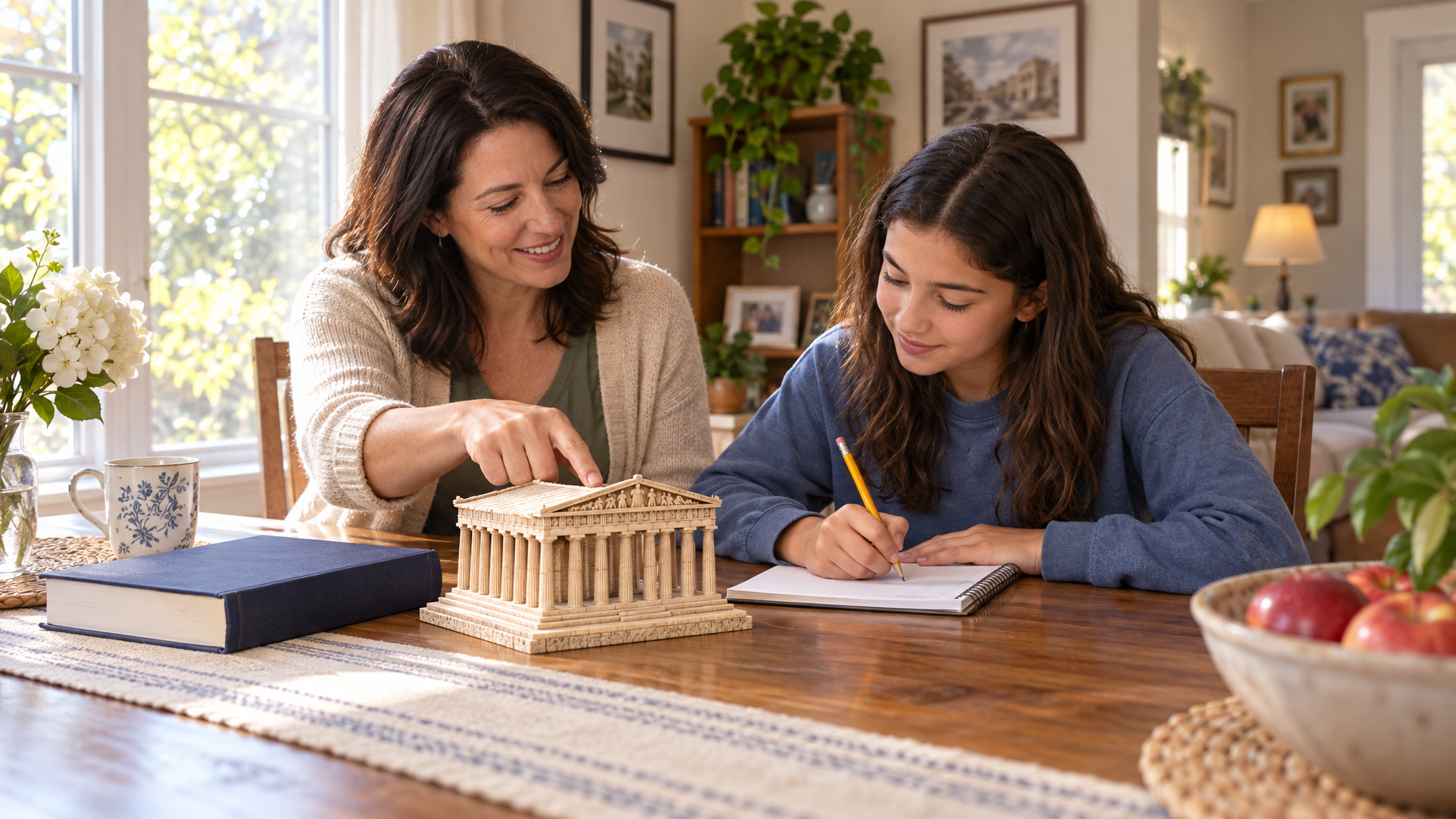
Despite what articles and headlines tend to have you think, the middle school years are about more than growth spurts, peer relationships, and the onset of puberty. It’s, as most homeschooling parents know well, also a key transition point between the foundational learning of elementary school and the more complex thinking skills called for in high school.
Finding the right social studies curriculum for kids at this age is important for helping them bridge the gap between elementary and high school. In addition to developing historical literacy skills and an awareness of global issues, kids at this age need opportunities to follow their own interests, research meaningful topics, and argue their positions with confidence. The goal is to find a curriculum that provides these activities and aligns with your child’s learning needs.
We’ll help you find the right path forward with great information below about how social studies changes from elementary to middle school, the common subjects taught, the types of curricula available, and how to support learners who have difficulties with reading or writing.
During the middle school years, kids leave behind learning about their state’s history and basic map skills to dive into content that allows them to think critically about history and global issues on a significantly larger scale.
Fortunately, homeschool social studies can be an ideal setting for these cognitive growth spurts because it allows time for a deep dive into areas your child may have a particular interest in, or answer questions they may have about a certain subset of history. Regardless of the curriculum you choose, you want to make sure you have what you need to help your child develop these core skills:
How learning social studies changes from elementary to middle school
Kids at this age move from learning facts to evaluating ideas, which is an essential step in developing the ability for abstract thought. High-quality curricula help kids make key transitions:
From concrete facts to abstract ideas
Middle school kids reach the Formal Operational Stage of cognitive development, meaning that they become able to go deeper than a surface-level understanding (Piaget 148-151). For example, in elementary school, your child learned that the Constitution was written in 1787. But during the middle school years, your child should be asked to debate why the authors included certain provisions and how they affect the law today. Instead of memorizing names and dates, they should be asked to grapple with themes of justice, power, social order, and cause-and-effect.
From social skills to civic competence
In elementary school, kids learn about society by being a “good neighbor.” In middle school, this concept is broadened to national and global communities. At this age, fairness is very important for kids, so helping them see that what may seem fair to one group may not seem fair to another helps to broaden their perspective and empathy.
From one-sided to multiple perspectives
Young kids learn history as a single story, but as they get older, they should be asked to evaluate multiple perspectives. This helps them begin to recognize bias (Selman 37-39) and can help hone their critical thinking skills.
Most high-quality curriculum materials follow a general progression in middle school to ensure that kids are ready for the academic demands of high school. It’s referred to as the “standard social studies sequence” and builds both chronologically and geo-spatially, meaning from the whole world down to the U.S.
The focus in 6th grade is world history and ancient civilizations. The goal is to move from learning facts to understanding how geography shaped how people lived, organized their communities, and conducted business.
Seventh grade moves to a focus on world geography and global cultures. Kids learn the five themes of geography: location, place, human-environment interaction, movement, and region. Kids learn about different cultures in order to develop a “global mindset.”
In the final year before high school, the focus is on civics and U.S. history from pre-Columbus times through Reconstruction. The goal is to help kids understand the Constitution, the three branches of government, and civic rights and responsibilities.
When it comes to social studies at this age, the “how” is just as important, if not more so, than the “what” of the curriculum. There are several common approaches to teaching social studies at home, each of which centers on a different philosophical approach.
This approach views learning in three stages, called the Trivium. Middle school kids are in the logic stage of that framework, which aligns well with their developing interest in argument. History is taught through a chronological cycle covering four time periods: Ancient, Medieval/Renaissance, Late Renaissance/Early Modern, and Modern. The focus is on analyzing primary sources and critical thinking (Bauer 283-287).
Known as the “Living Books” approach, this curriculum replaces textbooks with narrative stories that read like novels. In addition, kids also read related historical fiction, biographies, and primary sources, and they are asked to “narrate” orally and in writing to demonstrate mastery of the content (MacAuley 118-125).
This approach provides a deep dive into a single topic and integrates multiple subjects around one theme. For instance, if your child is interested in inventions, you might spend six weeks on the Industrial Revolution. While covering the history of the time, your child might also read Oliver Twist and study the science behind steam engines.
This curriculum aims to reproduce the traditional school experience at home. It’s highly structured, which ensures that every state standard is covered. Kids read a chapter in the textbook and complete the accompanying workbook activities, and parents supplement as needed.
This type of curriculum is technology-based and student-directed, so it can be useful for independent learners. Kids watch pre-recorded video lessons and complete activities online. The computer program assesses their work and doesn’t move forward to a new topic until the child has mastered the current lesson.
The right curriculum for your child will be one that provides a balance between their learning needs and future goals and your own needs as a parent regarding preparation. Ask yourself these questions when you are evaluating the different types of curricula.
A hands-on learner might prefer learning through unit studies where they can explore a single topic in depth. On the other hand, an avid reader might prefer a literature-based approach, and a child who works well independently and likes technology might excel with a digital platform.
If your child will transition to a traditional high school setting in the 9th grade, then a traditional textbook curriculum will ensure that they are on track with their peers. If college is the ultimate goal, then regardless of curriculum approach, you’ll want to make sure there’s an emphasis on primary source analysis and argumentative writing.
Classical and literature-based curricula allow for a lot of connection between parent and child, but they are time-intensive. Parents need to read aloud, lead discussions, and grade essays, which require a lot of preparation. Digital and traditional textbook programs are less time-intensive and designed for more child-directed learning, with the parent acting more as a coach or facilitator on the side.
There are curriculum options that view history through a religious lens and those that present neutral perspectives. If you have a strong preference for one or the other, this may be the first factor you want to use in making your decisions.
Feeling like you need your own growth spurt in educational planning to prepare to teach middle school social studies? Well, there’s no need to be concerned! By following these steps, you’ll be in great shape to ensure your child has everything needed for success.
The first choice to make is what “timeline” you want to follow. Most homeschool parents choose one of three paths.
The “spine” is the main resource you use to guide the learning. Depending on your preferred approach, this could be a textbook, a narrative history book, or a digital platform.
“Supplements” are the additional materials you use to flesh out the spine. These include primary sources, like speeches or letters, as well as historical novels and biographies. A good rule of thumb is to use a 60/40 split. Your spine should lead 60% of the work with supplements covering the other 40%.
Instead of just having your child read material and take a quiz, plan the lessons around a question that your child works to answer.
For instance, instead of just planning a unit on the Civil War, use a question like, “What happens to a nation that is divided in its understanding of human rights?” Your child then uses the materials you provide to find an answer to that question that they support with evidence.
Choose how you want to organize your child’s learning. Middle school is the time for them to learn time management along with academic content, so use a weekly checklist that they consult each morning to assess progress.
Also, consider setting aside one day a week for Socratic discussion, where you and your child discuss the issues from that week’s study together (Dawson and Guare 14).
When moving from the elementary to the middle school years, a child’s routine gets its own “growth spurt” in consistency over duration. Planning for 45-60 minutes of focused work four days a week is more effective than long sessions with gaps in between. Set up both a weekly and daily routine that prioritizes this kind of consistency.
Many parents use a four-day school week for dedicated study, with the fifth day reserved for field trips or in-depth projects. On Day 1, have your child engage with the “spine” material. As they learn new things in history, have them add to a timeline that they keep either on paper in the room or digitally on a computer. Then on Day 2, give them time to read from a biography or historical novel from the period being studied. On Day 3, ask your child to analyze related primary sources and discuss the different perspectives. Then on Day 4, plan for Socratic discussion or project work (Bauer and Wise 581-584).
Assuming a 60-minute plan, have your child spend the first 10 minutes reviewing their weekly checklist and identifying the specific learning target for the day. Then they can take the next 20 minutes to read/view the material in the “spine” on that topic.
From there, the next 20 minutes can focus on the “compelling question,” where your child proposes at least a partial answer and finds evidence for support. For the last 10 minutes, you can ask your child to summarize orally or in writing what was learned. (Dawson and Guare 14).
What’s best for you and your child depends on all the factors we’ve discussed so far. You have lots of options for how best to meet your child’s academic and personal growth needs, along with your needs, based on the time available for preparation.
Outschool’s online curricula and classes
Outschool has a wide variety of popular online middle school social studies classes that range from year-long courses to multi-week unit studies to one-time explorations to one-on-one tutoring.
There are pre-recorded lessons that are self-paced as well as live classes with credentialed teachers on engaging topics. These are a great way to meet your core curriculum standards as well as allow students to follow their interests by deep-diving into subsets of historical topics. For instance, a live class on Epic Battles in History lasts 30 minutes once a week over the course of three weeks. During the last session, the kids will get to vote on the next battle to focus on over the next three-week period, which makes the exploration highly engaging for kids.
Traditional textbook
These curricula generally come as a boxed set with a textbook and related workbooks. It follows a highly structured sequence that aligns with state standards and focuses on breadth of knowledge. This curriculum helps provide a school-at-home experience.
This “Living Books” approach includes a narrative overview of a time period as the spine, which is supplemented by a list of related historical novels and biographies. This curriculum appeals to kids who find textbooks dry and parents who want their kids to empathize with figures throughout history.
This method focuses on studying history chronologically through repeating cycles of Ancient, Medieval, Early Modern, and Modern History. It supplements the history with related science, math, literature, and fine arts materials. The academic focus here is on understanding cause and effect and gaining a deep understanding of world history.
This approach uses “unit studies” that allow kids to explore a single topic in-depth over multiple weeks while integrating material from different subject areas. This curriculum provides thematic bundles that include lists of primary sources and possible projects. This approach works well for hands-on learners with an interest in specific topics.
Digital mastery
This curriculum is technology-based and uses pre-recorded video and online assessments. The automatic grading within the system provides immediate feedback, and kids don’t move forward to a new concept until they’ve demonstrated mastery of the current one. This option works well for independent learners with parents who don’t have a lot of time for in-person instruction.
Teaching social studies might seem pretty straightforward, especially if you enjoy the subject matter yourself. But learning this content requires kids to do a lot of reading and writing. What if your child struggles in those areas? Never fear—by implementing the strategies we have here, even a reluctant reader or writer can find success.
There’s a lot of specialized vocabulary in social studies; think suffrage, authoritarianism, and reformation. You can help your child navigate challenging terms by looking up the “big words” together before they do the reading. Instead of having them write out definitions, try finding an image or video clip that demonstrates the concept. It’s also helpful to have a “word wall” in the room where your child can add new terms that come up. Then go back to the word wall periodically to review (Wanzek and Vaughn 24-29).
Look for resources with middle school level topics, but at elementary reading levels. Social studies “weeklies” are newspaper-like materials that cover topics in short chunks that are easy for kids to digest
Instead of always reading, let your child listen to audiobooks. Also, you can find great documentaries and YouTube videos online that make the material come to life, and graphic novel history books tell the same important stories in a comic-book format that may better appeal to reluctant readers.
If writing is a struggle, try other kinds of assignments, like oral narration, interviews, visual mapping, and 3D projects. Also, consider using speech-to-text voice typing, which allows your child to compose ideas but not get hung up in the actual transcription of them, especially for learners with dyslexia or other learning differences.
The growth spurts your child has during the middle school years aren’t just physical. They’re also cognitive, social, and emotional as well. This formative period marks the transition from child to adolescence and from the memorization of concrete facts to the exploration of abstract concepts. Middle school social studies can be a great tool for helping your child develop both the academic skills needed for high school and the time management strategies and intellectual curiosity that will serve them well for the rest of their lives.
Sources
American Psychological Association. “4 Important Considerations for Homeschooling: Middle School Years.” APA.org, 1 Nov. 2023, https://www.apa.org/topics/schools-classrooms/homeschooling-considerations/homeschooling-considerations-middle.pdf.
Bauer, Susan Wise, and Jessie Wise. The Well-Trained Mind: A Guide to Classical Education at Home. 4th ed., W. W. Norton & Company, 2016.
CAST. “Universal Design for Learning Guidelines Version 2.2.” UDL Guidelines, 2018, https://udlguidelines.cast.org/.
Coalition for Responsible Home Education. “Choosing Curriculum.” ResponsibleHomeschooling.org, 2024, https://www.responsiblehomeschooling.org/guides/curriculum-resource-center/choosing-curriculum/.
Dawson, Peg, and Richard Guare. Smart but Scattered Teens: The “Executive Skills” Program for Helping Teens Reach Their Potential. Guilford Press, 2013.
Education Commission of the States. ESSA: Mapping Opportunities for Civic Education. ECS, 2017, pp. 3-5, https://www.ecs.org/wp-content/uploads/ESSA-Mapping-opportunities-for-civic-education.pdf.
Larmer, John, et al. Setting the Standard for Project Based Learning. ASCD, 2015.
MacAulay, Susan Schaeffer. For the Children’s Sake: Foundations of Education for Home and School. Revised ed., Crossway, 2009.
National Council for the Social Studies. The College, Career, and Civic Life (C3) Framework for Social Studies State Standards: Guidance for Enhancing the Rigor of K-12 Civics, Economics, Geography, and History. NCSS, 2013, https://www.socialstudies.org/standards/c3.
Piaget, Jean. The Psychology of Intelligence. Translated by Malcolm Piercy and D. E. Berlyne, Routledge, 2001.
Selman, Robert L. The Growth of Interpersonal Understanding: Developmental and Clinical Analyses. Academic Press, 1980.
Wanzek, Jeanne, and Sharon Vaughn. “Unlocking Social Studies Text: Helping Students Access Content and Build Knowledge.” American Educator, vol. 45, no. 1, American Federation of Teachers, 2021,