A Montessori curriculum is a popular choice when homeschooling because it’s based on educational principles that align closely with what many homeschooling families value most: independence, curiosity, and hands-on learning. Rather than relying on rigid lessons or worksheets, Montessori encourages children to learn by doing, following their natural interests, and building real-world skills along the way.
What began with Maria Montessori’s initial efforts to teach underserved children in Rome, Italy, in 1907 has now become a highly successful educational approach for students of all ages. It’s based on a child’s natural curiosity and their innate ability to learn through self-discovery and real-life activities.
Below, we’ll explain the foundational principles of a Montessori curriculum, the subjects involved, and how to implement a Montessori curriculum in your own home. We also provide information on available options and answer frequently asked questions.
Overview of Montessori
Two key principles in a Montessori education are the “prepared adult” and the “prepared environment.” A prepared adult is a person who acts as a guide rather than a traditional instructor. A prepared environment involves a thoughtfully designed space and materials that invite exploration and independence. In this kind of environment, students follow their own interests to engage in practical, real-life activities. Children learn academic content alongside social skills and emotional awareness.
Unlike a traditional classroom, this approach connects learning across disciplines and prioritizes mixed-age groupings of students. It also provides flexible timelines and often includes outdoor learning activities.
But what does this look like day to day? Here’s an example. If middle-school-aged students enjoy working in a garden, their natural interest in plant life becomes a springboard for running their own produce stand. By growing their own vegetables and selling them, they learn about botany, soil health, weather patterns, and food preservation. Creating a business plan and marketing materials develops important communication skills. Managing a budget and converting units of measure builds key math skills.
But that’s not all. They also learn how to work together as a group: assigning roles, working through disagreements, and holding each other accountable. The value of hard work and the consequences of poor decisions or missed deadlines become meaningful life lessons. Through all of this, they develop a genuine sense of pride and accomplishment. Montessori’s blending of academic skills, social development, and self-discovery fits naturally with the goals of homeschooling.
Montessori and homeschooling
Many parents choose homeschooling because of their desire for an individualized, student-centered education that develops their child as a whole person. For that reason, the Montessori curriculum is a popular option, and there are several reasons why this pairing makes sense.
One key reason is self-direction and individualization. Sometimes, parents may feel that traditional classrooms are governed by rigid timelines and uniform activities for all, regardless of the students’ abilities and interests. Homeschooling can create an environment in which children experience more freedom of choice within clear limits. This helps them learn self-discipline and respect.
A primary goal of the Montessori curriculum is to allow students to learn at their own pace through hands-on activities that connect with their interests. In this way, both the homeschooling environment and Montessori curriculum prioritize following students’ natural curiosity through real-life learning activities. Both approaches also encourage children to cooperate, develop empathy, and learn important social skills (Lillard 16, 102).
Subjects Typically Covered in Montessori Homeschool Curriculums
Montessori education is organized around four “planes of development,” which are six-year stages during which children have unique developmental needs.
Early childhood (ages 0-6)
At this age, children naturally absorb information about the world around them almost effortlessly. Because of this, the focus of learning during these years involves exploring with the senses and using concrete materials.
The “subjects” typically covered include:
- Practical life: Young children learn how to dress and clean themselves, take care of their environment by picking up toys or watering plants, interact with others, and use fine motor skills (Montessori, Discovery 121-123).
- Senses: They learn to identify and distinguish between objects based on their size, shape, color, and texture by working directly with hands-on materials (Montessori, Discovery 95-105, 143).
- Language: At this stage, children build their vocabulary, learn to sound out words, and understand what they read. In a Montessori education, writing is usually introduced before reading (Montessori, Discovery 203-210).
- Math: Children learn the basic concepts of number and quantity along with introductory addition, subtraction, multiplication, and division. Once again, concrete materials are key (Montessori, Discovery 263-275).
- Culture: Kids experience art and music and gain basic knowledge about continents, landforms, plants, and animals (Montessori, Discovery 71, 155).
Elementary (ages 6-12)
During this stage, the focus shifts from concrete exploration to reasoning, imagination, and collaboration.
Several subjects are typically part of a Montessori education during this phase:
- Cosmic studies: This is a term for the study of history, geography, and science. Students learn how the universe began, how life evolved, and how civilizations formed. Related topics include biology, physical geography, and culture (Montessori, Human Potential 3-15).
- Math: Children at this age master the four basic operations and learn about decimals, fractions, equations, and more abstract mathematical concepts, especially in geometry (Montessori, Advanced Method 155).
- Language arts: During this phase, children learn about sentence structure, grammar, word origins, and basic research. They read classic literature and write formal essays.
- Practical life and arts: Field trips are major features of learning during this stage. Children develop skills in managing projects and collaborating on research, while also advancing more advanced art and music skills (Montessori, Advanced Method 1-30).
From childhood (ages 12-18)
A Montessori curriculum during this phase of development focuses on the “Erdkinder,” which is a German word that means “Earth children.” Children learn academic content by engaging in real-world experiences to gain a deeper understanding of the world around them (Montessori, From Childhood 101-103).
Common subjects include:
- Economics and vocational life: Students learn how to be self-sufficient by running their own home business or implementing service projects. Through real-life experiences, they learn about basic finance and business operations. They also pursue personal interests like sewing, cooking, coding, and metal or woodworking (Montessori, From Childhood 101-103.)
- Humanities: This area of learning includes history, civics, and ethics. During this phase, students analyze historical events, religions, philosophies, and government systems. Through reading, debates, and Socratic seminars, they learn about social issues and civic responsibility.
- Advanced academics: This catch-all subject involves in-depth learning of advanced math, physics, chemistry, and literature. The novels they read often connect with the history they are studying at the time (Montessori, From Childhood 105-107).
- Independent study and expression: Students often complete a “capstone project” or “senior thesis.” These culminating activities involve a self-directed research project that integrates several subject areas (Montessori, From Childhood 104-105).
Young adulthood (ages 18-24)
Although Maria Montessori didn’t develop specific curricular materials for this phase of development like she did for earlier stages, she identified several important goals for young adults.
These years focus on discovering and pursuing one’s personal mission or vocation. Learning becomes more specialized, and young adults work towards financial, moral, and professional independence (Montessori, From Childhood 93-95, 119-120).
How the Montessori Method Works at Home
Implementing a Montessori curriculum at home might seem a little challenging, but by keeping three core principles in mind, you’ll find that the Montessori approach is surprisingly orderly and logical. Here’s an overview of the principles that will guide your approach.
Rethinking your role as an adult
The first principle is the shift in the teacher’s mindset. Instead of the “sage on the stage,” the adult is more of a supportive “guide on the side.”
The Montessori approach relies on a “prepared adult,” meaning that the teacher models grace and decorum, is highly knowledgeable about using all learning materials, and carefully observes children without judgment (Montessori, Discovery 307-308).
Setting up a home environment that encourages learning
A second principle for success is the “prepared environment.” The Montessori approach prioritizes creating a rich learning environment.
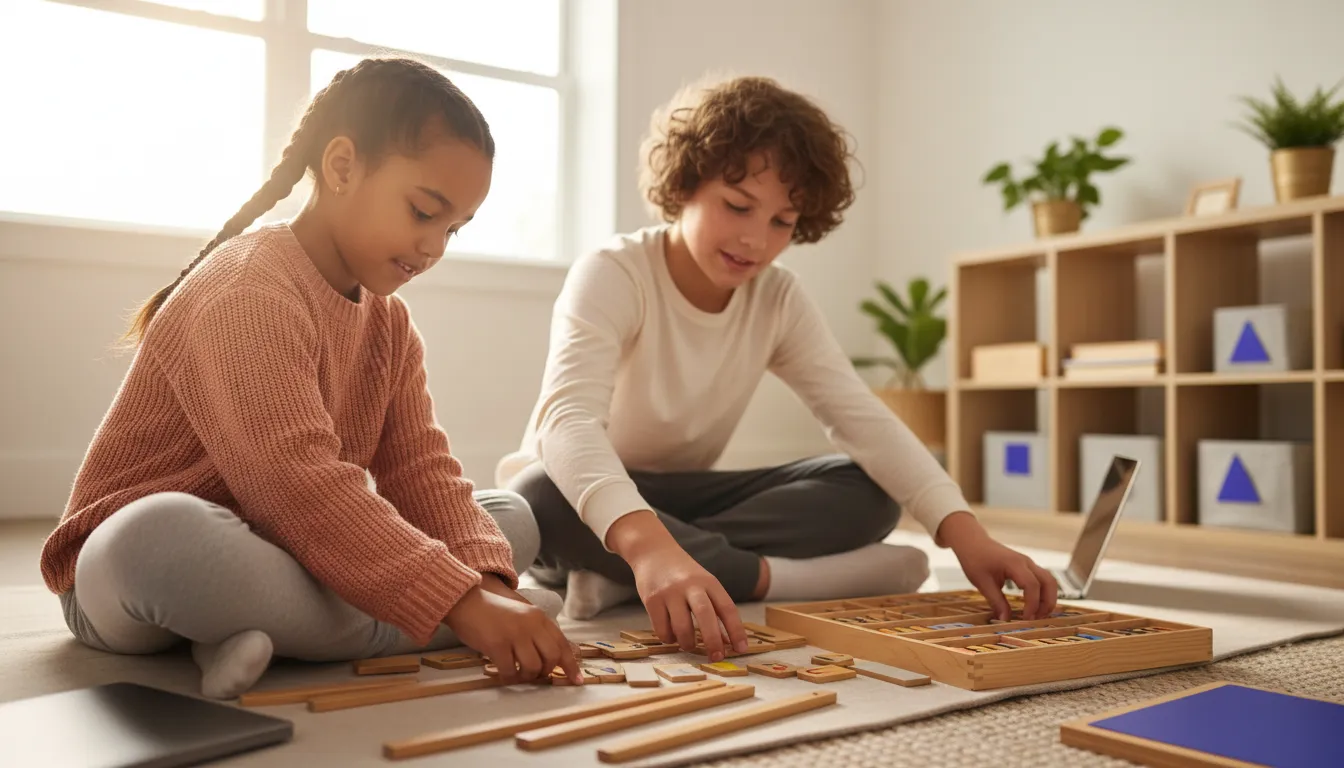
For example, furniture should match the child’s size, and concrete objects used for learning need to be orderly, well-made, and easily accessible. Each child needs their own workspace identified by a desk, table, or rug. Montessori is materials-intensive, but classic items, like the pink tower or sandpaper letters, can be purchased gradually over time. Many household objects can often be used in place of official materials, and teachers often create their own handouts (Montessori, Discovery 41-43, 58).
Creating a daily rhythm that works for your family
A third principle for making Montessori work at home is implementing a daily schedule that supports uninterrupted work time.
Dividing the day into three parts helps reduce interruptions. Usually, the longest block of time (2-3 hours) happens in the morning when students are most fresh. Children make choices about the work they will do during this time and settle into deep concentration.
After that, transition time helps a student to reset, both mentally and physically. This often includes time to eat lunch or a snack and play outside. The afternoon session is shorter than the morning block and can focus on integrated studies. This is a good time for field trips, creative endeavors, or service in the community.
Within that daily schedule, the adult teaches new material in short, purposeful lessons, also in a three-part format. The first part of the lesson introduces or names the concept to be learned.
For example, the adult might show the child objects that are spheres, cubes, and cylinders. The second part asks the student to complete a task that relies on an understanding of that concept. The teacher might say, “Point to the cube,” or “Put the cylinder behind your back.” This part of the lesson is the longest, and movement is encouraged to reinforce learning.
If the child makes a mistake, the teacher simply returns to part 1 and names the objects again. The final part of the lesson requires the child to recall what was learned. The teacher might pick up the sphere and ask, “What is this?” Correct answers show that the new concepts are now firmly stored in the child’s long-term memory (Montessori, Discovery 156-158).
Steps for Building and Planning the Best Montessori Homeschool Curriculum for Your Child
You might be thinking, “This sounds great! But where do I actually start?” By following these steps, you’ll be well on your way to implementing a Montessori curriculum in your own home.
Step 1: Get prepared
The Montessori approach is big on preparation. The first type of preparation relates to the developmental stage of your child. Children have different learning needs at different stages, and not every child of the same age is ready for the same experiences.
The next type of preparation involves the Montessori method itself. Adults need to be familiar with the incremental sequence of learning activities and the three-part lesson format.
Finally, the last preparation involves the learning environment (Montessori, Discovery 301).
Step 2: Identify and preserve uninterrupted work time
Long periods of time where the child can focus without distractions are essential. Whenever possible, commit to a 2–3-hour morning block where the child can choose the work they do (Montessori, Discovery 270).
Step 3: Prioritize observation
While the child is working, the adult should intentionally observe what kind of work the child chooses, how long they can concentrate, and what tasks they find easy or difficult. It’s helpful to keep records of what the child is working on and what new knowledge or skills are gained (Montessori, Discovery 107).
Step 4: Teach brief, specific lessons
Use the three-part lesson structure to present new concepts one-on-one. New material should be introduced when the child is developmentally ready, not on a predetermined date. Once the lesson is completed, you should step back and allow the child to work with the material until it is mastered (Montessori, Discovery 151).
Step 5: Integrate subject areas
Once a child reaches age 6, they tend to learn best when subjects are connected, instead of being taught one topic at a time in isolation. The Montessori approach uses what are called the “Five Great Lessons” that help students learn history, science, and geography together. Instead of giving a lecture about a topic, consider letting your child do their own research (Montessori, Human Potential 5-7).
Step 6: Include service and real-world applications
Be sure to include household chores and practical living activities as part of learning activities. Cooking, cleaning, and gardening are important life skills. You can also get your child out into the community by doing service work and visiting museums and libraries (Montessori, Adolescence 13-15).
Popular Montessori Homeschool Curriculums
Maria Montessori developed the Montessori approach, but there are many different curricula that interpret and apply her methods.
Outschool’s online Montessori curriculums and classes
Outschool offers a wide variety of online classes and full-year programs. Many of the teachers are certified by either the American Montessori Society (AMS) or the Association Montessori Internationale (AMI), which can be reassuring for parents new to Montessori
Most classes take place live on Zoom and make use of the three-part lesson format. However, there are also self-paced classes available that make use of assignments and pre-recorded videos so your child can learn at their own pace. There are three main formats for Outschool classes. One is a full curriculum in which a child attends class two to five times per week for multiple weeks to learn core subjects like math, science, and English. A second format is a subject-specific “work period,” where teachers offer sessions focused on a specific Montessori lesson area. Outschool also offers one-on-one tutoring, allowing students to master specific concepts one-on-one with individualized support.
All-in-one kits with materials
Another option is a comprehensive kit that includes not only all lesson plans, sequences, and workbooks, but also the physical materials needed to complete the lessons.
The lessons in them are fully scripted in a traditional style, so little Montessori training is needed to implement them. While some parents like the ease of having everything provided, others find these kits to be restrictive. Also, since they include both lesson guides and the actual objects needed for lessons, they can be costly (North American Montessori Center).
All-in-one guides without materials
Some companies provide detailed lesson guides, sequences, and handouts, but don’t include the physical manipulatives. Parents who are comfortable providing their own learning objects but want a structured, traditional Montessori classroom experience may choose this option (Montessori Homeschool).
Manuals from Montessori training centers
These are traditional materials that provide step-by-step guidance for every lesson, along with a deep dive into Montessori philosophy and the psychology of child development. This material can be overwhelming for someone without a background in education, but it does provide in-depth information on the “why” behind the Montessori approach (North American Montessori Center).
Frequently Asked Questions: Montessori Homeschool Curriculums
If you are new to the idea of implementing a Montessori homeschool curriculum, you probably have a few questions.
What’s the best Montessori homeschool curriculum for preschoolers?
Naturally, the best curriculum will depend on the specific interests and needs of your preschooler as well as your own preferences.
For instance, if the cost isn’t an issue and you don’t want to source concrete learning materials yourself, then an all-in-one comprehensive kit may be the way to go. But if cost is a factor, you may be more interested in creating your own manipulatives and prefer to purchase lesson guides only.
If quality online classes are your priority, then check out Outschool’s Montessori page and filter by the age of your child. There you’ll find a vast array of classes of different lengths covering all subject areas.
Do Montessori schools follow a national curriculum?
No, not directly. A Montessori approach follows a child’s individual interests and developmental readiness rather than a set list of grade-level targets. However, it does cover the material within national curriculums and often goes beyond them. Students in Montessori environments often go deeper in their learning than students in conventional settings, and they usually learn abstract concepts earlier than they would be covered in the traditional classroom. In short, the content of both curriculums is similar, but the methods are quite different (American Montessori Society, Standards).
Does the Montessori method offer curriculums past 8th grade?
Yes, they exist, but there are fewer options than the materials available for students aged 6-12. The Montessori curriculum for children over twelve looks a lot different from a traditional high school.
It involves the “Erkinder” (Earth children) philosophy designed to prepare them for adult life through practical, social, and financial learning experiences. It uses specialized materials for subject areas like advanced math and science, along with many outside-the-home opportunities such as mentorships, service learning, or civic projects. Since there may be unique high school curriculum requirements where you live, it's a good idea to make sure you are familiar with the homeschool laws in each state.
A Home Run for Homeschool
Since the Montessori curriculum is based on developmental readiness, natural curiosity, integrated study, and real-life learning experiences, it can be an excellent fit for a homeschool environment. The Montessori approach does require a great deal of preparation, but many parents find that the investment of time pays off and not just in terms of academic results. They also find that their children develop a sense of personal responsibility and agency, can collaborate and communicate effectively, and retain a natural love of learning well into adulthood.
Sources
1. American Montessori Society. Core Components of Montessori Education. AMS. 2024. amshq.org/the-ams-difference/core-components-of-montessori. Accessed 17 Dec. 2025.
2. Erdkinder: Montessori’s Vision for the Adolescent. AMS. 2024. amshq.org/About-Montessori/History-of-Montessori/Erdkinder. Accessed 17 Dec. 2025.
3. Montessori and State and National Standards. AMS, 2024, www.amshq.org/About-Montessori/How-Montessori-Works. Accessed 18 Dec. 2025.
4. Association Montessori Internationale. The Montessori Adolescent (12–18 Years). AMI, 2024, www.montessori-ami.org/adolescent-programs. Accessed 18 Dec. 2025.
5. Lillard, Angeline Stoll. Montessori: The Science Behind the Genius. 3rd ed., Oxford University Press, 2017.
6. Montessori, Maria. The Absorbent Mind. 1949. Translated by Claude A. Claremont, Henry Holt and Company, 1995.
7. The Advanced Montessori Method: The Montessori Elementary Material. 1917. Translated by Arthur Livingston, Kalakshetra Publications, 1965.
8.The Discovery of the Child. 1948. Translated by M. Joseph Costelloe, Ballantine Books, 1967.
9. From Childhood to Adolescence. 1948. Translated by the Association Montessori Internationale, Schocken Books, 1973.
10. To Educate the Human Potential. 1948. Clio Press. 1989.
11. North American Montessori Center. Montessori Homeschool Program: Curriculum and Implementation Guide. NAMC, 2024.


.svg)
.svg)