What changes when science reaches middle school
In elementary school, science tends to be exploratory and wonder-driven: observing, collecting, noticing. Middle school science shifts toward explanation and evidence. Students learn to ask a focused question, form a testable hypothesis, collect data systematically, and draw conclusions they can defend in writing.
The National Research Council's Framework for K-12 Science Education describes this shift as moving from "experiencing phenomena" to "explaining phenomena" [1]. That distinction matters for curriculum selection: a strong middle school program should push students to explain their observations, not just describe them.
Communication becomes central in grades six through eight. Students write lab reports, analyze data sets, and connect findings to broader concepts. For homeschool families, this often means building in more writing time alongside hands-on lab work.
Sixth grade science: what to teach and how to approach it
Core topics
Sixth grade science typically covers Earth science and introductory physical science. Students explore the structure of Earth's layers, the rock cycle, weather systems, and basic energy concepts. Many curricula also introduce the solar system and space science at this level.
Aligned with the Next Generation Science Standards (NGSS), sixth grade is where students begin working seriously with data. Tracking weather patterns, building simple models of landforms, and measuring temperature changes during experiments all build the habit of recording observations systematically. For a full breakdown of sixth grade expectations across all subjects, our sixth grade homeschool goals guide covers the landscape.
What sixth grade experiments look like at home
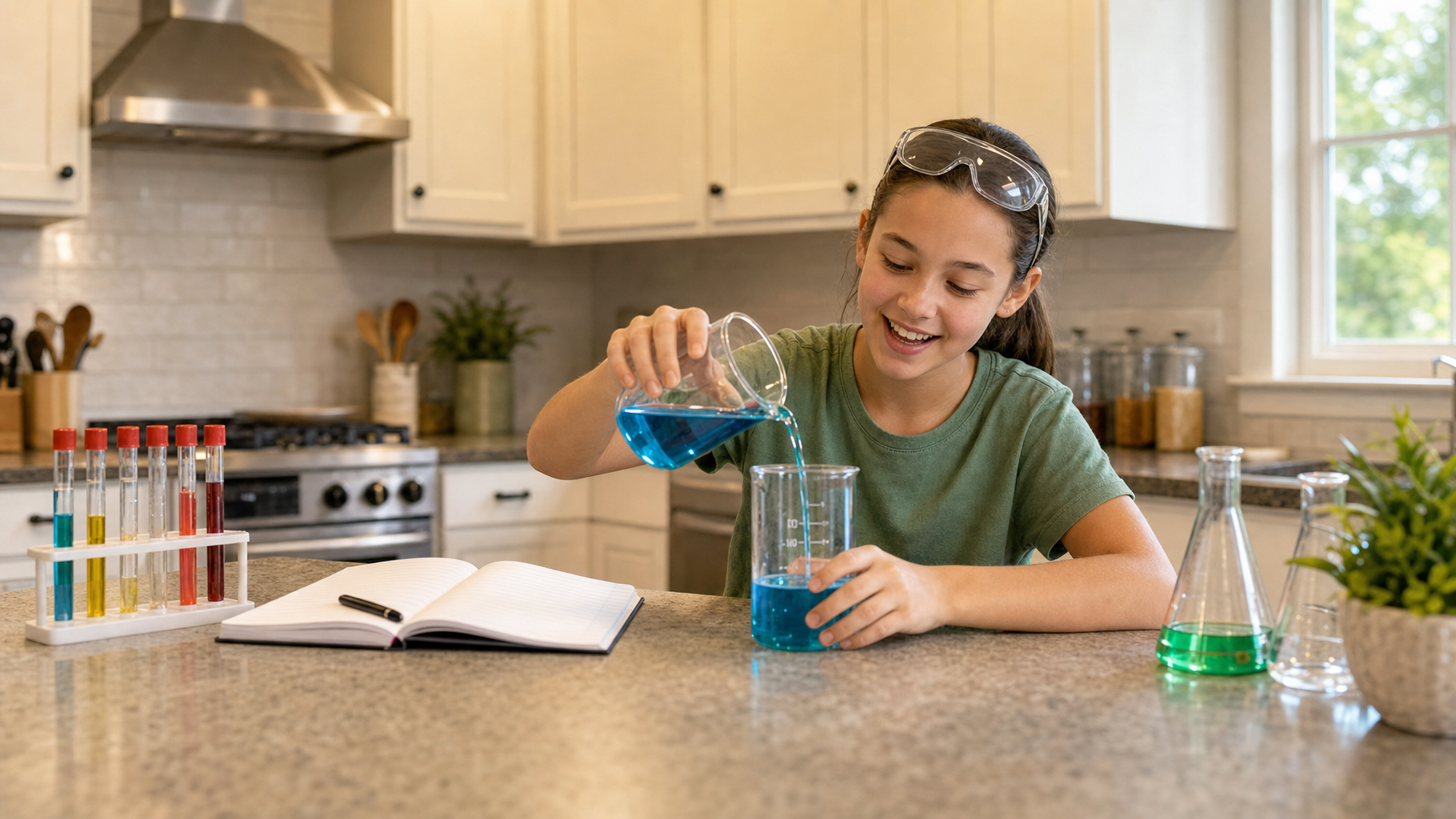
Hands-on work in sixth grade does not require expensive equipment. Strong options include:
- Weather tracking journal: students record daily temperature, precipitation, and cloud cover for four to six weeks, then identify seasonal patterns in their data.
- Rock and mineral classification: using a basic kit or rocks collected locally, students classify samples by hardness, color, and texture using a reference chart.
- Energy transfer demonstrations: ramps, pendulums, and simple circuits illustrate how kinetic and potential energy convert between forms.
- Weather tracking journal: students record daily temperature, precipitation, and cloud cover for four to six weeks, then identify seasonal patterns in their data.
- Rock and mineral classification: using a basic kit or rocks collected locally, students classify samples by hardness, color, and texture using a reference chart.
- Energy transfer demonstrations: ramps, pendulums, and simple circuits illustrate how kinetic and potential energy convert between forms.
For families who want structured lab guidance, our sixth grade science curriculum guide compares programs that include built-in lab sequences.
What students should be able to do by the end of sixth grade
By the close of sixth grade, a student should be able to identify patterns in data, write a structured observation paragraph, explain a basic cause-and-effect relationship in natural systems (such as how erosion shapes landforms), and construct a simple model representing a scientific concept.
Seventh grade science: what to teach and how to approach it
Core topics
Seventh grade typically centers on life science. Students study cell biology, genetics and heredity, ecosystems, and the interdependence of living systems. This is often the grade where students encounter their first microscope work, which opens up an entirely different scale of observation.
Genetics tends to generate high engagement. Punnett squares feel like puzzles, and students often start connecting concepts to their own family traits. Ecosystems work well for inquiry-driven projects because students can study local environments as primary data sources rather than relying entirely on textbook descriptions. Our seventh grade homeschool goals guide maps the full range of skills to target this year.
What seventh grade experiments look like at home
- Cell model project: students build a 3D model of a plant or animal cell using craft materials, labeling each organelle and writing a brief explanation of its function.
- Ecosystem observation project: students choose a small outdoor area and track changes in plant and animal activity over several weeks, identifying producer-consumer-decomposer relationships.
- Genetics trait survey: students survey family members for observable inherited traits (attached vs. free earlobes, tongue rolling, dominant hand) and calculate observed ratios.
- Cell model project: students build a 3D model of a plant or animal cell using craft materials, labeling each organelle and writing a brief explanation of its function.
- Ecosystem observation project: students choose a small outdoor area and track changes in plant and animal activity over several weeks, identifying producer-consumer-decomposer relationships.
- Genetics trait survey: students survey family members for observable inherited traits (attached vs. free earlobes, tongue rolling, dominant hand) and calculate observed ratios.
For curriculum options that include structured life science labs, our seventh grade science curriculum guide walks through what to look for.
What students should be able to do by the end of seventh grade
By the close of seventh grade, a student should be able to write a complete lab report with hypothesis, procedure, data, and conclusion; explain the relationship between a cell's structure and its function; use basic Punnett squares to predict trait inheritance; and describe how energy and matter cycle through an ecosystem.
Eighth grade science: what to teach and how to approach it
Core topics
Eighth grade science focuses on physical science: motion, forces, chemical reactions, and the properties of matter. This is the direct bridge to high school chemistry and physics, which are required courses in most states. Getting physical science foundations solid in eighth grade makes the transition to those courses significantly less stressful.
Motion and forces (Newton's laws), chemical versus physical changes, atomic structure, and waves and energy are the core concepts. Students also begin working with more formal mathematical representations: calculating speed and acceleration, using chemical equations, and graphing data with labeled axes and trend lines. For the full scope of eighth grade expectations, our eighth grade homeschool goals guide lays out benchmarks across all subjects.
What eighth grade experiments look like at home
- Motion lab: students roll a ball down ramps of different heights, measuring distance traveled and time elapsed. They calculate speed and graph their results, then connect the data to Newton's first and second laws.
- Chemical change investigation: using safe household materials (vinegar and baking soda, iron wool exposed to air), students distinguish chemical changes from physical changes and document evidence of each.
- Density column: students layer liquids of different densities (honey, corn syrup, dish soap, water, vegetable oil) in a clear container, predict where solid objects will float, and explain results using particle-level reasoning.
Our eighth grade science curriculum guide compares programs that build toward high school readiness.
What students should be able to do by the end of eighth grade
By the end of eighth grade, a student should be able to calculate speed, velocity, and acceleration; explain chemical and physical changes using evidence from observations; describe atomic structure in basic terms; interpret and construct graphs showing relationships between variables; and write a lab report that connects data to a scientific explanation.
Middle school science scope and sequence: grades six, seven, and eight
A scope-and-sequence overview helps you see the full three-year arc and plan transitions between grade levels.
Grade 6, Earth and Space Science: data collection, observation recording, pattern identification. Labs: weather journal, rock classification, energy transfer. Writing: observation paragraphs, lab notes.
Grade 7, Life Science: lab report writing, microscope use, basic genetics calculations. Labs: cell model, ecosystem observation, trait survey. Writing: full lab reports, ecosystem analysis.
Grade 8, Physical Science: speed/acceleration calculations, graphing, chemical equation balancing. Labs: motion lab, chemical change investigation, density column. Writing: multi-section lab reports, data-supported conclusions.
How to choose a middle school science curriculum
The right curriculum depends on your child's learning style, your state's documentation requirements, and how much lab support you need built in.
Check your state's requirements first
Some states require lab records, course descriptions, or Carnegie Unit credits during middle school. Reviewing your state's homeschool requirements before choosing a curriculum means you can pick a program that naturally supports documentation.
Curriculum formats to consider
- All-in-one programs: include instruction, lab outlines, assessments, and pacing guides. Best for families who want a structured plan with clear year-end expectations.
- Discipline-specific programs: focus on one science branch for the full year. Mirror the structure of high school courses and allow deeper exploration.
- Online or video-based curricula: deliver instruction through recorded lessons or live virtual classes. Outschool's middle school science classes work well as a complement: live instruction lets students discuss findings with peers and respond to a teacher's questions in real time.
- Inquiry-driven programs: organize learning around central questions rather than fixed topic lists. Work well for students motivated by open-ended exploration and real-world application.
How to plan science across the week
Most middle school students do well with three to five hours of science per week, spread across two to four sessions. A practical rhythm: one session for reading or instruction, one for lab work, and one for writing and reflection. The writing session is the one families are most likely to skip. It's also the one that most directly builds the skills students need in high school science.
Building a science portfolio for transcripts
A lab notebook is the most practical foundation for middle school science documentation. Have your student record each experiment: date, question, hypothesis, materials, procedure, observations, and conclusion. These entries serve as both a learning tool and a portfolio of lab work.
Beyond the lab notebook, keep a running list of topics covered each semester, any textbooks or curricula used, and samples of student work (data tables, graphs, written conclusions). If your state requires course descriptions or credits, these records provide the documentation foundation you need. Our homeschool record keeping guide covers the broader system.
Frequently asked questions
What order should I teach science in middle school?
Most programs follow Earth science in sixth grade, life science in seventh, and physical science in eighth. This sequence builds logically: Earth science introduces data collection, life science adds biological complexity and lab writing, and physical science adds mathematical reasoning. The order isn't fixed, though. Some families rotate through all three areas across the three years rather than dedicating a full year to each.
Do I need a boxed curriculum for middle school science?
No. Many families build effective programs by combining a standards-based textbook or digital curriculum for structure, online classes for live instruction and discussion, and at-home labs planned around what students are studying. The key is having a clear scope and sequence so nothing important gets skipped.
My child resists the writing components of science. What helps?
Start with sentence stems: "I observed that... I think this happened because..." These remove the blank-page pressure and teach the structure without requiring students to invent it from scratch. A graphic organizer for lab reports, with columns for hypothesis, observation, and conclusion, also lowers the barrier. Once the format is familiar, most students write more readily. If writing resistance extends beyond science, our guide on teaching writing to reluctant writers has strategies that apply across subjects.
How do I handle labs without a full science lab at home?
You don't need one. The experiments described in this guide use kitchen supplies, backyard materials, and basic measuring tools. For labs that require more equipment (microscope work in seventh grade, for instance), many homeschool co-ops share resources, and online classes with live demonstrations can supplement what's hard to do at home.
How do I know if my child is on track for high school science?
By the end of eighth grade, a student ready for high school science can write a multi-section lab report, work with basic algebraic relationships in data (calculating speed, graphing proportional relationships), and explain cause-and-effect chains using evidence. If your child can do those three things, the transition to high school biology, chemistry, or physics will be manageable. For a broader view of academic readiness, see our guide to assessing homeschool progress.
Sources
[1] National Research Council. A Framework for K-12 Science Education: Practices, Crosscutting Concepts, and Core Ideas. National Academies Press, 2012. nap.nationalacademies.org/catalog/13165
[2] NGSS Lead States. Next Generation Science Standards: For States, By States. National Academies Press, 2013. nextgenscience.org


.svg)
.svg)