Has your child’s school experience been less than inspiring during the elementary year? Have you thought about making a switch to homeschool for the 6th grade to make the most of their middle school years? It might seem a little scary at first, but the good news is that a transition to learning at home can be a smooth, and even exciting, shift when you tackle it one step at a time.
In this guide on how to start homeschooling in 6th grade, you’ll learn what to do first, from checking your state’s homeschool requirements to choosing a curriculum that fits your child’s strengths and your family’s schedule. You’ll also learn the core subjects most 6th graders study, simple ways to plan your year, and what your first month can realistically look like. By the end, you’ll have a clear starting plan along with the confidence to adjust as you go.
Overview: Homeschooling a 6th Grader
A move to homeschooling in 6th grade comes at a great time. Your child may be ready for more independence, but you still have time to build strong learning habits before middle school work gets more demanding.
One major perk to learning at home is flexibility. You can adjust pace, level, and teaching style, build in movement breaks, and spend more time where your child needs it most. Many families also love the chance to tailor reading lists, add interest-based projects, and choose online classes for subjects they don’t want to teach alone.
The biggest challenges tend to be practical: figuring out what your state requires, selecting a curriculum without overspending, and creating a routine that balances school, work, and extracurriculars. Social connection and accountability can take planning, too, but with the right support in place, they can be addressed easily.
Teaching at home vs. in a school setting
When families compare homeschool vs. traditional school in 6th grade, it helps to think less in terms of which is “better” and more in terms of “best fit.” School offers built-in structure, class periods, benchmarks, and a steady peer group, while homeschooling offers a high level of customization, which is especially helpful in the middle school years, when kids’ maturity, motivation, and academic readiness can vary widely.
Flexibility in pace and approach is a key reason parents make this choice. If your child needs more time to strengthen reading comprehension or math foundations, you can slow down without the pressure of keeping up with a class. That can be especially reassuring given that national data has shown recent dips in reading performance. For example, the National Assessment for Education Progress (NAEP) reported lower average 8th grade reading scores in 2022 compared with 2019 (National Center for Education Statistics, Nation’s Report Card 1).
If they’re ready to move faster or go deeper into a favorite topic, you can do that too. And if your family’s reason for homeschooling is related to the school environment itself (safety, social issues, or dissatisfaction with instruction), you’re not alone. National survey data shows many parents cite concerns about the school environment among their top reasons for homeschooling (National Center for Education Statistics 5).
A school setting, on the other hand, can make it easier to access specialized supports, such as lab-based science, electives, counselors, and formal disability-related services through plans like Section 504 (U.S. Department of Education, Parent and Educator Resource Guide 1).
But if your child doesn’t need these kinds of services or you can access them on your own, then homeschooling will likely be an enticing option.
Consider these day-to-day realities:
- Schedule: Homeschool can be shorter and more flexible because it’s more efficient, whereas school follows a fixed calendar and bell schedule.
- Curriculum: Homeschool families choose materials and can mix levels by subject, but traditionally, schools use district-selected programs and grade-level pacing guides.
- Social: School offers built-in peers while homeschool requires intentional community, but these can be provided through co-ops, clubs, sports, and live online classes.
- Assessment: School provides regular feedback through standard grading practices, but homeschooling can use portfolios, quizzes, projects, or teacher feedback from online classes to keep track of progress.
- Family bandwidth: Depending on the curriculum you choose, homeschooling requires adult planning time, whereas school shifts most planning and instruction to teachers.
Is 6th grade too late to begin homeschooling?
Not at all! In fact, many families choose to start or switch around this age because the transition into middle school can be a bumpy academic and social shift. Research has found that grades often dip, and students can feel less confident during the first year of middle school, even when they previously did well in elementary school (American Psychological Association).
Homeschooling in 6th grade can give you room to rebuild momentum: you can review shaky foundations, adjust the workload, and teach study skills (planning, note-taking, longer reading assignments) before the higher demands of later middle school and high school. And if your decision is driven by concerns about the school environment or a desire for more individualized instruction, those are common reasons families report for homeschooling (National Center for Education Statistics 5).
Steps to Start Homeschooling a 6th Grader
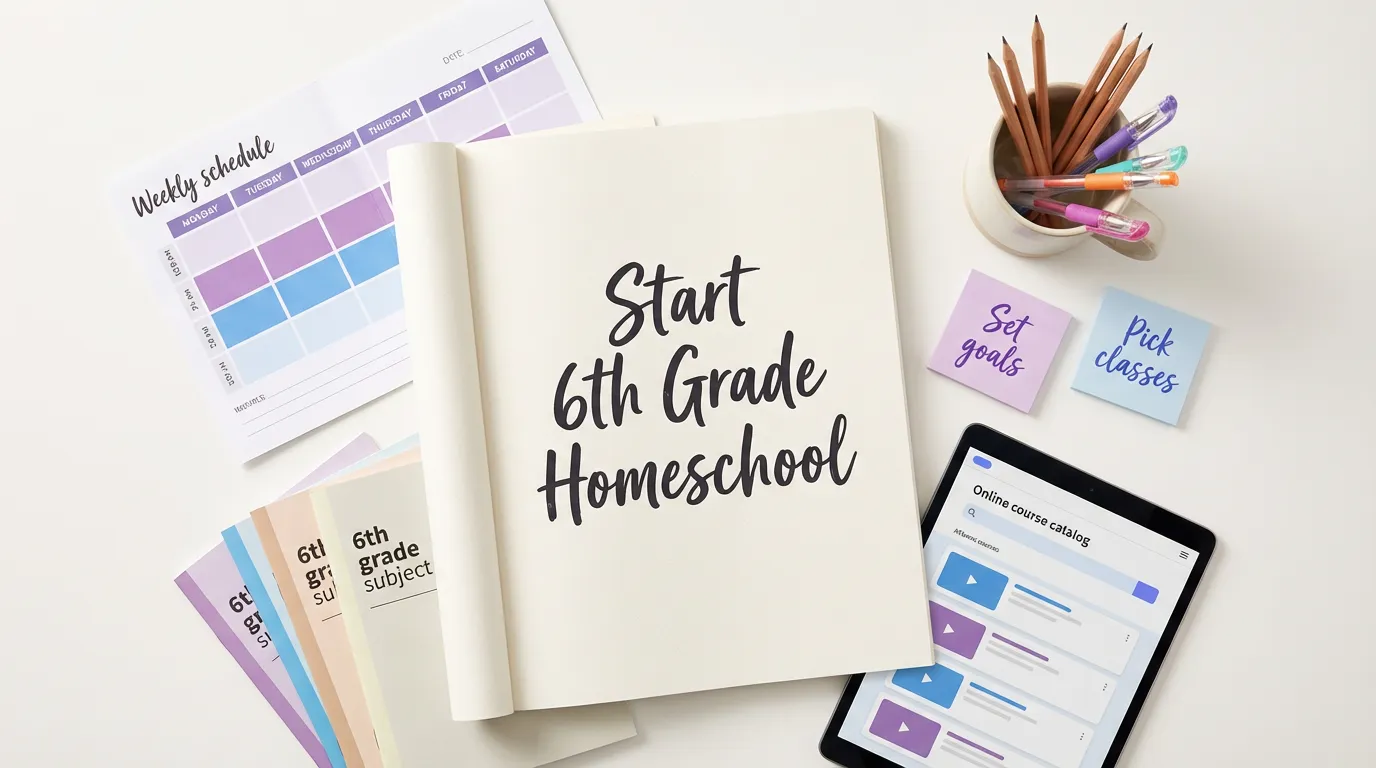
Starting homeschool doesn’t have to mean reinventing school at your kitchen table. The simplest way to begin is to handle a few key decisions in order: legal setup first, then academics, then daily logistics. The steps below walk you through what to do (and what you can safely decide later) so you can start 6th grade with a clear plan and room to adjust as you learn what works for your child.
Step 1: Check your state’s homeschool laws
Homeschool is regulated at the state level, so your first task is to confirm what your state requires (for example: whether you need to file a notice, keep specific records, teach certain subjects, or complete an annual evaluation). A solid starting point is Outschool’s overview of homeschool laws in each state.
Then follow up with your state’s education agency for the exact forms and deadlines. If your child is currently enrolled in school, you’ll want to understand your district’s withdrawal process so the transition is documented correctly.
Step 2: Decide on your primary goals
Before you pick the curriculum, get clear on what you want 6th grade to accomplish for your child. Based on past grades along with placement tests that you can find free online, determine where the level of work your child will do in the big four: math, reading, writing, and spelling/grammar. You may want them to be challenged but not overwhelmed.
Next, set a few realistic goals for the semester or year. Some can be academic, like mastering fractions/decimals, writing a five-paragraph essay, or building stamina for longer chapter books, and some “school skills,” like using a planner, taking notes, or finishing independent work. Finally, make space for interests.
Middle school can be a great time to add passion projects or electives that keep motivation high. If your child learns differently or needs accommodations, note what supports help most, like extra time, audiobooks, movement breaks, so you can choose materials and classes that match.
Step 3: Choose your curriculum
Before you buy anything, list your “must-cover” subjects, which are typically math, English language arts, science, and social studies, plus any electives your child wants to try, like coding, art, or world language.
Then, decide what you want to teach at home versus outsourcing. You might want to use a core curriculum for math and English and add live online classes for writing, labs, or discussion-based subjects. Some families find that online classes relieve their preparation load, especially in areas where they may not feel comfortable, like geometry and physics. Don’t worry if your child is working above grade level in one subject and below in another. That’s normal in middle school. One of the strengths of homeschooling is being able to place by skill level rather than by age.
Step 4: Create a weekly schedule
Many 6th grade homeschool plans work well with 2–3 focused academic blocks per day, like math, reading/writing, and one content area like science or history. Then, add in time for independent reading, hobbies, and movement.
You can try your schedule for two weeks, then adjust as needed. If mornings are tense, shift heavy work later. If attention fades quickly, break lessons into shorter chunks.
Step 5: Gather materials
Give some thought to setting up the space. Set up the practical pieces, like a place to keep books and supplies, a calendar you’ll actually check, and a simple recordkeeping system using a folder, binder, or digital document.
It’s helpful to have plenty of paper, pens, colored pencils, a compass, a calculator, and a computer all at hand so that you don’t have to lose momentum to stop and hunt for supplies.
Step 6: Decide how you’ll track progress
Finally, choose an assessment method that matches your state’s requirements and your child’s needs. This might be a portfolio of work samples (Coalition for Responsible Home Education, “Creating a Homeschool Portfolio”), periodic unit tests, your own notes on topics covered, etc.
Of course, the goal is not constant testing. It’s making sure your child is learning and that you can show progress if your state asks for documentation.
Common Challenges When Homeschooling a 6th Grader
Homeschooling a 6th grader can be incredibly rewarding, but it also comes with some predictable bumps, especially as kids adjust to more independence, longer assignments, and higher expectations. If you run into any of the challenges below, it's not a sign you're doing it wrong or that homeschooling isn't for you. It's a sign that you're homeschooling a real, live middle schooler! You can troubleshoot one piece at a time.
- Finding the right level of academic challenge: Sixth grade spans a wide range of readiness. Your child might be advanced in reading but need a slower pace in math. Consider using a placement test when possible (many can be found online for free). Then start slightly easier for the first 1–2 weeks and increase the rigor once they're working confidently.
- Power struggles: The move toward independence can come with more pushback, procrastination, and "Why do I have to do this?" moments. One strategy that often helps is offering choices. For example, letting your child choose the topic, the order of tasks, or the format. Frequent movement breaks can help too.
- Inconsistent routine: Without the built-in structure of school, it's easy to let the day get away from you, and middle school work can be harder to catch up on later. Draft a simple weekly rhythm (same start time, core subjects on set days, and a rotation for electives or projects). Try it for two weeks, then revise anything that feels unrealistic.
- Work takes longer than you expected: Sixth graders often need time to learn how to read directions carefully, write in complete sentences, and show their work, which are all important tasks that can make lessons feel slow. When energy is fading, try switching to shorter chunks, like a 20-minute segment, and finish with something lighter, like read-aloud, audiobooks, or a hands-on activity.
- Time and task management: Middle school means more multi-step assignments and long-term projects, and many kids at this age need explicit coaching in "executive function" skills. A helpful system is to use one planner, either paper or digital, and do a 5-minute daily "check-in" to list tasks. This can help teach your child to break projects into mini-deadlines and take responsibility for their own work.
- Parent burnout: Homeschooling can be incredibly rewarding and downright fun, but it can also start to feel like you're running a small school by yourself. Ease the load by outsourcing a subject through a live online class, a co-op, or a tutor. You can also look for "open-and-go" materials that provide lessons and activities.
- Worries about social time and friendships: Your child may miss a steady peer group or feel anxious about falling behind socially. But there's no reason they need to give up friends just because they are learning at home. You can plan social time the same way you plan academics through clubs, sports, volunteering, or discussion-based online classes.
- Keeping records consistently: Even in states with minimal oversight, documentation saves stress later and helps if you transfer back to school if you ever want to do that. Try setting a recurring reminder to file a few work samples and a short log of what you cover each week, and keep everything in one place.
- Fatigue, moodiness, and "everything feels hard" days: Sixth graders are growing fast, and learning is tougher when sleep is short, or screens run late. If schoolwork is consistently melting down, try protecting bedtime. Kids aged 6-12 generally need 9-12 hours of sleep each night.
What Your First Month of Homeschooling a 6th Grader Can Look Like
The first month of homeschooling might feel like a mix of "I've totally got this" and "what have I done?" But don't worry, that's normal! Instead of trying to replicate a traditional school day at home, consider building a workable routine, figuring out the right level of academic challenge, and creating simple systems for follow-through. You can always make changes and add bells and whistles later. Below is one realistic way your first month can unfold.
Starting slow and adjusting expectations
For Week 1, aim for a "soft start." Pick 1–2 core subjects per day (typically math and reading/writing). You can keep lessons short and treat everything else as optional. Your main goal at this point is observation: How long can your child focus before they fade? Do they do better with a written checklist, verbal directions, or sitting beside you? Are mornings smooth, or is a later start kinder for everyone? By Week 2, you can add the rest of your core subjects and begin lengthening work time in small increments.
If you're coming from a difficult school situation, it can also help to plan a short "decompression period" first, such as less pressure, more reading, and more hands-on learning, so homeschool doesn't feel like school-at-home.
Developing a routine
A simple routine helps 6th graders know what to expect without making you feel locked into a rigid timetable. Here's one example for a 3–4 hour homeschool day (not counting independent reading):
- Start-up (10 minutes): Snack/water, look at the day's checklist, set up materials
- Block 1 (30–45 minutes): Math lesson and practice
- Break (10–15 minutes): Movement, outside time, quick chore
- Block 2 (30–45 minutes): Writing or language arts with a short assignment
- Read (20–30 minutes): Independent reading, read-aloud, or audiobook + short narration
- Lunch/free time
- Block 3 (30–45 minutes): Science or social studies (alternate days)
- Wrap-up (5 minutes): File one work sample, tidy up, and preview tomorrow
If that feels like too much at first, shorten the blocks or drop Block 3 for the first week. The real win is consistency: starting around the same time, doing the same start-up routine, and ending with a quick wrap-up so school doesn't blur into the rest of the day.
Tracking progress
In the first month, tracking is less about grades and more about answering two questions: Is my child learning? and Can I show what we've done if I need to?
A simple system is usually enough. Here are some common options:
- Weekly learning log (10 minutes on Fridays): Write 3–5 bullets for each subject with topics covered, books read, and projects started.
- Work samples: Save 2–3 dated samples per subject each month. For instance, you might include a math page, a writing piece, a worksheet, and a photo of a project.
- Quick checks: Consider using unit reviews, short quizzes, or an oral summary ("Tell me what you learned about…"). Although informal, they still provide very useful information about progress.
Many families keep a simple homeschool portfolio as they go, which can be a curated collection of work samples and notes, so documentation doesn't pile up (Coalition for Responsible Home Education, "Creating a Homeschool Portfolio"). If your state requires an annual evaluation, consider setting a calendar reminder now so you're not scrambling later.
Making adjustments
By the end of Week 2, you'll probably have enough information to make smart adjustments. Look for patterns and change the simplest thing first.
For example, if math is ending in tears, shorten the lesson and add more guided practice. If writing is stalling, switch to dictation or a writing class for a while. If everyone is exhausted, move the hardest subject to the time of day your child is freshest.
Also, pay attention to the workload. It may be better to do fewer things consistently than to start with an ambitious plan you can't sustain. Your goal is a routine that your child can follow and that you can realistically facilitate week after week.
Frequently Asked Questions: Homeschooling a 6th Grader
Entering the world of homeschooling might seem daunting at first, especially if your educational background includes only traditional schooling. But don't let making the switch scare you! Many families have done exactly what you are doing now and have learned a lot along the way. Here are some of the answers to the most commonly asked questions.
What if my 6th grader struggles with the transition to homeschooling?
First, expect a transition period. Even positive changes can feel stressful in early adolescence, and it's common for motivation and confidence to dip during big school shifts (American Psychological Association). Start by lowering the pressure for 1–2 weeks and focus on rebuilding trust and routine before you worry about "being at grade level."
- Do a soft start: Keep school short (1–2 core subjects per day), then add time and subjects gradually.
- Make the day predictable: Use the same start-up routine and a simple checklist, so your child isn't carrying everything in their head.
- Prioritize connection: Build in daily one-on-one time that isn't about schoolwork—kids often cooperate more when they feel emotionally "full."
- Watch for anxiety signals: Frequent stomachaches, tears, avoidance, or perfectionism can be signs your child needs more support than a stricter schedule (American Academy of Pediatrics). If distress is persistent or intense, consider looping in your pediatrician or a licensed mental health professional.
What should I do before withdrawing my child from school to homeschool?
Before withdrawal, take a few steps to prevent paperwork headaches and accidental truancy issues down the road.
- Check legal requirements and deadlines: Start by confirming your state's homeschool requirements, especially whether you must file a notice or letter of intent before your child's last day of attendance. Outschool's homeschool laws in each state is a fantastic resource.
- Request copies of school records: Report cards, standardized test scores (if any), and any support plans (IEP/504) can help you target your child's academic levels appropriately and document progress.
- Write a brief withdrawal notice: Provide the withdrawal date, keep it professional, and ask for written confirmation that your child has been withdrawn from enrollment.
- Choose a start date: Then create a simple plan for the first 1–2 weeks so you can begin learning right away.
- Set up your basics: Choose your curriculum, decide how you'll keep records, and line up any outside supports (co-ops, tutoring, or online classes) you'll use in the first month.
How long does it take to set up homeschooling for a 6th grader?
It depends on your state's requirements and how much you want in place before you begin. Many families can start learning the same week they decide to make the change, especially if they begin with just math and language arts. Then you can build out the rest over the next few weeks.
- Within the first three days: Confirm your state's notice/withdrawal steps, choose a start date, and pick a curriculum.
- Within one week: Add science/social studies, set a basic weekly routine, and set up a simple recordkeeping folder or digital log.
- Within two to four weeks: Fine-tune the level of academic challenge, add electives or outside classes (co-ops or online classes), and settle into a sustainable rhythm as you learn what pace and workload actually fit your child.
Making the Shift
Homeschooling a 6th grader is a double transition. Your child is stepping into more independence and higher expectations, and you're stepping into a new role as the teacher. Give yourselves permission to start simple, learn what works, and adjust as you go because the best homeschool plan is the one you can actually sustain.
Focus on the basics first, like strong reading, solid math, consistent routines, and supportive relationships. You can add the extras once you've found your rhythm. With a little patience and a willingness to adjust, the shift into middle school at home can not only be effective but also exciting… for both of you.
Sources
American Psychological Association. "Middle School Malaise." American Psychological Association, https://www.apa.org/topics/schools-classrooms/middle-school.
American Academy of Pediatrics. "Help Your Child Manage Anxiety: Tips for Home & School." HealthyChildren.org, https://www.healthychildren.org/English/family-life/family-dynamics/Pages/help-your-child-manage-fears-and-anxieties.aspx.
Centers for Disease Control and Prevention. "About Sleep." CDC, 15 May 2024, https://www.cdc.gov/sleep/about/index.html.
Coalition for Responsible Home Education. "Creating a Homeschool Portfolio." Coalition for Responsible Home Education, https://crhe.org/guides/resources-for-homeschool-parents/assessments-record-keeping/creating-a-homeschool-portfolio/.
---. "Homeschool Record Keeping." Coalition for Responsible Home Education, https://crhe.org/guides/resources-for-homeschool-parents/assessments-record-keeping/homeschool-record-keeping/.
National Center for Education Statistics. 2019 Homeschooling and Full-Time Virtual Education Rates. U.S. Department of Education, Institute of Education Sciences, NCES 2023-101, 2023, https://nces.ed.gov/pubs2023/2023101.pdf.
Outschool. "Your Guide to Homeschooling in All 50 States." Outschool, https://outschool.com/homeschool.


.svg)
.svg)