Eighth grade can be about preparing your learner to handle future academic expectations. At this stage, many homeschool families begin shifting from simple daily lessons to helping their child manage their workload.
Instead of asking, “What should our day look like?” the question often becomes, “Is my child learning how to handle their responsibilities?”
A strong 8th grade homeschool routine acts more like a system than a schedule. It supports consistent progress across subjects while giving learners the space to plan, prioritize, and complete their work with increasing ownership.
In this article, we will walk through how an 8th grade homeschool day can function, how much time is typically needed, and how to design a routine that helps your learner build the habits they will rely on in high school.
What an 8th Grade Homeschool Day Can Look Like
An 8th grade homeschool day is built around making meaningful progress. Learners are expected to keep track of their work, manage multiple responsibilities, and follow through on tasks. The routine you create can still provide structure, but it now functions as a guide for managing workload rather than directing each step.
Instead of moving from subject to subject in a fixed order, many learners are working on multiple assignments at once. A typical day might include practicing a math concept, working on a writing assignment, reading independently, and moving forward on a science project.
What stands out at this stage is the process and how things get completed. Some differences to years prior are:
- Work is often spread across multiple days rather than completed in one sitting
- Learners return to assignments to revise, improve, or extend their thinking
- Tasks overlap more often, requiring planning rather than simple completion
The ability to complete work in this manner requires a great deal of independence and responsibility.
How 8th graders take on more independent learning
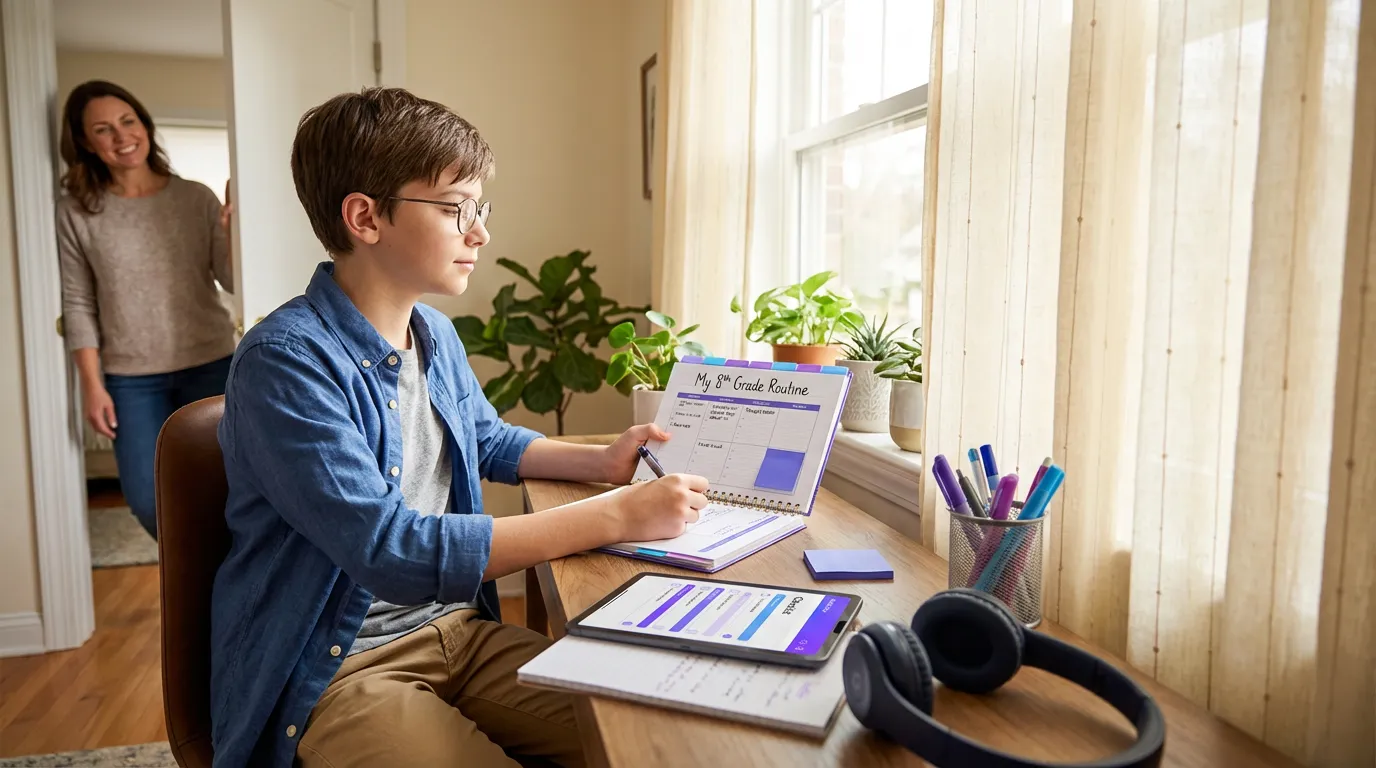
By 8th grade, independence is a natural part of learning. Your child is likely ready to manage a majority of their work, make decisions about how to approach assignments, and complete tasks on time.
You may see this from the very start of the day. Instead of waiting for direction, a learner may review their assignments and decide what to tackle first. They might begin to think ahead, not just about what needs to be done today, but how their work fits into the rest of the week.
Assignments also become more complex and extended. A writing project may take several days to complete, requiring planning, drafting, revising, and editing. A science investigation might involve tracking results over time, analyzing data, and presenting findings. These types of tasks naturally require learners to manage their time and stay organized.
Your role as a parent continues to shift. Rather than guiding each step, you can step in at key points. You might help your child plan a project, check their progress, or talk through specific challenges. This allows your child to build confidence while still having support when needed.
Research on adolescent learning shows that students develop stronger motivation and problem-solving skills when they are given opportunities to manage their own work and make decisions about their learning. Eighth grade is an ideal time to strengthen these habits before the transition to high school.
The role of structure in a 8th grade homeschool day
Even as independence increases, structure still plays an important role. The difference in 8th grade is that structure becomes a framework rather than a set of instructions.
Most learners benefit from having clear expectations, along with a general flow to the day. This might include starting with core academics, setting aside time for longer assignments, and leaving space for applied or real-world learning.
Instead of assigning each task in order, many families use a priority-based approach. Your child may have a list of responsibilities for the day or week and decide how to organize their time. This allows them to practice planning and time management while still working within a clear structure.
Structure helps prevent overwhelm. When learners know what is expected and have a general plan for completing their work, they are more likely to stay focused and follow through.
In 8th grade, the goal of structure is not control. It is to support consistency while giving learners space to take ownership of their time.
Balancing direct teaching with independent study time
By 8th grade, most homeschool routines include a clear balance between direct instruction and independent study. While new concepts still need to be taught, a large portion of the day is often spent working independently.
Direct teaching might include explaining a new math concept, discussing a reading passage, or helping your learner plan a writing assignment. These moments are often shorter but more targeted than in earlier grades.
Independent study takes up a larger part of the day. Learners may complete assignments, read, take notes, or work on long-term projects without constant supervision. This builds the focus and responsibility they will need in high school.
The goal is not to remove support, but to shift how it is provided. By 8th grade, learners are developing the ability to manage their work, seek help when needed, and take responsibility for their learning process.
How Long an 8th Grade Homeschool Day Should Take
By 8th grade, the question is less about “how many hours” and more about how effectively your learner is using their time. As assignments become more complex and independent work increases, the structure of the day shifts toward longer, more focused work periods rather than adding more hours.
Most families find that homeschool days are still shorter than traditional school, even at this level, because learning is more direct and efficient.
Typical daily learning time for 8th grade homeschool
Most 8th grade homeschool routines include about 4 to 6 hours of focused academic time each day.
This time often includes:
- Independent work on core subjects like math, reading, and writing
- Short, targeted instruction for new concepts
- Longer blocks for projects, research, or writing
- Time for revision, discussion, or review
The key difference from earlier grades is how that time is used. Learners are often working for longer stretches without interruption and managing a greater share of their workload independently.
For example, a learner might spend:
- 45–60 minutes on math
- 60–90 minutes on writing or a research project
- 30–60 minutes reading or analyzing text
- Additional time on science, history, or applied learning
Rather than switching tasks frequently, the day allows for deeper focus and fewer transitions.
How independent study fits into the daily routine
Independent study becomes one of the most important parts of an 8th grade homeschool routine. In many cases, it makes up the majority of the learner’s day.
Instead of completing short assignments with constant guidance, learners are:
- Working through multi-step assignments
- Managing long-term projects over several days or weeks
- Returning to work to revise, edit, or improve it
- Making decisions about when and how to complete tasks
For example, a learner might:
- Spend the morning drafting part of an essay
- Take a break, then return later to revise and strengthen their argument
- Continue working on that same assignment over multiple days
This type of structure mirrors what students will experience in high school, where assignments often require planning and follow-through.
Example Daily Routines for 8th Grade Homeschool
At this stage, the learner is more involved in how the day unfolds, while the parent provides guidance and accountability.
Below are a few ways families might structure an 8th grade homeschool day.
Sample structured homeschool schedule
A structured routine can help learners stay organized and build consistent habits, especially when managing multiple assignments.
A typical structured day might start with a quick check-in over breakfast or at the table. You and your child review what needs to be done, what is already in progress, and any upcoming deadlines. This helps set expectations before the day begins.
From there, the morning is often used for core subjects while focus is strongest. Your child might start with independent math work, then check in with you to review any problems. After that, they may move on to reading or begin a writing assignment.
By mid-morning, it is usually time for a break. This might look like grabbing a snack, going outside, or stepping away from work for a bit. At this age, short breaks can make a big difference in maintaining focus throughout the day.
Later in the morning, your learner may return to more involved work. This is often when longer assignments happen, such as drafting part of an essay, continuing a research project, or working through a science lesson that requires more time and attention.
Afternoons tend to be more flexible. Some families use this time for projects, creative work, or getting out of the house. That could mean working on a science experiment, heading to the library to find sources for a project, or spending time outdoors and using that experience as part of learning.
As you can see, the structured routine still allows for plenty of flexibility and freedom.
Sample flexible homeschool routine
Some families find that a more flexible routine works better in 8th grade, especially when schedules include activities, co-ops, or real-world learning. Instead of following a set order each day, the focus shifts to making steady progress while allowing the day to unfold naturally.
A flexible day might start more slowly. Your learner might begin with reading, journaling, or simply reviewing what needs to be completed. This kind of start can help ease into the day, especially if your schedule varies or mornings feel rushed.
From there, your learner works through their assignments based on priority and energy. Instead of being told what to do next, they decide how to move through their work. For example, they might start with a writing assignment one day and math the next, depending on what requires the most focus.
Throughout the day, learning adjusts around real life. You might have an outing planned, a co-op class, or time set aside for something outside the home. Academic work can happen before or after these activities, rather than needing to fit into a fixed block.
Block-style scheduling for middle school students
Block scheduling can work especially well in 8th grade because it gives learners the time they need to stay focused and actually make progress on more complex work. Instead of jumping between subjects, the day is broken into a few larger chunks where your learner can settle into what they are doing.
A block-style day often starts with a longer stretch for core subjects. Your learner might spend this time working through math, then shifting into reading or writing without feeling rushed. There is space to complete work, ask questions, and go a little deeper if needed.
Later in the day, you might have a second block set aside for content subjects like science or history. This is often where longer assignments happen. Your learner could spend that time working through a science investigation, organizing research, or continuing a project that takes more than one sitting.
The final part of the day is often more open. Many families use this time for creative work, outdoor learning, or personal interests. This could look like heading outside to observe nature, working on an art project, or following up on something your learner is curious about.
One of the biggest advantages of block scheduling is how easily it allows for meaningful experiences outside the home. Instead of trying to fit everything into short periods, you can dedicate time to things like:
- Visiting a museum or historical site and spending time exploring it fully
- Attending a homeschool group, class, or community activity
- Spending extended time outdoors observing, sketching, or collecting information
For many families, block scheduling helps the day feel calmer and more focused. Learners have time to think, work through challenges, and stay engaged, rather than constantly stopping and starting.
How to Design a 8th Homeschool Routine That Works for Your Family
By 8th grade, designing a routine becomes less about managing your child’s day and more about helping them learn how to manage it themselves. The steps below can help you plan a routine that will accomplish this.
Step 1: Move from daily planning to weekly planning
At this stage, many families begin shifting from planning each day to planning the week as a whole. This helps learners see how their work fits together and begin managing deadlines across multiple days.
For example, instead of assigning writing each day, you might set a goal to complete a draft by midweek and a final version by the end of the week. The learner then decides when to work on each part.
Step 2: Prioritize workload over schedule
Rather than assigning specific times for each subject, focus on what needs to be completed. This encourages learners to think about their workload and make decisions about how to approach it.
For example, a learner might choose to complete math first while they are most focused, then move into reading or writing later. Another day, they may prioritize a longer project that requires more attention.
Step 3: Teach time management and deadlines
Eighth grade is an ideal time to begin practicing real-time management skills. This includes understanding how long tasks take, planning ahead, and meeting deadlines.
You might introduce simple systems such as:
- Tracking assignments in a planner
- Setting personal deadlines for larger projects
- Breaking work into smaller steps across several days
Step 4: Encourage ownership of learning
As independence increases, learners benefit from having a voice in how their routine is structured. This might include choosing the order of tasks, selecting project topics, or deciding how to approach an assignment.
Tips for Maintaining a Consistent 8th Grade Homeschool Routine
At this stage, consistency comes less from a strict schedule and more from strong habits and clear expectations. The goal is to help learners follow through on their work while continuing to build independence.
Here are some tips for maintaining consistency:
Set clear expectations for the week
Instead of focusing only on daily tasks, make sure your learner understands what needs to be completed by the end of the week. This helps them plan ahead and stay accountable.
Use simple systems to track progress
Tools like planners, checklists, or digital trackers can help learners stay organized without feeling overwhelmed. The goal is to give them a clear way to manage their work independently.
Check in without taking over
Regular check-ins help ensure that work is being completed and that learners are staying on track. These moments might include reviewing assignments, discussing challenges, or helping adjust plans.
Allow flexibility while maintaining responsibility
Flexibility is still an important part of homeschooling, but by eighth grade, it should exist alongside responsibility. If the day shifts due to an outing or activity, learners are still expected to complete their work.
Keep space for meaningful experiences
Even with increased academic demands, it is important to maintain the parts of homeschooling that make learning engaging. Outdoor time, creative work, and community experiences continue to play a valuable role. These activities support both learning and overall well-being.
A Routine That Prepares Your Learner for What’s Next
A strong 8th grade homeschool routine is not about filling every hour of the day. It is about helping your learner build the skills they will need to manage more advanced work with confidence.
By focusing on independence, time management, and meaningful learning experiences, you can create a routine that supports both academic growth and personal responsibility.
As your learner moves toward high school, this foundation will help them approach new challenges with confidence, organization, and a growing sense of ownership over their education.
Sources
Benner, Aprile D. “The Transition to High School: Current Knowledge, Future Directions.” Child Development Perspectives, 2017.
Center on the Developing Child. “Executive Function & Self-Regulation.” Harvard University, https://developingchild.harvard.edu/science/key-concepts/executive-function/.
Centers for Disease Control and Prevention. “Child Development: Middle Childhood.” CDC, https://www.cdc.gov/ncbddd/childdevelopment.
Chiefs for Change. Middle School Strategy: Leveraging the Science of Learning and Development to Inform Education in Middle School. 2022, https://www.chiefsforchange.org/wp-content/uploads/2022/10/Middle-School-Strategy-Leveraging-the-Science-of-Learning-and-Development-to-Inform-Education-in-Middle-School.pdf.
“Developing Responsible and Autonomous Learners: A Key to Student Motivation.” American Psychological Association, www.apa.org/education-career/k12/learners.
Library of Congress. “Teaching with Primary Sources.” Library of Congress, https://www.loc.gov/programs/teachers/getting-started-with-primary-sources/.
National Assessment of Educational Progress. “Mathematics Framework for the 2022 Assessment.” National Center for Education Statistics, U.S. Department of Education, https://nces.ed.gov/nationsreportcard/mathematics/.
National Association of State Boards of Education. “Promoting Students’ Well-Being during the Transition to High School.” NASBE, https://www.nasbe.org/promoting-students-well-being-during-the-transition-to-high-school/.
National Academies of Sciences, Engineering, and Medicine. How People Learn II: Learners, Contexts, and Cultures. National Academies Press, 2018.
National Center for Education Statistics. “The Nation’s Report Card.” NCES, U.S. Department of Education, https://www.nationsreportcard.gov.
Stanford Graduate School of Education. How People Learn: Brain, Mind, Experience, and School. National Academies Press.


.svg)
.svg)