8th grade is a pivotal year for English and Language Arts, also known as ELA. This is when a love of literature may emerge, and writing begins to feel purposeful. Your child can now grasp complex characters, shape opinions, and explore new genres.
One day, during reading time at home, your child may suddenly turn to you and say, “Wait! He’s not a villain afterall.” Or during writing time, they may ask, “Is this sentence strong enough?” You will begin to see a powerful shift from completing assignments to taking ownership of their work.
In this article, we will walk through what a strong 8th-grade homeschool English curriculum looks like and how to plan an eighth-grade English Language Arts year. The goal is simple: to help your student enter high school ready to read thoughtfully and write clearly.
Overview: Teaching 8th Grade English or ELA at Home
By 8th grade, ELA shifts from learning to read and write to reading and writing to learn. The NAEP grade 8 ELA framework emphasizes interpretation, analysis, and evaluation, not just recall. But learning in middle school isn't linear. Some weeks, your child will sound like a budding author. Other weeks, they will stare at a blank page and feel stuck. Both are normal.
8th-grade homeschool English or ELA vs. in-school English or ELA
At home, you can choose literature that matches your child’s interests, slow down when needed, provide feedback in the moment, and utilize discussion in a way that feels natural. Research from ASCD shows students benefit from discussion-rich environments.
At home, discussion might look like talking through a chapter while folding laundry or debating a character’s choice over breakfast. That kind of informal conversation often leads to deeper thinking than a traditional school worksheet or assignment.
A traditional school setting is often controlled by a pacing guide and testing requirements. Literature is selected in advance. Writing assignments are prescheduled and often not interdisciplinary.
Topics Covered in 8th Grade Homeschool English Curricula
In 9th grade, English combines all previous skills. Students are expected to use them more independently and thoughtfully. A strong curriculum balances literature, composition, grammar, and vocabulary. Here are the core areas usually included in 8th-grade homeschool English.
Understanding literature on a deeper level
Your child will read novels, short stories, and possibly poetry, and start digging into theme, character growth, and author choices. Instead of simply retelling the plot, they will learn to explain what a text reveals and why it matters.
Reading and evaluating nonfiction
They will read essays, articles, or speeches and learn how to spot the main idea, recognize strong evidence, and question weak arguments. This strengthens critical thinking and prepares them for high school coursework.
Writing strong arguments
Expect more formal essays this year. Your child will practice making a clear claim, organizing ideas into paragraphs, and using quotations from texts to support their thinking. A typical assignment might ask them to argue whether a character made the right moral choice, using two quotes to defend their position.
Analytical and explanatory writing
In addition to arguments, they may write essays that explain a theme in a novel or analyze how an author develops a character. They will learn about writing structure with clear introductions, well-organized body paragraphs, and thoughtful conclusions.
Grammar and vocabulary in real writing and text
Instead of endless worksheets, grammar is often taught through revision. You and your child may look at their draft together and improve sentence clarity, punctuation, and word choice.
Vocabulary is usually connected to what they are reading. Your child learns new words in context. This makes new words easier to remember and use correctly.
Common Types of 8th Grade Homeschool English or ELA Curricula
Below are the most common ELA curricula used in 8th grade. As you read through, think about your teaching needs and which will best fit your homeschool rhythm.
- Comprehensive curricula: These are all-in-one programs that provide required materials. Reading selections, writing assignments, grammar, vocabulary lessons, and assessments are all organized into a single package. Comprehensive curricula work well for families who want a year-long program with minimal planning. Teaching multiple subjects at the middle school level can be overwhelming, and a comprehensive program can reduce some of the stress.
- Subject-specific or component curricula: These programs use separate resources or textbooks for each subject, allowing families to customize instruction. This approach is best suited for those who want to tailor their program to meet a student’s strengths or needs. This is the perfect option for a student who is an advanced reader but needs more support in writing and grammar.
- Online curricula: These programs offer instruction through video lessons, interactive learning modules, or live online classes. Online curricula are well-suited for students who benefit from visual instruction, as well as for parents who want added support in teaching a particular topic. Many online platforms offer features homeschoolers find helpful, such as progress tracking and instant feedback on assignments.
- Thematic curricula: These programs organize learning around major themes, big ideas, or real-world problems. Reading, writing, vocabulary, and grammar are taught in the context of a larger theme or project. This method supports students who enjoy hands-on, integrated learning. Thematic curricula encourage critical thinking, creativity, and deeper engagement across genres.
Elements to Consider Before Choosing an 8th Grade Homeschool English Curriculum
Choosing a curriculum means finding what fits your child. Consider these factors:
Age appropriateness and challenge
8th graders should read more complex texts and face higher writing expectations. Review the program’s reading list. Make sure it matches your child’s reading level and maturity. Stretching comprehension and challenging your student to grow will be beneficial in 8th grade.
Balance of reading and writing
A quality ELA curriculum will blend the areas and topics rather than teach them in isolation. Writing and grammar come through reading responses and literary analysis. Students learn language conventions when revising their work and seeing examples in real texts.
Guidance for writing instruction
Choose a program with helpful resources, such as detailed rubrics, step-by-step writing instruction, and revision examples. Pick resources based on how much support you need.
How to Build an 8th Grade Homeschool English or ELA Curriculum
When you plan your 8th-grade curriculum, focus on progress. Decide what you want your child to achieve by the end of the year.
Step one: Have an end goal in mind
Before choosing materials, think of your end goal. By the end of 8th grade, most students should be able to:
- Read a novel independently
- Write an analytical essay using evidence
- Revise their work
- Discuss literature thoughtfully
Write these goals down, as they can guide your choices and keep you focused.
Step two: Choose core texts
Pick four to six anchor texts for the year. Choose books that challenge but don’t overwhelm. It’s better to read a few books deeply than to read many with little comprehension. These texts are the basis for discussion and writing.
If you aim for variety, your choices may look like this:
- One or two novels with strong themes
- At least one nonfiction text
- A selection of poetry or short stories
- A play
Step three: Plan writing across the year
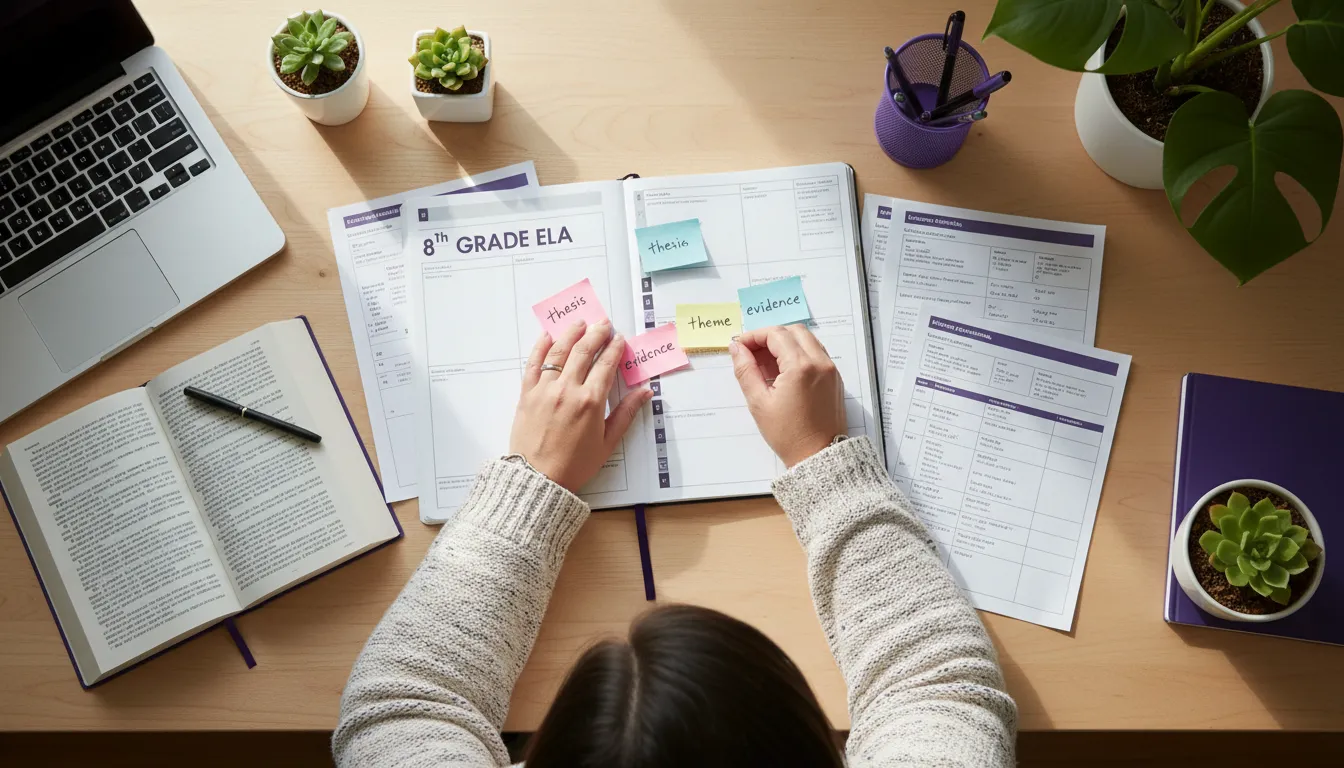
Plan essays intentionally instead of assigning them randomly. You might plan a literary analysis essay in the fall, an argumentative essay in the winter, and a research-based essay in the spring. Between big projects, assign shorter tasks, such as response paragraphs or journal entries. Spread out major assignments so your student has time to draft, edit, and revise.
Step four: Build independence gradually
Independence will grow over time. At the beginning of the year, you might model outlining an essay. By winter, your student can complete the outline independently. In the spring, you are focusing on editing and giving your child feedback. Gradually pulling back builds confidence and prepares students for high school.
What Teaching 8th Grade English or ELA at Home Can Look Like
Let’s imagine your 8th grader is reading The Giver by Lois Lowry. Below is how a novel study week may look with the goal of steady reading, meaningful conversation, and writing that grows across the week.
Monday: Reading and big questions
Your student reads two assigned chapters independently. After reading, you sit down together and talk through first impressions.
Your student writes a short response explaining one early sign that the community values control over individuality, using a direct example from the text.
Tuesday: Close reading
Choose a passage from the book. Read it aloud together and look closely at word choice and writing style. Your child writes a focused paragraph explaining how word choice helped to show a particular emotion or struggle.
Wednesday: Writing Workshop
Now move toward formal literary analysis. The assignment: Write one well-developed paragraph explaining a key part of the book. Model how to do the following: Make a clear claim, embed a quotation, and follow it with an explanation. You might also show them how to move from summary (“This happens…”) to analysis (“This shows…”).
Thursday: Revision and language focus
Read the paragraph aloud together. Does the claim match the evidence? Are transitions smooth? Are sentences varied? Instead of doing isolated grammar worksheets, you revise together.
Friday: Broader thinking or creative extension
End the week by zooming out. Discuss themes, compare the fictional society to historical or modern examples, and compare the text to other books you’ve read so far.
In a week like this, reading, discussion, writing, and revision work together. Your child is not just finishing chapters. They are learning how to interpret literature and express their thinking clearly.
Popular Homeschool English or ELA Curricula for 8th Graders
By this stage, many parents feel two things at once: proud of how far their child has come and, at times, unsure of how to guide the next step. Here are common curriculum support options for families homeschooling 8th grade.
Outschool’s online curricula and classes
Outschool offers small-group English classes that can support your ELA program in multiple ways. Some families use Outschool as their primary English curriculum. Others pair it with independent reading and writing at home.
Just a few of the offerings are:
- Full-year English courses: Students read novels together, participate in live discussions, and complete guided writing assignments with teacher feedback. This can be especially helpful if you want accountability and outside evaluation.
- Focused writing workshops target specific writing skills such as argumentative essays, literary analysis, or research writing. These classes work well if your student needs targeted support in one area.
- Discussion-based literature seminars allow students to explore novels in depth with peers. For many 8th graders, hearing other perspectives strengthens understanding and builds the confidence they need to express ideas aloud.
Planning guides and standards resources
Not every family wants a boxed curriculum. Some prefer to design their own plan using trusted frameworks as a guide.
You might look to:
- The National Association of Educational Progress (NAEP) Reading Frameworks to understand grade-level expectations. These give a clear picture of the skills students are expected to demonstrate by the end of middle school.
- Association for Supervision and Curriculum Development’s (ASCD) adolescent literacy resources provide insight into discussion, vocabulary, and reading comprehension strategies that support this age group.
- The Library of Congress's primary source collections can be incorporated into historical speeches, letters, or essays in reading and writing assignments. These can add depth and variety to your literature studies.
Frequently Asked Questions: 8th Grade Homeschool English Curricula
As you plan your 8th-grade English year, a few practical questions tend to surface. Below are answers to the most frequently asked questions from families.
Can homeschoolers earn high school English credit in 8th grade?
If your child is truly working at a high school level and you are documenting it carefully, 8th grade can absolutely include advanced work and high school credit. Keeping a portfolio with writing samples, reading lists, and grading rubrics will be helpful. If you are unsure, you can also speak with a local homeschool association or guidance counselor familiar with homeschool transcripts.
Do homeschoolers need to follow state English standards?
Homeschool requirements vary by state. Some states require specific instruction, while others require only certain assessments. Reviewing your state's homeschool laws will clarify what you need to document. Many families find standards to be helpful benchmarks without using them as a full curriculum.
How do assessments work in homeschool English?
Assessments for homeschool English can be flexible. Options include: Reading responses, vocabulary quizzes, writing portfolios, oral presentations, and literary analysis papers. It is best to keep a portfolio of your child's work to assess growth over time.
Reading Deeply, Writing Clearly
Eighth-grade English is more than a middle school checkpoint. It is the year when students begin to see themselves as readers and writers with something to say. A powerful novel may now spark real conversation. A well-written essay feels like an accomplishment, not just an assignment. Skills that once required step-by-step guidance begin to feel more natural.
One day soon, your student will walk into a high school English class. If this year has been intentional, they will not feel intimidated by reading Shakespeare or writing a long essay. They will recognize the process because they have done it before and succeeded.
Sources
National Assessment Governing Board. The NAEP Reading Framework for the 2022 National Assessment of Educational Progress: Reading and Writing. U.S. Department of Education, 2022, www.nagb.gov.
Association for Supervision and Curriculum Development (ASCD). “Seven Strategies for Improving Adolescent Literacy.” ASCD, www.ascd.org.
Institute of Education Sciences. Teaching Secondary Students to Write Effectively. What Works Clearinghouse, U.S. Department of Education, 2017, ies.ed.gov.
Library of Congress. “Primary Source Analysis Tools for Literacy Learning.” Library of Congress, www.loc.gov.


.svg)
.svg)