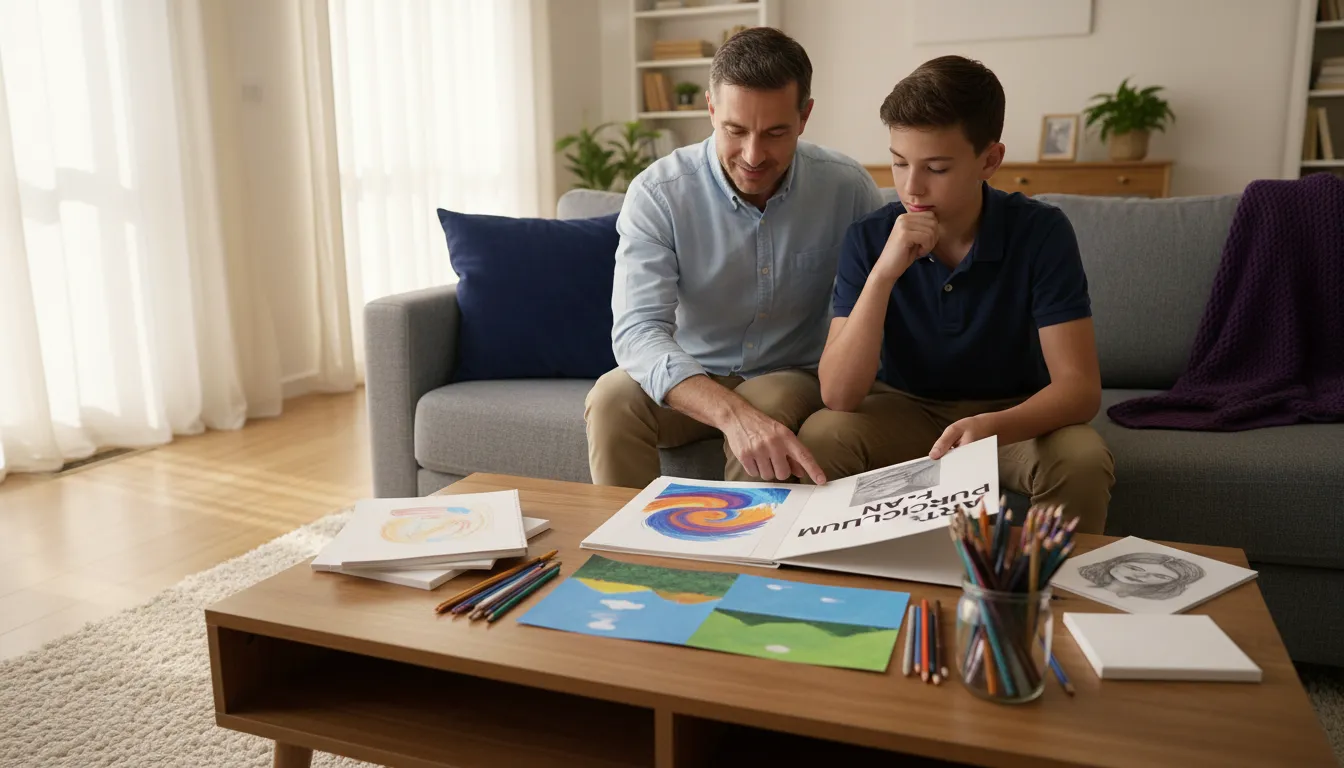
Eighth grade can be a beautiful year for art and creativity. You may notice that your child is no longer doodling to fill space. Instead, they are experimenting with identity, noticing details, or comparing artistic styles. They may suddenly care deeply about how an art project turns out. Luckily, in a homeschool environment, art has room to flourish and develop. You may find your child adding to a painting they made two weeks ago or stepping outside to sketch when they need a break.
Research shows that meaningful arts education strengthens critical thinking, problem-solving, and reflection skills. The National Core Arts Standards also emphasize that by middle school, students should be creating, presenting, responding to, and connecting through art, not just completing projects.
With these elements in mind, an effective 8th grade homeschool art curriculum makes space for exploration, thoughtful practice, and personal expression, while still building skills and visual literacy. In this guide, we’ll walk through what an 8th grade homeschool art curriculum should include, how teaching art at home can look different from a classroom setting, and how to choose or build a program that balances joy, skill, and meaningful growth.
Overview: Teaching 8th Grade Art at Home
By 8th grade, learners are thinking more abstractly and beginning to form a sense of identity. Art can become a way to process ideas and explore personality.
National data show that arts education supports both academic and cognitive development. The National Assessment of Educational Progress also notes that visual arts education engages students in creating, responding, and connecting, all of which strengthen critical thinking and visual literacy.
Teaching 8th grade art at home vs. in school
Teaching art at home can open up possibilities that are not available in a traditional school setting. Art can naturally connect to whatever you are learning. For example, a photograph can connect to a time in history, or a perspective drawing can reinforce geometry.
In a classroom, projects usually need to align with grading cycles. The art supplies are shared, budgets can be tight, and time can be limited to one period. But at home, you have the flexibility to spend multiple days getting the shading in a portrait just right.
Another key difference is ownership. In school, projects are often assigned with narrow parameters. At home, you can blend foundational skill-building with personal choice. For example, in school, every student completes the same still life in graphite. At home, your learner studies value and shading using graphite, but chooses their own subject, perhaps a family pet or a meaningful object.
There is also the emotional environment to consider. Middle school can be socially intense. Art in school may unintentionally become another space for comparison. At home, the focus can remain on growth. A conversation around the dinner table can turn into a self-evaluation. You might ask, “What was hardest about this project? What would you try differently next time?”
Topics Covered in 8th Grade Homeschool Art Curricula
The National Core Arts Standards organize learning around creating, presenting, responding, and connecting. Simply put, this means making art, studying art, talking about art, and connecting art to life. This framework can help you plan without turning your home into an art school with grades and pressure.
Below are the most common topics you’ll see, and some ideas on how to teach them at home.
Drawing fundamentals
This includes observation, proportion, value, and shading. Learners practice observation and translating what they see into paper. At home, you may ask your child to draw the same object three ways. This can support observation and skill development.
Composition and design
Composition and design are really about how the eye moves across a piece of art. For example, you may teach that balance keeps art from feeling lopsided, that contrast helps the eye focus on certain areas, and that emphasis tells the viewer what to notice first. These ideas sound technical, but they are surprisingly practical to teach.
At home, you might try a simple challenge: ask your child to redesign the cover of a favorite book using only three shapes and just two values, light and dark. This forces the artist to focus on placement, size, and perspective rather than relying on color or extra details.
Color theory
By 8th grade, students are ready to see that color is not just for fun. It shapes mood, focus, and meaning.
You can keep this simple at home. You could choose one basic scene, like a small landscape and have your child create it twice. Tell them the first version should feel calm, the second should feel tense or dramatic, and that the only significant change is the color choice.
Art history and appreciation
By 8th grade, art history is focused on learning about cultures through images. Art reflects the time, the values, and the experiences of the artist.
At home, you could choose one piece of artwork and become “art detectives” together. Ask three questions: What do you notice? What do you think it means? What makes you say that? Notice clothing, expressions, setting, color, and symbols.
Common Types of Homeschool Art Curricula for 8th Graders
In many homes, art can be a source of connection. As a family, you can create together and exhibit the work in your home. An 8th grade homeschool art curriculum, when chosen thoughtfully, can bring both structure and joy into your homeschool environment.
When you start searching for an art curriculum, the options can feel overwhelming. The key is not finding the most impressive program, but finding the one that fits your learner, your schedule, and your energy.
Here are the most common types you will encounter:
- All-in-one comprehensive programs: These programs combine drawing, design, art history, critique, and, sometimes, portfolio development into a single, structured plan. They often follow a scope and sequence aligned with middle school standards, such as the National Art Education Association. These programs work well for families who like precise pacing and planned projects.
- Skill-focused or subject-specific programs: Some curricula focus on one skill at a time. Each month, you may focus on drawing fundamentals, painting techniques, digital illustration, or art history. This approach is especially helpful if your learner shows a strong interest in one medium or wants to prepare for high school art courses. Research from Harvard’s Project Zero highlights the importance of developing craft and engaging persistently in a medium over time. A subject-specific curriculum gives space for depth.
- Project-based or studio-based curricula: Project-based programs are organized around a creative challenge. For example, instead of a unit on “color theory,” the learner might complete a project that intentionally applies color theory. This model aligns with arts education research that emphasizes problem-solving and reflection as core components of learning in the arts.
- Online or video-based instruction: Online programs offer classes taught by experts, which is perfect if you do not feel confident teaching art yourself. They can include recorded lessons, live classes, or interactive feedback. This model can be powerful for middle school learners who benefit from outside voices and structured demonstrations.
Elements to Consider When Choosing an 8th Grade Homeschool Art Curriculum
Choosing an 8th grade homeschool art curriculum is less about finding the best program and more about finding the right fit for your learner and your home. Middle school is a transition year, so you may take your learner’s skills, confidence, and joy into consideration when choosing a curriculum.
Here are the key elements to weigh carefully:
Age appropriateness and skill level
According to the National Core Arts Standards, middle school students should be developing independence in generating ideas, refining techniques, and evaluating their own work.
You can look for a curriculum that moves beyond craft projects and teaches composition and design. Your art program may include reflection and encourage your middle schooler to express themselves personally through their artwork.
Balance of structure and creativity
As parents, we can teach specifics like shading and also allow our learners to decide what they draw. If every assignment is open-ended, some learners may stall. If every assignment is rigid, creativity may shrink. The right curriculum blends both structure and open-endedness.
Supplies, cost, and preparation
Core tools like sketchbooks, pencils, erasers, watercolor sets, and basic acrylics are sufficient for most middle school skill development.
Before choosing a curriculum, check if there is a required materials list or if assignments can be adapted to use what you already own. At home, your living space or dining room table can become your art studio. All you need is the basics and the desire to create.
Alignment with state standards
Even though art is often flexible in homeschool settings, it is essential to understand your state's expectations, especially as your learner approaches high school.
Some states require documentation of subjects taught, while others require portfolios or evaluations. Reviewing homeschool laws in each state can help you determine whether you need to track hours, save work samples, or assign grades.
How to Plan an 8th Grade Homeschool Art Curriculum
Planning an 8th grade homeschool art curriculum does not require a massive time commitment or a stressful plan. It requires a clear goal, a simple structure, and space to adjust as your learner grows.
Here is a practical way to build a balanced, realistic plan.
Step one: Clarify your goals for the year
Start by asking yourself: What do I want my 8th grader to be able to do by the end of the year?
The National Core Arts Standards emphasize creating original work, refining technique, analyzing art, and connecting art to personal meaning, which can give you a helpful framework to start from.
For example, you might have the goal of three to five completed pieces by the end of the year that show understanding of color theory or elemental composition.
Step two: Blend skill practice with creative exploration
Finding that sweet spot between skill practice and open-ended exploration may take some time, but it may be worth it. For example, you might spend one day introducing one-point perspective and practicing it by drawing boxes to understand how lines move toward a vanishing point. That practice gives your child the tools they need to understand this type of perspective. Then, later in the week, you hand the creativity back to them. You have them create a visual of a sneaker shop and put their new skills to use. Suddenly, the skill has a purpose.
Step three: Integrate art history and visual literacy
In a homeschool setting, this step can be simple. For example, you might choose one piece of artwork each week, sit with it together, and look quietly for a moment before saying anything. Then start with an easy question: What do you notice first? Let your child talk. Follow up by asking what details stand out, what kind of mood the piece creates, and what might have influenced the artist at that time.
This process of "thinking about art" is a powerful one and can help your child grow as an artist and learner.
Step four: Build in reflection and documentation
Middle school learners can benefit from reflecting on their work. The National Core Arts Standards include analyzing, interpreting, and evaluating art as part of artistic growth. One possible way to end a project might be to write a short written artist statement, include a self-evaluation, or take a photo for a digital portfolio.
Day-to-Day or Weekly Routines for 8th Grade Homeschool Art
One of the advantages of homeschooling is that you get to set the rhythm. Art does not have to be squeezed into a crowded schedule. For example, you can pair a skill lesson with a free painting day or keep a sketchbook on the table for five-minute daily sketches that can quietly build confidence over time. Whatever your rhythm is, remember that the goal is steady engagement.
At home, simplicity is what will keep your program going strong. To keep things simple, you can try to store supplies in one easy-to-access spot and create a specific time slot in your weekly or daily routine for art. This can help it become part of your homeschool culture instead of an occasional extra. Just as necessary, protect the joy of creating art. Middle schoolers can be hard on themselves, so it's important to celebrate growth, sit and draw beside them once in a while, and ask about their ideas before correcting technique. An intentional 8th grade homeschool art routine builds skill, but it can also preserve that natural love of creating.
Popular Homeschool Art Curricula for 8th Graders
Finding art curricula that match your learner's interests and your family rhythm is easier when you know what is available.
Outschool's online curricula and classes
Outschool offers a variety of art classes that work well for 8th graders because they combine expert instruction with a flexible schedule that fits a homeschool routine. What makes Outschool particularly homeschool-friendly is that many classes are short blocks (60–90 minutes) that you can schedule weekly. Live instruction gives your learner opportunities to ask questions, receive feedback, and see techniques demonstrated in real time, which can strengthen skill acquisition. Some homeschool parents choose to pair an Outschool class with independent studio time and reflections.
Free and low-cost planning resources
There are quality resources available from trusted institutions that can support your at-home art program.
Frequently Asked Questions: 8th Grade Homeschool Art
How does 8th grade art prepare students for high school art courses?
A strong 8th grade homeschool art curriculum builds foundational skills that can be built upon in high school. These include observational drawing, understanding composition and color theory, completing multi-step projects, and writing brief artist statements. If your learner finishes 8th grade with a small portfolio of varied, intentional work and the ability to discuss their choices, they will be more prepared for high school art.
Can an 8th grade art class be taught by a non-art-focused parent?
Yes. You do not need to be a trained artist to guide meaningful art learning. The role of the homeschool parent is often that of a facilitator. Online instructional videos, art curricula, and museum resources can provide the expert voice.
Can one art curriculum work for multiple middle school grade levels?
Often, yes. Many art curricula are written for grade bands rather than single grades, such as 6–8. The National Core Arts Standards are also organized in grade bands, which allows flexibility.
Building Skill and Protecting Joy
Choosing the best 8th grade homeschool art curriculum is about creating space for growth. Middle school is a powerful age for art development. With a balanced plan, confidence can grow, and personality can shine through their creations. At home, art can breathe freely. With clear goals, you can build a program that prepares your child for high school while preserving the natural love of art that makes it worthwhile.
Sources
Association for Supervision and Curriculum Development. "Does Arts Education Matter." ASCD, https://www.ascd.org/el/articles/does-arts-education-matter
Library of Congress. "Digital Collections." Library of Congress, www.loc.gov/collections.
National Coalition for Core Arts Standards. National Core Arts Standards: A Conceptual Framework for Arts Learning. 2014, www.nationalartsstandards.org.


.svg)
.svg)