Topics Covered in 7th Grade Writing Curricula for Homeschool Learners
Many of the usual topics covered in 7th grade writing will look a lot like those they worked with in earlier grades. But that's as it should be. The increased rigor comes from the use of more complex topics and techniques within them.
The writing process
Even though your kids have likely been learning about the writing process for years, it remains the most useful tool for arriving at a finished product that your child can be proud of.
By now, your child has probably internalized this reiterative workflow: 1) pre-writing (brainstorming, outlining), 2) drafting (getting ideas down in a first draft without worrying about correctness, 3) revising (improving the content, organization, and style leading to a second draft) 4) editing (fixing grammar, punctuation, and spelling errors leading to a final draft), and 5) delivering the final draft to its intended audience.
While the process remains the same, the length and complexity of the pieces of writing your child takes through it grow in length and complexity each year (National Council of Teachers of English).
Types of writing
Seventh grade involves writing several different types of pieces: descriptive (using vivid language to paint a picture with words), narrative (telling a story), expository (explaining a topic), and persuasive (making a claim and supporting it with evidence).
Again, most of these will be familiar to your child, but the bar is raised this year in terms of the subject matter they write about and the expectations for demonstrating proficiency. Also, persuasive writing takes on a featured role in the 7th grade as your child's developing critical thinking skills are applied in multiple contexts (National Governors Association).
Research
The National Governors Association also notes that 7th grade research involves turning a "big question" into a research paper or presentation. Kids learn skills like how to evaluate the credibility of sources, take notes from them in ways that don't result in plagiarism, synthesize information clearly, use in-text documentation, and complete a bibliography.
Grammar and mechanics
Each year of writing instruction typically includes lessons on grammar, punctuation, and mechanics. It's usually taught in the context of the student's own writing rather than through worksheets. In 7th grade, areas of focus include sentence variety, use of transitions, and paraphrasing and citing sources to avoid plagiarism (National Writing Project et al. 71).
Types of 7th Grade Homeschool Writing Curricula
Homeschool curricula for 7th grade writing can be categorized in two important ways: delivery method and instructional focus. These are the most common types.
Delivery method
The delivery method refers to how the curriculum actually teaches writing, including how lessons are presented, modeled, and practiced with the student. The following approaches describe the most common ways homeschool writing programs structure instruction and guide students through learning new skills.
- Direct instruction: This method, whether scripted or via video, models how to apply a concept before kids try it themselves (Graham et al. 12)
- Process-based Instruction: This approach focuses on the "writing process" with particular emphasis on the importance of the revision stage (17).
- Literature-based Instruction: This method asks students to analyze high-quality writing from professional authors to see how various writing techniques are used in the real world. Then they attempt to imitate these techniques in their own writing (20).
- Incremental instruction: This approach breaks a writing assignment down into small, foundational skills before moving on to longer pieces. For instance, kids might work on crafting a masterful sentence or an outstanding paragraph before diving into a full essay (13).
Instructional focus
Instructional focus refers to what the curriculum prioritizes teaching within writing itself. Some programs treat writing as part of a broader language arts experience, while others focus specifically on particular writing skills, genres, or real-world projects.
- Integrated language arts: This approach weaves writing instruction in with literature study, grammar, and spelling to show how these skills overlap.
- Subject-specific: These are stand-alone writing units of study that focus solely on the craft of writing without any connection to literature. For instance, one unit might be on expository writing and another on argumentation.
- Project-based: This approach starts with a "big question" or real-world problem that asks the child to produce a piece of writing that addresses it. For instance, a 7th grader might research traffic laws in different nearby neighborhoods and then write a persuasive letter to a local board recommending needed changes (National Council of Teachers of English).
Elements to Consider Before Choosing a 7th Grade Homeschool Writing Curriculum
If staring at a blank page has ever made you or your child nervous, then you might be anxious about choosing the 7th grade homeschool writing curriculum that will work best in your home. But there's no need for nerves. By considering the factors outlined here, you'll feel confident in the curriculum you choose to help your child experience the power of writing.
Readiness
Your 7th grader might be a budding Hemingway or Brontë. But then again, they might find the idea of putting pen to paper scarier than having their phone or tablet taken away for a week. If you aren't sure where your child falls on that spectrum, consider having them complete an assessment. There are several free versions online. This can keep you from jumping into a persuasive research paper assignment before they've mastered writing expository paragraphs (Tomlinson 45).
Instructional philosophy
There are very different, even contradictory, schools of thought on the best way to teach writing. These are common approaches used in 7th grade homeschool writing instruction.
- Classical approach: Rooted in the classical three-part structure of the "Trivium" (Grammar, Logic, and Rhetoric), this approach is systematic and rules-based. Kids learn by imitating the features used by master writers (Wise and Bauer 44).
- Formulaic approach: This approach treats writing like a construction project. The blueprint is a checklist of techniques that kids need to incorporate into their writing. For instance, they might be asked to include a thesis statement that makes a claim and the use of relative clauses (Graham and Perin 15).
- Natural approach: Based on the philosophy of Charlotte Mason, this approach hinges on the belief that if kids are exposed to great art and literature, then this will spill over into their own writing. A key strategy is "copy work," where kids are asked to write like examples presented, and for homeschooling, the focus is more on the parent-child relationship than any rigid expectations for the final product (Mason 233).
- Workshop approach: Popularized by Donald Murray and Lucy Calkins, this approach treats kids as professional writers in their own studio. The process is more important than the product, and kids spend lots of time in the drafting and revising stages. Typically, the parent will teach a 10-minute mini-lesson on a specific skill, like writing a hook that grabs the reader's attention or the types of evidence to use to support a claim. Then, most of writing class is the child working through the various stages of the process (Calkins 193).
Parent capacity
Teaching writing doesn't only involve lesson planning. It comes with a lot of time spent reading and responding to your child's writing. It's helpful to be clear up front about the time you have available to avoid burnout.
There are on-demand, self-paced video lessons on digital platforms that provide feedback on the writing kids submit, but a potential drawback here is the passive nature of the learning. Instead, many parents opt for live group classes in real time, taught by experienced educators and writing coaches (Moore and Kearsley 211).
Evaluation
You'll want to decide how you will evaluate your child's writing based on your instructional philosophy. Many teachers and parents use rubrics to assess final drafts. Rubrics list the features of the piece, like five paragraphs, a clear thesis statement in the introduction, three specific points in the body, sentence variety, correct conventions, etc.
Then scores (1-10) or descriptions (from "not meeting expectations" to "exceeding expectations") are assigned to each element, which provide feedback on strengths and weaknesses (Andrade 15).
How to Implement a 7th Grade Homeschool Writing Curriculum
Once you've determined your child's readiness, your instructional philosophy, your capacity for what's involved, and how you want to evaluate writing, then you're ready to implement your chosen curriculum at home. Consider this three-part plan to ensure success.
Step 1: Create a plan for the year
A great thing about homeschooling is that if an exciting new learning opportunity surfaces or your child discovers a new talent or passion, you can switch up your routines to make the most of them.
Even still, having a general plan for the year is a great practice to ensure you cover the skills you want your child to learn. Consider breaking a 36-week academic year into four quarters. The first could focus on descriptive and narrative writing, the second on expository essays, the third on persuasive writing and argumentation skills, and the fourth on a research project.
Step 2: Create a weekly rhythm
While you'll probably want your child to do some writing every day, there's no need for you to provide direct instruction from Monday through Friday. A possible weekly plan could look like this:
- Monday (Mini-lesson and pre-writing): Give a 10–15 minute writing "ip, like how to write a good conclusion or the correct use of a semicolon. Then give your child time to brainstorm a topic and ideas for the next writing assignment.
- Tuesday (Drafting): Let your child write without interruption. Your only job here is to be on call for questions.
- Wednesday (Revising): Have your child read the draft aloud and together discuss places that may need adjustments for clarity or organization. Don't let your child worry about grammar or punctuation at this point; the goal is to get the content down first. Then have them incorporate those revisions into a second draft.
- Thursday (Editing): Once your child is happy with the content of the pieces, have them read it over with an eye toward conventions, like spelling, punctuation, grammar, and mechanics. They can then make those edits and produce a final draft.
- Friday (Publishing): To publish means to get a piece of writing to its intended audience. That might simply be you as the teacher, and you can use a rubric to provide feedback on the finished piece. Take time to discuss the assessment results with your child (Calkins 193).
Step 3: Audit progress
Your child's final writing assignments will help you know whether putting word after word after word is achieving the intended results. You can ask yourself these questions each time your child completes a writing assignment as a way of auditing progress:
- What strengths did I see? Do those accomplishments suggest that I don't need to spend as much time on one topic or another?
- What growth areas did I see? Are there skills that I should go back and re-teach?
- Did my weekly plan "work?" In other words, does my child need more time to revise or edit? Or do they need more frequent mini-lessons to ensure that the new learning "sticks?" There's no need to force a five-stage process into a five-day week. If your child would do better spending a large block of time prewriting, drafting, and revising in one day, let them!
- Is my annual plan on track? At the end of each quarter, ask yourself if your child's progress warrants moving on to focus on the new type of writing. If they don't have expository skills down, then jumping into persuasive writing will only cause frustration (William 46).
Popular Homeschool Writing Curricula for 7th Graders
Don't worry, you don't need superpowers to make it possible for your 7th grader to excel at the art and science of writing. Check out these popular homeschool writing curriculum options that can support you and your goals.
Outschool's online curricula and classes
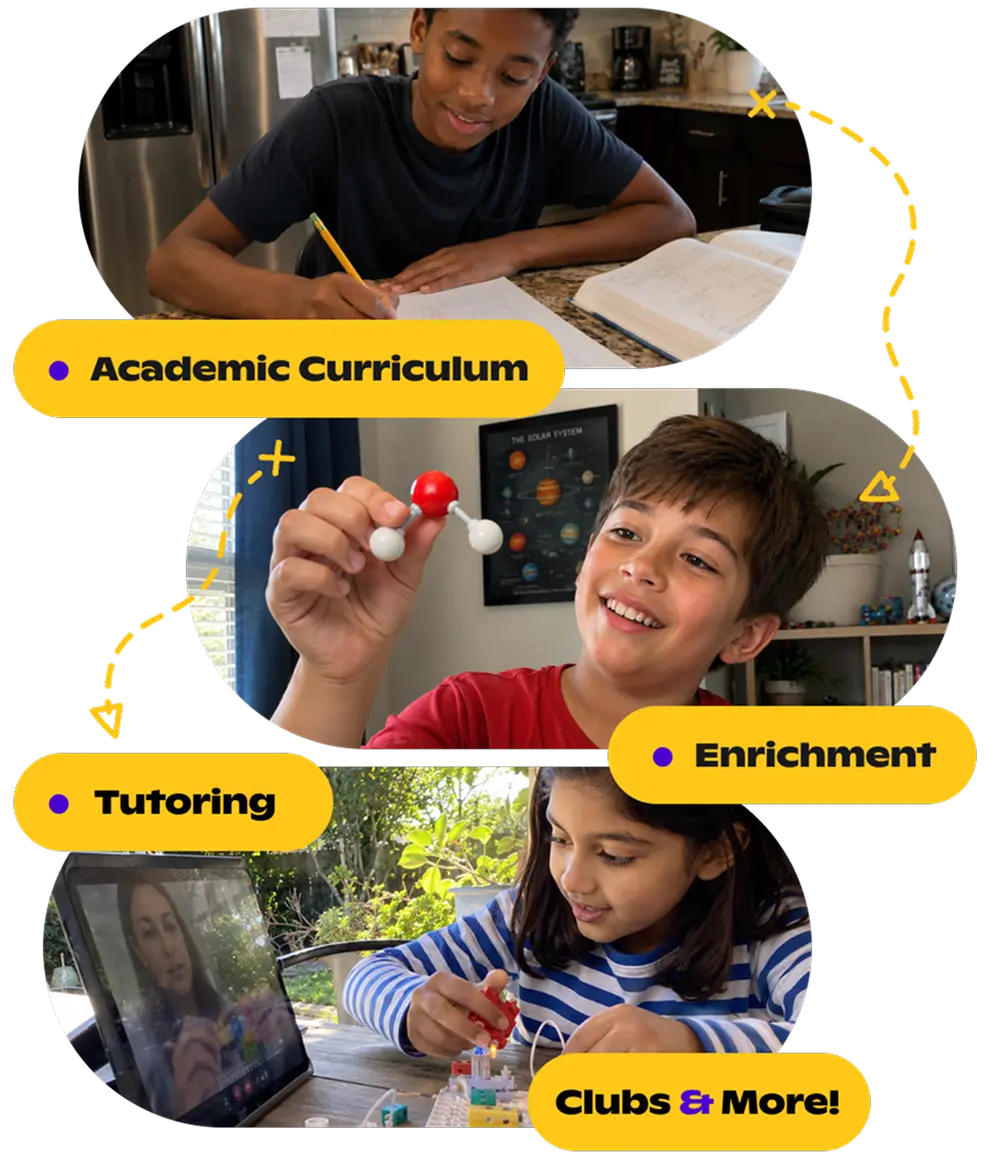
Parents love Outschool's 7th grade online writing classes. Their live group classes take place in real time and are led by vetted professionals, which is a great resource for parents who don't feel confident in their own ability to teach writing as their kids get older.
Also, parents like that their child is able to interact with other students online, which makes the writing process even more engaging. The classes include full-year courses, multi-week unit studies, one-week targeted support on a specific skill, and even one-on-one tutoring, and there are options for advanced and reluctant writers.
They even have clubs, like the year-long Roald Dahl Club for Writing and Reading Fun. Kids love the engaging lessons, and parents appreciate the guidance from professional educators.
Open-access curricula
One example of free curriculum materials online is from the Core Knowledge Foundation, which was established by E.D. Hirsh, who popularized the educational focus on cultural literacy in the 1980s.
It provides complete planning guides at no cost, but the lesson guides are heavily scripted and designed for a classroom setting of 25+ students, which doesn't always translate well at home.
Also, a parent using this curriculum would need to spend a lot of time going through all of it. One unit might be hundreds of pages long, as it contains both essential skills and "classroom filler activities" that you won't be interested in. It's rigorous but not very flexible and requires a fast pace to cover everything. Also, it's been criticized for being too literature-focused, with the related literature being too Eurocentric.
National Writing Project
Another free resource is the National Writing Project, which has tons of information available on the teaching of writing. However, it's not organized into unit studies or lesson plans, so a great deal of preparation is needed to translate the content there into usable homeschool lessons.
Public domain vintage texts
Textbooks published prior to 1923 can be found free of charge in the public domain. Therefore, some homeschool families use their multi-week planning materials, especially if they are interested in old-school rigor.
However, a tool commonly used is sentence diagraming, which many experts feel is fine for use as a logic exercise but not very helpful for improving writing (O'Hare 57, 68).
Frequently Asked Questions: 7th Grade Homeschool Writing Curricula
Writing is a complex activity, one that's both process and product, both art and science. So it would make sense to have questions about how to implement a 7th grade homeschool writing curriculum successfully in your home. But that's okay, we've got answers!
Should grammar be taught separately or integrated into a 7th grade homeschool writing curriculum?
Most experts agree that teaching grammar in isolation doesn't necessarily result in better writing. Circling the dependent clauses in a paragraph on a worksheet doesn't mean your child will be able to use them to create sentence variety. It's usually more effective to teach kids a grammar concept, like relative pronouns, and then have them use them immediately in their current piece of writing to combine choppy sentences.
The immediate application in their own work helps to make the learning stick. That said, there are times when an isolated grammar lesson may be helpful. For instance, if your child hasn't ever heard of a participle or gerund, you may need to spend some time on them before they can understand how to use them to give the beginnings of sentences some extra spark. Teaching grammar on its own may also be needed if your state's standardized tests include a section on writing conventions.
How do I assess progress in a 7th grade homeschool writing curriculum without standardized testing?
Yes, the rigidity of standardized testing is not a good fit for evaluating your child's growth as a writer. Fortunately, there are other ways to keep track of their development over time.
- Rubrics: As previously discussed, rubrics provide more detailed feedback on strengths and weaknesses than any letter grade could provide. And since writing is a recursive process, kids can use the feedback on the rubrics used to go back to the revising and editing stages to continue improving the piece if desired.
- Portfolio: A portfolio is a collection of your child's writing over a period of time. You might include one final product of each of the major types of writing covered during the year, as well as a couple of writing assignments from start to finish that demonstrate significant improvement throughout the process.
- Self-reflection: Asking kids to reflect on the process of arriving at their final draft is a great way to help them develop meta-cognitive skills. You might ask your child to answer a few questions each time they finish a piece: What do you feel best about in this piece? What part was hardest for you? How did you use (you can insert any lesson topic here) in this piece? If you had another hour to work on it, what would you change?
Word After Word After Word
Strong writing truly is a source of great power. And the combination of high-quality curricula, your careful planning, and the supportive environment of your home will ensure that your child will be able to develop that superpower in spades. They'll use it not just for 7th grade writing assignments but also for the many tasks in high school, college, and beyond that require clear, compelling prose. Without a doubt, the skillful use of language may be one of the greatest powers of all time.
Ready to plan ahead? Our 8th grade homeschool writing curriculum guide walks through how the skills built this year carry into high school preparation.
Sources
Andrade, Heidi Goodrich. "Understanding Rubrics." Educational Leadership, vol. 54, no. 4, 1997.
Association for Middle Level Education. This We Believe: Keys to Educating Young Adolescents. AMLE, 2010.
Atwood, Margaret. "Spelling." True Stories, Oxford University Press, 1981.
Calkins, Lucy McCormick. The Art of Teaching Writing. New ed., Heinemann, 1994.
Core Knowledge Foundation. 2025, www.coreknowledge.org.
Edutopia. George Lucas Educational Foundation, 2026, www.edutopia.org/article/helping-middle-school-students-be-better-writers/.
Graham, Steve, et al. Teaching Secondary Students to Write Effectively. NCEE 2014-4005, National Center for Education Evaluation and Regional Assistance, Institute of Education Sciences, Nov. 2014, https://ies.ed.gov/ncee/wwc/PracticeGuide/19.
Graham, Steve, and Dolores Perin. Writing Next: Effective Strategies to Improve Writing of Adolescents in Middle and High Schools. Alliance for Excellent Education, 2007.
Mason, Charlotte. Home Education. 1886. Reprinted by Charlotte Mason Community School, 1989.
Moore, Michael G., and Greg Kearsley. Distance Education: A Systems View of Online Learning. 3rd ed., Wadsworth Cengage Learning, 2012.
Mueller, Jon. "Portfolios." Authentic Assessment Toolbox, 2024, https://jonfmueller.com/toolbox/portfolios.htm.
Murray, Donald M. "The Maker's Eye: Revising Your Own Manuscripts." The Writer, vol. 86, no. 10, 1973.
National Council of Teachers of English. Professional Knowledge for the Teaching of Writing. NCTE, 28 Feb. 2016, https://ncte.org/statement/teaching-writing/.
National Governors Association Center for Best Practices, Council of Chief State School Officers. Common Core State Standards for English Language Arts & Literacy in History/Social Studies, Science, and Technical Subjects. Common Core State Standards Initiative, 2010, https://www.thecorestandards.org/ELA-Literacy/W/7/.
National Writing Project. 2026, https://www.nwp.org/.
National Writing Project, et al. Because Writing Matters: Improving Student Writing in Our Schools. Jossey-Bass, 2006.
O'Hare, Frank. Sentence Combining: Improving Student Writing without Formal Grammar Study. National Council of Teachers of English, 1973.
Tomlinson, Carol Ann. How to Differentiate Instruction in Mixed-Ability Classrooms. 2nd ed., Association for Supervision and Curriculum Development, 2001.
Wiliam, Dylan. Embedded Formative Assessment. Solution Tree Press, 2011.
Writing Center. University of North Carolina at Chapel Hill, 2024, writingcenter.unc.edu/tips-and-tools/style/.



.svg)
.svg)