What seventh grade social studies covers (and why it matters)
Seventh grade is when social studies shifts from learning facts to learning how to think about them. Your kid is not just memorizing dates anymore. They are comparing civilizations, analyzing primary sources, and starting to form their own perspectives on why things happened the way they did.
Developmentally, kids around age 12-13 are building the capacity for abstract reasoning. They can compare viewpoints, trace cause-and-effect chains, and evaluate evidence. The National Council for the Social Studies (NCSS) C3 Framework emphasizes that middle school students should learn to develop questions, evaluate sources, communicate conclusions, and take informed action. [1] A strong seventh grade curriculum leans into this.
The challenge for homeschool families is that there is no single seventh grade social studies sequence. Public schools vary by state: some teach world history, others teach early American history, others blend geography and civics. At home, you get to choose the focus, which is both freeing and overwhelming.
Four paths through seventh grade social studies
Ancient civilizations through the Middle Ages
Many programs start with the river valley civilizations (Mesopotamia, Egypt, Indus, Yellow River) and move through Greece, Rome, and the medieval period. This path gives your kid a broad foundation in how governments, trade networks, and religions developed and influenced each other.
At this age, your kid can do more than identify civilizations on a map. Ask them to compare political structures: "How was Rome's republic different from Athenian democracy? Who had power, and who did not?" These questions build the analytical thinking that the C3 Framework targets.
Early American history
Some states teach U.S. history in seventh grade, covering Native American cultures through the Civil War. If you plan to cover U.S. history again in high school (most colleges expect it), this serves as a strong foundation.
Primary source analysis works well here. The Declaration of Independence, letters from the Constitutional Convention, accounts from the Lewis and Clark expedition: these documents give kids practice reading historical texts and evaluating the perspectives behind them.
Geography and global cultures
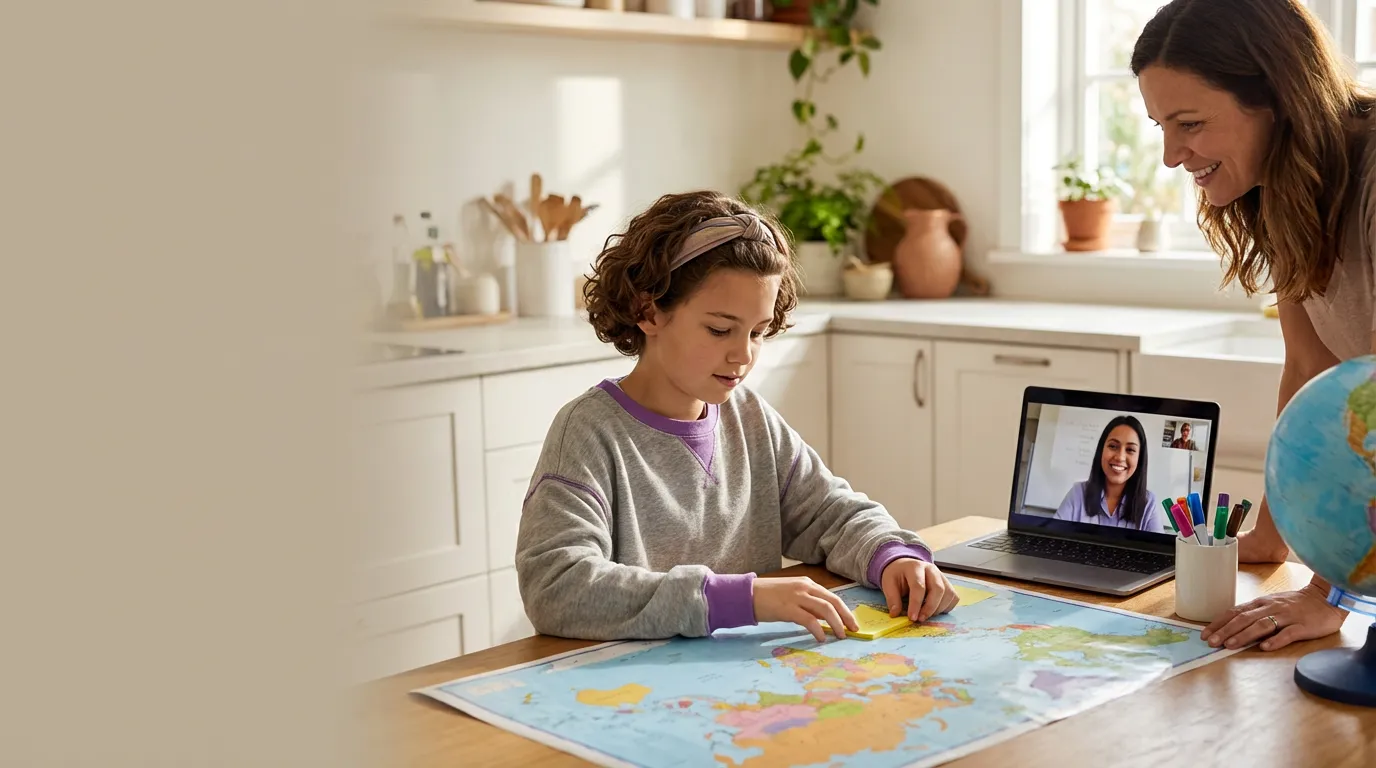
A geography-centered year explores continents, economic systems, migration patterns, and how physical geography shapes culture and trade. This approach appeals to visual learners who connect with maps, and it builds the global awareness that makes current events meaningful.
Civics foundations
Some families dedicate seventh grade to government and civic responsibility: forms of government, the U.S. Constitution, voting and representation, and how laws are made. This is especially engaging for kids who are interested in politics, current events, or community action.
$20 off your first class WITH promo code: blog
Build the Education your Kid Deserves
Discover thousands of live classes taught by expert teachers, across academics and enrichment.
Browse classesChoosing a curriculum approach
Once you pick your content focus, the next decision is how to deliver it. Four common approaches:
- Textbook-based programs. Predictable, structured, and easy to follow. Daily plans and built-in assessments are included. The trade-off: textbooks summarize rather than explore, so you may need to supplement with primary sources and discussion to build deeper thinking.
- Discussion-driven or literature-based programs. These rely on historical novels, biographies, speeches, and primary documents. Your kid analyzes sources and forms their own arguments. This works well for families who value inquiry, but it requires active facilitation from the parent.
- Project-based curricula. Kids build models, create presentations, write historical fiction, or produce documentaries. This approach suits creative kids and integrates social studies with writing, art, and technology. At home, you can combine subjects in ways a classroom cannot.
- Online or video-based courses. Online social studies classes provide direct instruction, peer discussion, and accountability outside the home. Live classes let kids debate in real time and analyze sources together in small groups. This format reduces parent prep time and works well for kids who are ready for more independence.
Planning your year: a three-step framework
Step one: pick your story arc
Start with one question: what story are we exploring this year? If you choose ancient civilizations, your themes might be government, trade, religion, and daily life. Repeat those themes across each civilization you study, and your kid starts seeing patterns instead of isolated facts. That is historical thinking.
Step two: build a weekly rhythm
A simple structure that works for many families: one reading and discussion day, one map or geography day, one writing or project day. Not every week needs all three. Rotate the emphasis so your kid practices different skills without feeling overloaded.
A typical week might look like this: Monday, read a chapter on ancient Rome's government and discuss two questions ("Why would citizens support this system?" "Who might not have benefited?"). Wednesday, pull out a map and trace Roman trade routes, maybe cook a dish inspired by the region. Friday, write a paragraph explaining how geography affected Roman expansion, or a diary entry from a merchant's perspective.
Step three: use primary sources
The Library of Congress, National Archives, and Smithsonian Institution all offer free, curated primary source collections with classroom-ready analysis tools. When your kid examines a document, guide them with questions: "Who created this? What was their goal? What might they have left out?" There are no right answers. The value is in the process of thinking critically about evidence.
Writing in seventh grade social studies
This is the year when writing shifts from basic summary to explanation and argument. Your kid practices describing what happened and why it mattered. A strong curriculum introduces paragraph structure, using evidence from a text, and comparing viewpoints.
At home, this might look like teaching your kid to create an outline, pull a quote from a source, and explain what it means. Short, regular writing (a paragraph or two per week) builds reasoning skills more effectively than occasional long essays. If your kid resists writing, strategies for reluctant writers can help reduce the friction.
Popular curriculum options
Outschool's live online classes
Outschool offers history and social studies courses ranging from full-semester world history surveys to focused units on ancient Egypt, government, or historical writing. Live classes give your kid the opportunity to engage in peer discussion, receive guided questions from expert teachers, and practice articulating their thoughts in a small group. Browse seventh grade social studies classes to find options that match your focus.
Free institutional resources
If you prefer to build your own curriculum, these institutions offer high-quality free materials:
- Library of Congress (loc.gov): primary source documents, lesson plans, and curated collections for student analysis
- National Archives (archives.gov): foundational government documents, historical records, and document analysis tools
- Smithsonian Institution (si.edu): digital exhibits, articles, and multimedia resources across cultural and scientific history
- Stanford History Education Group (sheg.stanford.edu): research-based history lessons focused on sourcing, contextualization, and evidence-based reasoning
Meeting your state's requirements
Check your state's homeschool laws before planning your year. Some states require annual assessments, portfolio reviews, or specific subject coverage. Even in states with minimal regulation, keeping records of readings, projects, and writing samples helps you track growth and prepares your kid for high school transcript documentation.
Frequently asked questions
How do I balance reading, discussion, and projects?
Build a weekly rhythm and rotate the emphasis. One or two reading days, one discussion or document analysis session, and one project or writing activity per week is a sustainable structure. Not every lesson needs all three. Rotate so your kid practices different skills without feeling overloaded.
Should I include geography and timelines alongside history?
Yes, and it works best when woven in rather than taught separately. Keep a map nearby and reference it when studying any region. Add events to a running timeline as you move through the year. These small habits build the understanding that history and geography are deeply connected.
What role should writing play in seventh grade social studies?
Regular, short writing is more effective than occasional long essays. Short paragraphs, simple comparisons, and cause-and-effect responses build reasoning skills and prepare kids for high school expectations. Aim for one to two writing tasks per week.
Can my kid take online social studies classes alongside our curriculum?
Yes. Many families pair a home curriculum with online social studies classes to add peer discussion, teacher-guided analysis, and accountability. This hybrid approach lets you customize content at home while outsourcing the discussion component.
Sources
[1] National Council for the Social Studies. The College, Career, and Civic Life (C3) Framework for Social Studies State Standards. NCSS, 2013. https://www.socialstudies.org/sites/default/files/c3/C3-Framework-for-Social-Studies.pdf


.svg)
.svg)