By 7th grade, many homeschool families notice a shift. Learning is no longer just about building basic skills. It starts to feel more like preparation. Assignments take longer, expectations are higher, and your child is capable of handling more responsibility throughout the day.
At the same time, a rigid schedule rarely works well at home. What most families need is not a strict timetable, but a routine that supports focus, independence, and flexibility.
A strong 7th grade homeschool routine can create space for deeper thinking while still leaving room for movement, creativity, and real-world experiences. Instead of managing every step, parents begin guiding from the side as learners take a more active role in their education.
In this article, you will learn what a 7th grade homeschool day can possibly look like, how much time to spend per day, and how to build a routine that supports both academic growth and increasing independence.
What a Daily Homeschool Routine Looks Like in 7th Grade
Seventh grade homeschool often feels self-directed as your child moves through their day with less assistance. Most families build their routine around a rhythm that fits their needs rather than a strict schedule. The day usually includes focused academics, independent work time, and movement or exploration.
A typical day might begin with a short lesson on a new skill, followed by independent math work or reading. As the parent, you may step in to answer questions, review work, or discuss ideas. Later, your child may spend time working on a longer research project before taking a break outside. Afternoons can be opened up for more flexible learning. This could include a science experiment, a history discussion, or time spent in the community applying what they are learning. A nature walk might turn into sketching for art or collecting data for science
Compared to earlier grades, the biggest difference is that the learner is no longer moving from activity to activity with constant direction. Instead, they are beginning to manage parts of their day, work for longer periods, and take more ownership of their learning.
How 7th grade learning becomes more independent
Independence in 7th grade does not mean doing everything alone. It means learning how to take responsibility while still having guidance available. Over time, this balance helps learners build confidence, manage their work more effectively, and prepare for the expectations of later middle school and high school.
This does not happen all at once. Independence in 7th grade usually develops through small changes in the daily routine. Parents can begin setting expectations, checking in, and offering support when needed.
One of the biggest changes is the management of workload. You may start the day with a list of priorities that your child is in charge of completing. They will decide the order and time spent depending on their learning style.
For instance, if your child is finishing a large project, they might start the day with the most complex, focus-heavy work. Then later, they might then pivot to a hands-on creative section of the assignment before finishing with a collaborative peer discussion in the late afternoon. This allows them to treat their education as a workflow rather than just a to-do list.
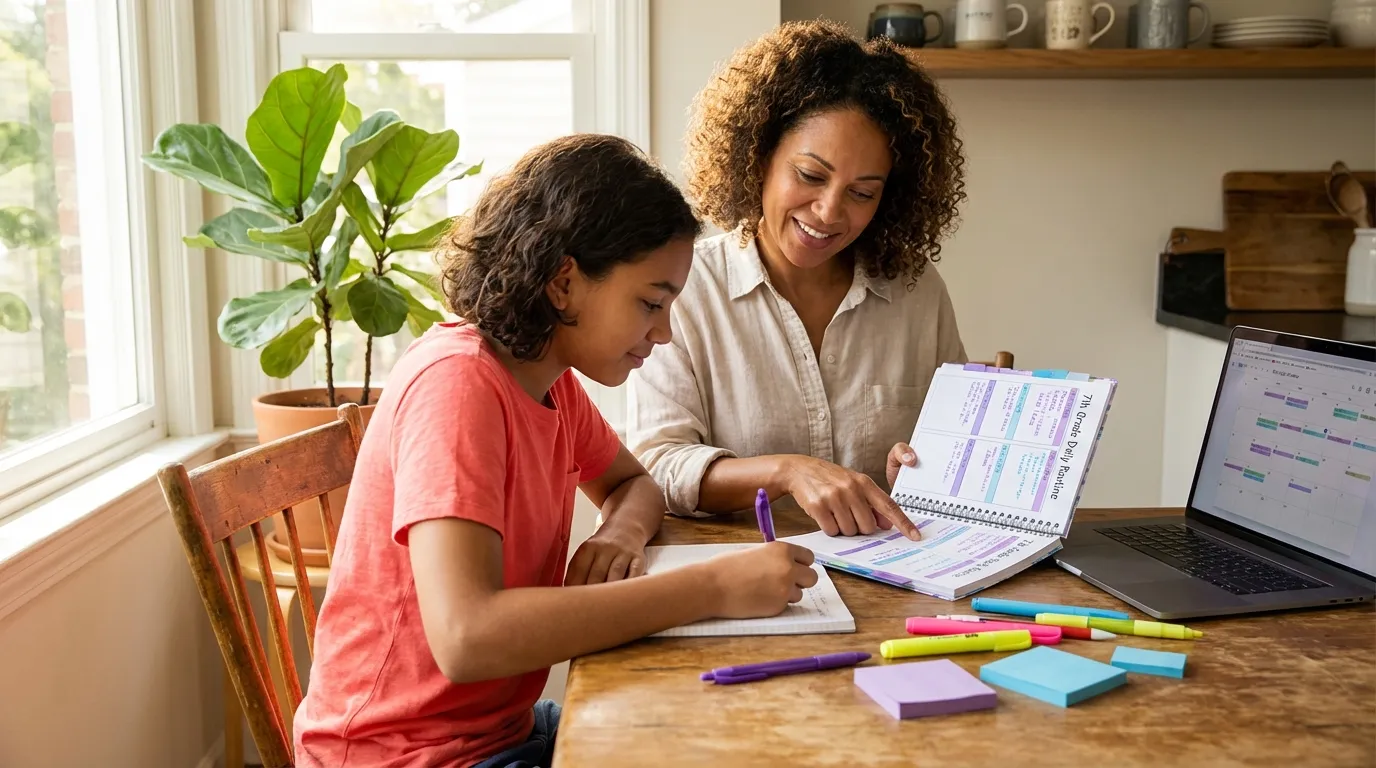
You may also notice that your role begins to shift. Instead of sitting beside your child for each lesson, you might step in only at certain times, such as introducing a new concept, reviewing completed work, or helping them think through a challenge when you notice frustration. The goal is to support without taking over.
Research on adolescent development shows that middle school is a critical time for strengthening executive functions such as planning, organization, and self-monitoring. A homeschool routine that allows space for decision-making, reflection, and independent work helps these skills grow naturally.
The amount of structure 7th grade students still need
With all of this newfound independence, 7th graders still can benefit from structure; they just don’t need constant direction throughout the day. What they need instead is a routine that provides clear expectations while giving them space to learn what works for them.
A predictable and consistent routine often works best. This might look like starting the day with academics, setting goals for what needs to be completed, and then allowing the learner to work through those tasks with check-ins to see how they are doing.
Too much structure can squelch your students' growth, while too little can lead to unfinished work or frustration. The key is finding a balance.
Balancing guided instruction with self-directed work
By 7th grade, one of the biggest changes in a homeschool routine is how long learners can stay engaged with their work. Instead of moving quickly between guided lessons, many students are ready to focus and work independently for longer periods.
On a typical day, this might look like spending an extended block of time working on writing, reading, or a science investigation. A learner may draft part of an essay, take a short break, and then return to revise or continue writing later in the day.
This kind of routine helps develop:
- Sustained attention during longer assignments
- The ability to return to work after a break
- Deeper thinking and problem-solving
- Confidence in handling more complex tasks
Parents still support the process and are there to reflect and assist, but the focus shifts toward helping learners stay engaged and follow through with a plan.
How Long a 7th Grade Homeschool Day Should Be
One of the most common questions families ask is how long their homeschool day should be at this stage. Seventh grade often brings longer assignments, but that does not mean the day needs to mirror traditional school.
The focus shifts toward longer periods of meaningful work rather than more hours overall.
A day that includes focused academic time, independent work, and real-world learning experiences will be full of learning and growth, despite the hours spent.
Typical learning time for 7th grade homeschoolers
Most 7th grade homeschool routines include about 4 to 6 hours of focused learning time. This often includes a mix of independent work, guided lessons, and project-based learning.
The difference from earlier grades is that more of this time may be spent working independently or on longer assignments. A learner can make the choice to spend extended time working on writing, research, or problem-solving.
Because homeschool learning is more direct and individualized, this time is often more productive than a longer traditional school day.
The role of independent study in a 7th schedule
As your 7th grader begins working through tasks on their own, you will notice a new daily rhythm and flow. There are fewer interruptions and more sustained focus. You may check in from time to time rather than staying constantly involved.
Your child might spend a full hour drafting an essay, pausing only when needed, rather than completing small sections with constant feedback. Later that same day, they might return to revise or discuss their work.
Independent work also allows space for deeper exploration. Learners can spend more time researching a topic, building a project, or following an area of interest without feeling rushed.
Why homeschool schedules are often more efficient than traditional school days
Even with the deeper, more personalized work, homeschool days are still typically shorter than a traditional school day. This is largely because time is used more efficiently.
There may be no need for class transitions, waiting for a group to be ready to learn, or managing classroom behavior. Learning can begin when you and your child are ready and can move at a pace that works for you.
This opens up time for the parts of homeschooling that are often the most meaningful. Many families use this time for:
- Outdoor exploration, such as hiking, biking, or nature study, that connects to science and health.
- Community-based learning, including library visits, co-ops, or local events.
- Project-based work, where learners build, design, or create something over time.
- Interest-driven learning, where students explore topics they are curious about in greater depth.
You may decide to spend the morning working through core subjects, then use the afternoon to visit a local trail, collect observations, and later turn that experience into a written reflection or science project.
Research on learning suggests that students benefit from a balance of focused academic work and active, applied experiences. Homeschooling naturally allows for this combination.
Sample Daily Routines for 7th Grade Homeschool
By 7th grade, some families still prefer structure, while others lean into flexibility. Both can work well at this stage, as long as the routine supports focus and allows the learner to take increasing ownership of their time.
Below are a few examples of how a 7th grade homeschool routine might look in practice.
Example of a structured homeschool schedule
A structured routine can help learners stay organized and build healthy habits, especially as assignments become longer and more complex.
A structured day might look like this:
- Morning planning and check-in: Begin the day by reviewing priorities. This could include looking over assignments, setting goals, or organizing materials for the day.
- First learning block: Focus on math and language arts while attention is strongest. A learner might complete math independently, then review with a parent before moving into reading or writing.
- Midday break: Take a break for food, movement, or time outside. This helps reset before continuing.
- Second learning block: Work on science, history, or a longer writing assignment. This may include research, note-taking, or project work that requires sustained attention.
- Afternoon flexibility: Use this time for creative subjects, independent reading, or real-world learning such as outings, co-ops, or hands-on projects.
Example of a flexible homeschool routine
A flexible routine allows the day to shift based on energy levels, interests, and schedule changes. This approach works well for families who want to encourage independence and want learning to be integrated into daily life.
A flexible day might include:
- A slower start: Some learners benefit from easing into the day with reading, journaling, or discussion before beginning formal work.
- Priority-based learning: Instead of assigning a fixed order, the learner works through a list of tasks in the order that makes sense to them.
- Adaptable timing: Academic work may happen in the morning, afternoon, or split throughout the day, depending on that day's needs and schedule.
- Real-world integration: Outings, errands, or outdoor time become part of the learning process rather than interruptions.
A block-style schedule for middle school learners
A block schedule works especially well in seventh grade because it allows learners to stay focused on a single subject or project for an extended period.
A block-style day might look like this:
- Core subjects block: Dedicate a longer stretch of time to math and language arts. This allows for both instruction and independent work without feeling rushed.
- Project or content block: Focus more deeply on science or social studies. Learners may read, research, conduct experiments, or work on presentations during this time.
- Application or exploration block: Set aside time for outdoor learning, creative work, or personal interests that connect to what the learner is studying.
Creating a 7th Grade Homeschool Routine That Fits Your Family
By seventh grade, building a routine is less about managing every part of the day and more about creating a structure your learner can begin to navigate on their own. The goal is to support independence while still providing enough guidance to keep learning on track.
Step 1: Shift from schedule to priorities
Instead of planning every hour, many families begin the day by identifying a short list of priorities. This helps learners focus on what needs to be accomplished without feeling tied to a timeline.
Step 2: Design longer focus blocks
Seventh graders are often ready to work for longer periods without interruption. Structuring the day around extended blocks of time allows for deeper thinking and fewer transitions.
Step 3: Incorporate real-world learning
Learning in 7th grade becomes more meaningful when it connects to real life. Many families intentionally include time for outings, projects, and hands-on experiences as part of their weekly rhythm.
Step 4: Build in reflection
Seventh grade is a great time to introduce simple reflection into the routine. This helps learners think about what is working and where they may need to adjust.
A Routine That Grows With Your Learner
A strong 7th grade homeschool routine does not need to rely on constant direction. Instead, your routine should create a framework that allows your learner to begin taking responsibility for their time, their work, and their progress.
By focusing on longer work periods, encouraging independence, and making space for real-world learning, you can build a routine that supports both academic growth and personal development.


.svg)
.svg)