Seventh grade is often a year when homeschooling may begin to feel more serious. Parents may start wondering what their child should accomplish during this year and how to set goals that balance academics, independence, and personal growth. Education research shows that the middle school years play a key role in preparing students for high school expectations and independent learning.
Planning goals for your 7th grader can help bring focus to the school year as their thinking skills are increasing, and the academic work is more challenging. At the same time, they can handle more responsibility and manage learning in new ways.
This article will help you identify realistic goals, understand 7th grade academic expectations, and walk you through step-by-step how to support your child’s growing independence.
Overview: 7th Grade Homeschool Goals
Homeschool goals can provide you with a solid roadmap for the year. They can help you decide which skills and habits to focus on. In 7th grade, these goals are even more valuable because students are preparing for high school and more intense academics.
Instead of focusing only on mastering basic skills, 7th graders begin applying what they learn in more complex ways. Many national education frameworks emphasize reasoning, analysis, and problem-solving as essential skills during middle school. They may analyze texts more carefully, solve multi-step math problems, conduct longer science investigations, and organize larger writing projects.
Research also shows that academic progress during the middle school years is strongly connected to later success in high school coursework, which is why many families begin focusing on deeper thinking and independent learning during this stage.
As learners move through 7th grade, many begin taking a more active role in their education. Instead of simply finishing assignments, they may be ready to set personal goals, track their progress, and reflect on what works and what doesn't in their education. Homeschooling provides space for all of this to develop naturally, as your student builds confidence and takes greater responsibility for their learning.
Why choosing 7th grade goals can be different in a homeschool setting
In many traditional classrooms, 7th grade learning is organized around curriculum standards and scheduled units. Teachers must cover the material required for the school year. This structure can limit how much time students spend exploring topics they are passionate about.
Homeschooling allows families to take a more personalized approach. At home, you can encourage your children to explore subjects more deeply, choose topics that interest them, or spend more time strengthening life skills. Instead of focusing solely on completing lessons, homeschooling often emphasizes curiosity, discussion, and independent thinking.
This flexibility can be especially helpful in 7th grade, when many learners begin developing stronger interests and preferences for how they learn best. Homeschool families can use this time to nurture those interests while continuing to build strong academic foundations.
Developmental goals vs. academic goals in 7th grade
When planning the homeschool year, it helps to think about both academic and developmental goals.
- Academic goals focus on subject knowledge and skills such as writing essays, solving algebraic equations, interpreting scientific data, or analyzing historical events. An academic goal may be to complete a unit or research project.
- Developmental goals focus on the habits and thinking skills that support learning. These are the years when students are developing stronger executive function skills, which allow them to plan tasks, organize information, and manage more complex learning responsibilities. A developmental goal would strengthen these important skills.
Many homeschool families combine academic and developmental goals. For example, planning a small budgeting project can reinforce math skills while helping learners practice decision-making and financial awareness.
Tracking your 7th grader’s goals
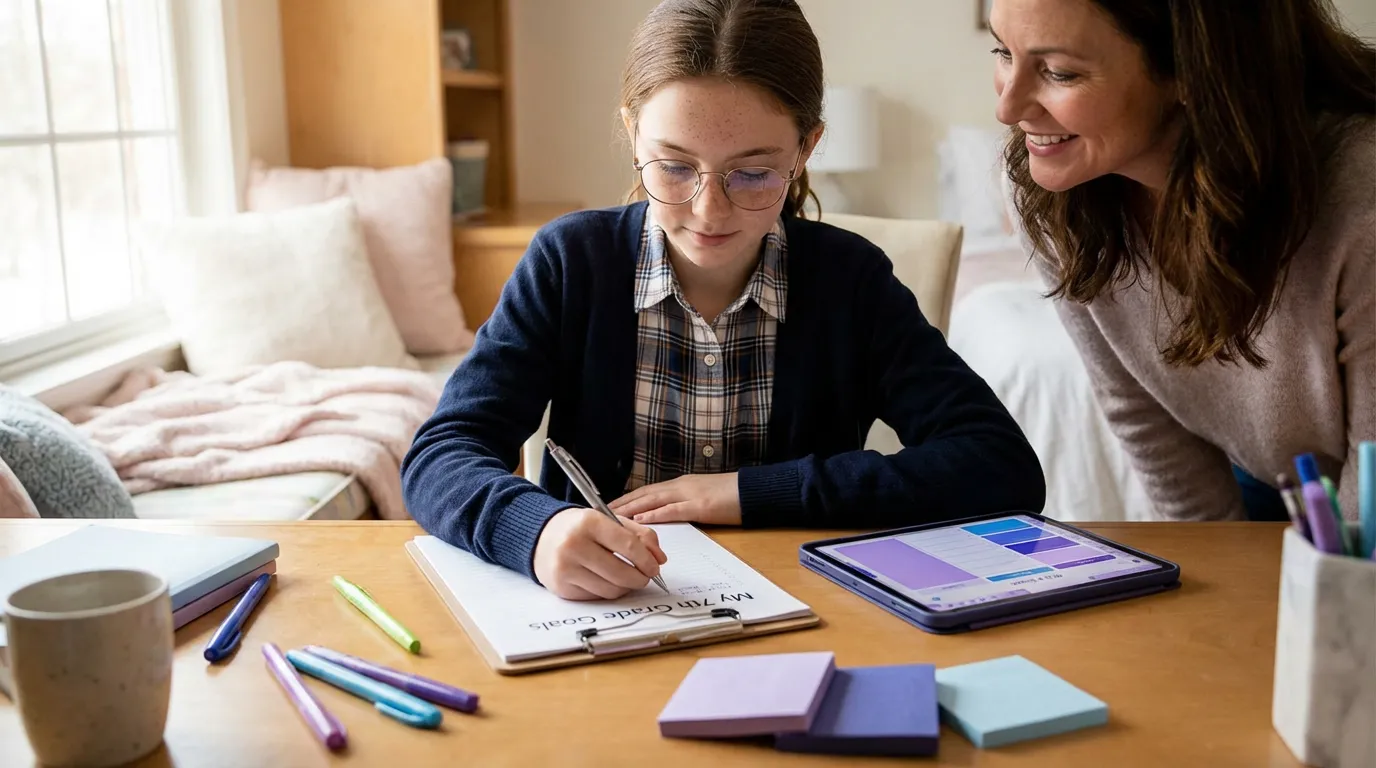
By 7th grade, many homeschool families begin including their child in the tracking process. Instead of parents managing every record, students can start using planners, goal charts, or simple study logs to monitor their assignments and projects.
This helps your child see how their work builds over time. For example, a student might keep a record of completed essays, science lab reports, or books read during the year. Reviewing this work from time to time allows both parents and learners to recognize improvements in writing, reasoning, and overall comprehension.
Tracking progress can also support important planning skills. Studies on goal setting in adolescents show that learners are more motivated when they monitor their own progress and reflect on their achievements. It allows students to see their own growth and take increasing responsibility for their education.
Families should still remain aware of their local homeschooling requirements. Reviewing your state's homeschool laws can help you understand whether portfolios, assessments, or other records may be required.
How to Choose Your 7th Grader’s Goals
Every homeschool family is different, so there is no single set of goals that works for everyone. Some learners need a strictly academic plan, while others will thrive with developmental goals or hands-on projects. Ultimately, you want to choose goals that challenge your child while still igniting a love of learning.
These steps can help you build clear and meaningful 7th grade homeschool goals for the year.
Step 1: Identify areas where your learner wants to grow
Involving your child in setting goals can increase motivation and personal responsibility.
You can start by discussing which subjects they enjoy and which areas feel more challenging. These conversations can help you identify topics that spark curiosity as well as skills that may need additional support.
Research shows that structured goal setting helps adolescents build self-regulation and motivation, especially when they participate in choosing the goals and reviewing their progress. Even simple conversations about what they want to learn or improve can help them stay engaged throughout the year.
Step 2: Choose goals that deepen learning
Instead of focusing only on covering new topics, 7th grade goals can go deeper. Learners may expand their understanding by completing longer writing assignments, analyzing complex texts, or investigating scientific questions more thoroughly. These types of goals help students strengthen reasoning and critical thinking.
For example, in Language Arts, a surface goal may be to read three novels and write summaries. A deeper learning goal would be to choose one novel and write a literary analysis that identifies major themes and cites evidence from the text to show those themes.
Step 3: Build independence and healthy habits
Seventh grade is an ideal time to strengthen learning and study habits. In the adolescent years, executive function skills such as planning, organization, and self-monitoring continue to develop. Researchers note that these skills help learners manage complex tasks and adapt their strategies when they face new challenges. To support this growth, you can begin encouraging schedule management, assignment tracking, and responsibility for projects.
Step 4: Plan goals around larger projects or milestones
By 7th grade, many learners are ready to work toward goals that take longer to complete. Instead of focusing only on daily lessons, some families organize the year around larger milestones such as a research paper, science investigation, or history presentation.
Working toward a larger project helps students practice planning, research, and revision. For example, a learner might spend several weeks gathering information, organizing ideas, and writing an in depth report. Breaking these projects into stages can help students develop the organizational and time management skills that will become increasingly important in later grades.
Common Academic Goals for 7th Grade Homeschool Learners
Academic expectations typically increase during 7th grade. Instead of focusing only on skill practice, many seventh grade lessons emphasize reasoning, investigation, and communication.
National Assessment of Educational Progress (NAEP) frameworks highlight that middle school students should increasingly interpret data, analyze information, and explain their thinking across subjects. These skills help prepare learners for more advanced work in the future.
Below are the common academic areas to consider when setting learning goals for the year.
Math goals
Seventh grade math typically builds on the concepts introduced in sixth grade while introducing more algebraic thinking and real-world problem solving.
Common goals for 7th grade math include:
- Strengthening proportional reasoning and ratios by solving problems involving rates and proportions in real-world situations such as budgeting, scaling recipes, or comparing measurements.
- Working with algebraic expressions and equations by solving multi-step problems and writing expressions that represent relationships between numbers.
- Understanding rational numbers and operations by practicing calculations with positive and negative fractions and decimals, and exploring how these numbers interact.
- Exploring geometry and measurement concepts by calculating area, circumference, surface area, and volume.
- Analyzing data and probability by interpreting graphs, calculating averages, and exploring basic probability concepts.
Science goals
Science learning in seventh grade often becomes more investigative, with learners asking questions, testing ideas, and analyzing results through hands-on exploration.
Common science goals may include:
- Designing and conducting structured experiments by forming hypotheses, identifying variables, and recording observations during investigations.
- Studying life science or earth science topics in depth by exploring concepts such as ecosystems, cells, genetics, energy systems, or environmental science.
- Collecting and interpreting scientific data by organizing results into charts, graphs, or short reports that explain what the experiment revealed.
- Developing scientific communication skills by using science journals or simple lab reports to explain procedures, observations, and conclusions.
Reading, English, and writing goals
Literacy development during seventh grade often focuses on analyzing texts more carefully and expressing ideas through more structured writing.
Common goals include:
- Reading a variety of complex texts by exploring novels, nonfiction books, articles, and historical documents.
- Analyzing themes, arguments, and perspectives by identifying an author’s purpose and evaluating how ideas are presented.
- Writing analytical or argumentative essays by organizing ideas clearly and supporting claims with evidence from texts or research.
- Conducting research and citing sources by gathering information from reliable references.
- Strengthening grammar and vocabulary skills by refining sentence structure and expanding word choice to communicate ideas more effectively.
Social studies and history goals
Seventh grade social studies often focuses on world history, cultural development, and understanding how historical events shape modern societies.
Common goals may include:
- Exploring world civilizations and historical periods by studying societies such as medieval Europe, early Asian civilizations, or pre-colonial cultures.
- Interpreting primary sources and historical documents by analyzing letters, photographs, artifacts, and other records from the past.
- Connecting geography with historical events by examining how landscapes, trade routes, and resources influence culture and conflict.
- Discussing global perspectives and historical themes by exploring topics such as government systems, trade, exploration, and cultural development.
Health and physical education goals
Physical health and wellness remain important parts of a balanced homeschool routine during the middle school years.
Common goals include:
- Maintaining regular physical activity by participating in movement-based activities.
- Learning about nutrition and healthy habits by exploring balanced meals, sleep routines, and strategies for managing stress.
- Building teamwork and cooperation skills by participating in group activities, sports teams, or community programs.
Art goals
Creative subjects allow learners to explore personal expression while developing artistic and creative thinking skills.
Common goals may include:
- Experimenting with different art forms by exploring drawing, painting, digital design, music, or theater.
- Studying artistic styles and cultural influences by learning how artists and movements reflect historical and cultural contexts.
- Creating interdisciplinary projects by connecting art activities with topics from literature, science, or history.
Common Developmental Goals for 7th Homeschool Learners
Academic growth is important during seventh grade, but personal development plays an equally important role.
During early adolescence, learners are experiencing rapid cognitive, emotional, and social changes. The Association for Middle Level Education notes that middle school students are developing stronger reasoning abilities, a growing sense of identity, and an increasing need for independence.
Because of these changes, many homeschool families include developmental goals alongside academic ones. These goals help learners build the habits and life skills they will need for more advanced learning in the coming years.
Strengthening independence and responsibility
Seventh grade is a time when many learners begin taking greater ownership of their education. Your child may be able to begin:
- Managing daily assignments independently by tracking tasks using a planner, checklist, or digital tool.
- Taking responsibility for completing projects by managing longer assignments such as research papers or science projects.
- Reflecting on progress and challenges through regular conversations about what is working well and what needs improvement.
Developing time management and executive function
Executive functioning skills continue to develop throughout adolescence. These skills allow learners to plan tasks, manage time, and organize information.
Some ways to support this growth may be:
- Using planners or schedules to manage learning by tracking assignments and deadlines.
- Breaking larger tasks into smaller steps in order to learn how to organize long-term projects over several days or weeks.
- Adjusting strategies when facing challenges to become more resilient learners.
Building critical thinking and problem-solving skills
By 7th grade, many learners are ready to think more deeply about the information they encounter.
They are able to start:
- Asking thoughtful questions during lessons to explore topics more deeply.
- Evaluating sources during research to determine whether information is reliable.
- Applying knowledge to real-world problems by designing experiments or analyzing historical events.
Practicing communication and collaboration
Social development also becomes increasingly important during the middle school years. Research on early adolescent development highlights that peer interaction becomes increasingly important during this stage, making collaborative learning experiences valuable for social and academic growth.
Goals that will nurture that may be:
- Explaining ideas clearly in discussions and sharing their reasoning during lessons and presentations.
- Participating in group learning opportunities like homeschool co-ops, clubs, or classes.
- Engaging in respectful debates and discussions about literature, history, or current events to explore different viewpoints.
Frequently Asked Questions: 7th Grade Homeschool Goals
Many homeschool parents have similar questions as their child moves through the middle school years. Seventh grade often brings more independence and higher expectations, which can make goal-setting feel more important. The answers below address a few common questions families ask when planning their homeschool year.
How often should homeschool goals be reviewed during the school year?
Most families find it helpful to review homeschool goals every few weeks or at the end of each learning unit. Regular check-ins allow you to see whether your learner has mastered a concept or needs more practice before moving forward.
These reviews also give you a chance to adjust pacing, add new challenges, or shift focus if your child develops a new interest. Homeschooling works best when goals remain flexible and responsive.
How can I involve my 7th grader in setting their homeschool goals?
By 7th grade, many learners are ready to help plan their own goals. Start by asking your child what subjects they enjoy, what they find challenging, and what skills they want to improve. Together, you can choose a few priorities for the year and keep track of them in a planner or journal. When students help set their own goals, they are often more motivated to follow through.
How do I challenge a 7th grader who finishes goals early?
If your learner completes goals quickly, consider expanding the topic rather than simply moving ahead to the next lesson. You might encourage deeper research, creative projects, or real-world applications.
For example, a student who enjoys writing might expand a short essay into a longer research project, while a student interested in science could design an independent experiment. Providing opportunities for exploration helps learners stay engaged.
Supporting Growth in 7th Grade
Creating 7th grade homeschool goals can guide your year while still preserving the flexible homeschool environment you cherish. In middle school, learners are strengthening academic skills but also developing independence, responsibility, and confidence in their abilities.
Seventh grade is a critical year for building the habits that will propel your child forward and make future learning less stressful. By focusing on both academic progress and personal development, homeschool families can help their learners grow into capable and curious students who are prepared for the challenges of high school and beyond.
Sources
Association for Middle Level Education. “Developmental Characteristics of Young Adolescents.” AMLE, https://www.amle.org/young-adolescent-development/.
Association for Supervision and Curriculum Development. “The Characteristics of Young Adolescents.” ASCD, https://www.amle.org/developmental-characteristics-of-young-adolescents/.
Center on the Developing Child. “Executive Function & Self-Regulation.” Harvard University, https://developingchild.harvard.edu/science/key-concepts/executive-function/.
Chiefs for Change. Middle School Strategy: Leveraging the Science of Learning and Development to Inform Education in Middle School. Chiefs for Change, 2022, https://www.chiefsforchange.org/wp-content/uploads/2022/10/Middle-School-Strategy-Leveraging-the-Science-of-Learning-and-Development-to-Inform-Education-in-Middle-School.pdf.
Library of Congress. “Teaching with Primary Sources.” Library of Congress, https://www.loc.gov/programs/teaching-with-primary-sources/.
National Assessment of Educational Progress. “Mathematics Framework for the 2022 Assessment.” National Center for Education Statistics, U.S. Department of Education, https://nces.ed.gov/nationsreportcard/mathematics/.
National Center for Education Statistics. “The Nation’s Report Card.” NCES, U.S. Department of Education, https://www.nationsreportcard.gov.
Youth-Nex Center to Promote Effective Youth Development. “Strategies for Teaching Goal Setting to Middle Schoolers.” University of Virginia, https://youthnexdrive.virginia.edu/strategies-teaching-goal-setting-middle-schoolers.


.svg)
.svg)