If you’re searching for a 7th grade homeschool art curriculum, you may be wondering what your child should be learning and how to support their artistic growth. If done correctly, art can be a metaphorical deep breath in your busy day.
Seventh grade is often when art becomes more intentional. Your child may start paying closer attention to technique and personal style. At the same time, they may feel more self-conscious and begin comparing their work to others. This mix of creativity and questioning makes middle school an important stage for art instruction.
This article covers what a strong 7th grade art program typically includes, how homeschool art compares to a traditional classroom setting, and how to choose or build a plan that fits your family’s routine.
What is a 7th Grade Art Curriculum?
A 7th grade art curriculum builds skill while still giving your child space to express themselves. Art in adolescence often becomes more than a fun activity, but a place where your child tests ideas and practices techniques.
The National Visual Arts Standards organize middle school art around four main processes: creating, presenting, responding, and connecting. In practical terms, that means your child should not only make art but also reflect on it, discuss it, and understand how it connects to culture and history.
Unlike elementary art, which often centers on exploration, 7th grade art requires foresight and intention. At this stage, art becomes less about completing a craft project and more about developing a process and honing a skill.
Learning art at home vs. in a school setting
In a traditional classroom, art can be limited by class size, available materials, and time. In many classrooms, students create the same project with the same parameters, leaving little room for full creative expression.
Homeschooling can give you flexibility in how you approach this. If your child wants to improve a specific skill, you can focus on skill lessons. If they want more creative freedom, you can pair technique practice with open studio time. Many families combine both.
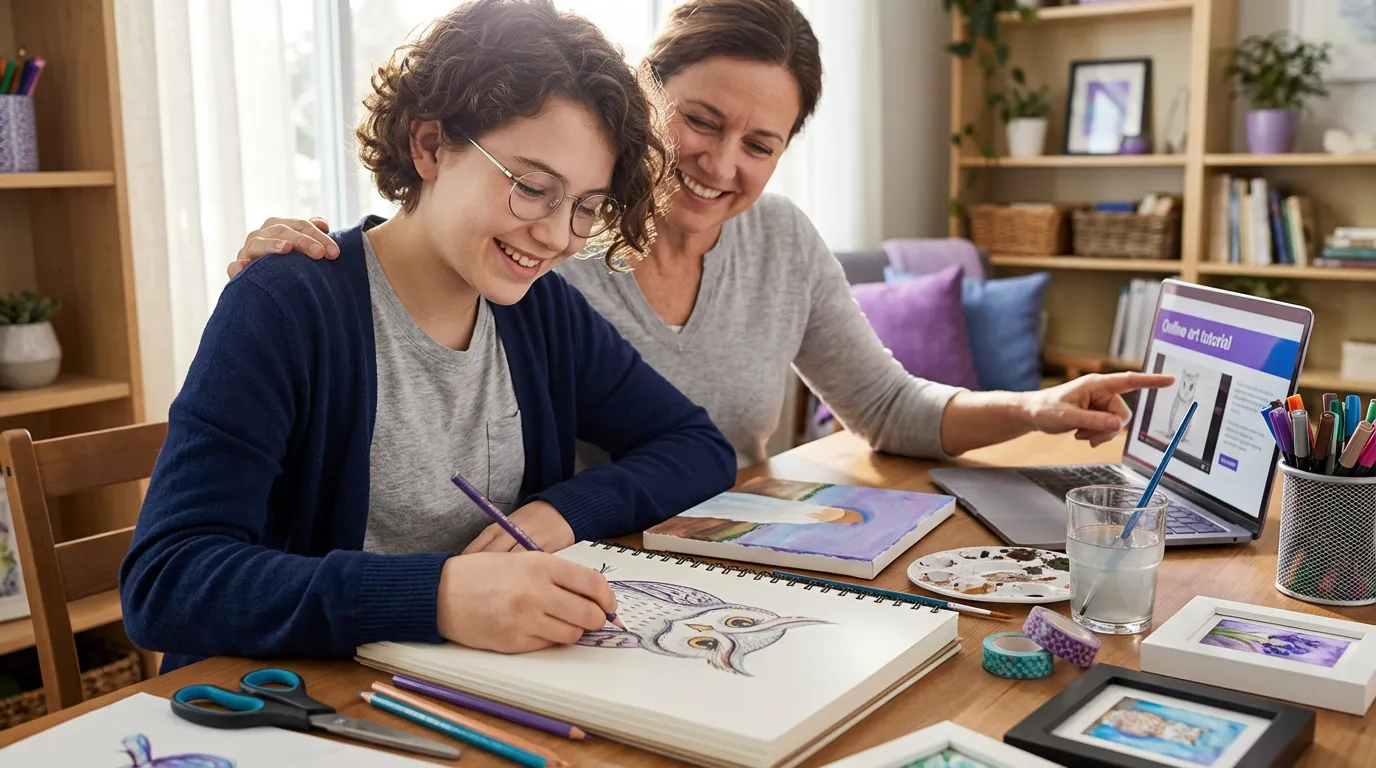
There are also practical differences. Some homeschool parents worry about space and materials. A dining table, a sketchbook, and a small supply bin are all you need. Projects can rotate between drawing, painting, collage, or mixed media.
That said, school settings do offer peer interaction and outside perspective. Some homeschool families choose to incorporate online classes or community workshops to add that dynamic. A live virtual art class, for example, can provide structured instruction and discussion while you maintain flexibility at home.
Topics Taught in 7th Grade Art Curricula for Homeschoolers
By 7th grade, art moves beyond simple projects and into specific skills. A well-rounded homeschool art curriculum balances technique, creativity, and visual literacy. While programs vary, most strong 7th grade plans include the following topics.
Drawing foundations
Drawing is often the backbone of middle school art. Students can work on observing proportions, creating depth, and understanding light and shadow. This might include contour drawing, shading exercises, and introductory perspective.
At home, this can look as simple as practicing shading in a sketchbook and then applying that skill to a drawing.
Composition and design
Seventh graders can begin learning how to organize their canvas. They can also explore balance, contrast, and visual flow. Instead of asking whether a piece looks “good,” you can begin asking why it works.
A simple homeschool activity might involve rearranging basic shapes on a page to experiment with balance before applying those ideas to a larger project.
Color theory
Students explore how colors interact, how to mix them, and how they affect mood. They begin understanding complementary colors, warm versus cool tones, and harmony.
At home, this could mean painting the same simple subject twice using different color schemes and discussing how the feeling changes. These exercises strengthen both technical skill and emotional awareness.
Mixed media
Middle school is also a time for experimentation. Students might work with collage, printmaking, watercolor, charcoal, or simple sculpture. Trying different media helps them discover preferences and strengths.
Critique and reflection
Perhaps most importantly, 7th grade art introduces reflection. Students begin learning how to evaluate their work and articulate their choices.
Critique and reflection do not have to be formal. A short written response or a brief discussion of what worked and what could be improved can be enough. Research on arts education emphasizes that reflection strengthens critical thinking and persistence, not just artistic output.
Main Types of 7th Grade Art Curricula
Once you understand what 7th grade art should include, the next step is deciding how it will be delivered. Homeschool families have several different options, each with its own level of structure, creativity, and parent involvement.
- All-in-one structured curriculum: These curricula provide a full year of lessons, often organized by week or unit. They typically include step-by-step instructions and materials lists. This format works well for parents who want minimal planning. You open the guide, gather the materials, and follow the lesson. The trade-off is that projects may feel less personal due to the strict guidelines.
- Skill-focused or classical drawing programs: Some families prefer to teach technical skills that build sequentially. An example might be teaching your student perspective, proportion, and shading. If you have a child who is seeking measurable growth and improvement, this may be the way to go.
- Project-based or mixed media programs: This is an exploration approach in which students rotate through media while applying their foundational skills. An example might be experimenting with watercolor, sculpture, or collage, and reflecting on the process for each.
- Online or video-based art classes: For homeschoolers who feel less confident teaching art, or for students who need more small-group interaction and feedback, online classes are ideal. Engagement stays high while professionals guide students. Both live and recorded classes are available for your family to choose from.
Elements to Think About When Choosing or Building a 7th Grade Art Curriculum
Many curricula can look impressive at first glance, but it is important to consider what will work best for your particular learner. Below are some elements to consider before making your final choice.
Age-appropriateness and challenge
Seventh graders are ready for more structure and challenge, but still need space to experiment and express themselves. You can try to look for lessons that build skills gradually. If a curriculum jumps into a complex skill too quickly, your student may get frustrated or have their confidence dampened. On the other hand, if the program is too simple, motivation can drop.
Supplies and cost
Before committing to a program, check the materials list and see if what they require fits into your home and budget. It is helpful if the materials are reusable and will enhance your homeschool. Storage should be simple and easily accessible, not overwhelming and taking up space.
Level of parent Involvement
Be honest about how much involvement you would like to have in your child's art class this year. Some programs require you to guide each lesson and model techniques heavily, while others rely on video demonstrations or written instructions.
Documentation and requirements
Even though art is enjoyable and relaxing, it still counts as an academic subject in many states. It is helpful to keep simple documentation, such as sketchbook entries, photos of finished work, and reflection notes. Checking the homeschool laws in your state will clarify exactly what is required of you.
How to Build a 7th Grade Art Curriculum for Homeschoolers
If you prefer flexibility over a pre-packaged program, then building your own curriculum is entirely doable. All it takes is a simple framework and some consistency.
Step one: Start with core skills
You can begin by identifying the foundational skills you would like your child to learn this year. Then, you can plan a collection of units that each focus on one skill for several weeks. This will keep your lessons purposeful.
Step two: Integrate art history
You can also weave art history into your skills lessons. For example, if you are studying perspective, then spend time exploring Renaissance artwork. If you are studying color theory, look closely at impressionist paintings and discuss them. This process will build visual literacy over time.
Step three: Balance structure with choice
Middle school students thrive with some autonomy. Plan structured skill lessons, but also carve out free studio time for your child to explore mediums, styles, and create whatever they choose.
For example, after learning about complementary colors, your child may choose to make a poster for their room using collage materials. This balance will preserve creativity and ensure that art is enjoyable and engaging.
Step four: Plan for reflection
Short written responses or casual discussions can build the habit of self-evaluation in a stress-free way. Reflection questions could sound like: What worked well? What was challenging? What would you adjust next time? What feelings did this piece bring up for you?
Day-to-Day or Weekly Routines for 7th Grade Homeschool Art
Every family's routine will look different; some choose to incorporate art daily, and others do well with two focused sessions a week. Whatever you choose, be sure to save time for skill introduction, practice, and creativity.
A typical week may include:
- On Monday, you demonstrate drawing with one-point perspective, you watch a few videos on the process, and have a conversation about what felt clear and what was confusing. You give your child an opportunity to practice drawing simple shapes and using vanishing points.
- On Tuesday, you have “open studio” time, where you pull out the sketchbook and pencils and spend time drawing. This is an unstructured, creative time.
- On Wednesday, you apply the new skill to a project, for example, designing a storefront. Saving time for revision and reflection, you look at the project together and ask guiding questions like: Where does the eye go first? And does the space feel deep or flat?
- Lastly, at the end of the week, you explore online resources and examine examples of artwork from history that use one-point perspective, or you visit a local art exhibition.
With this rhythm, art feels expected and is part of the daily routine. It feels like a welcome part of your homeschool culture.
Popular Homeschool Art Curricula for 7th Graders
Once you have figured out structure and pacing, the next choice is which resources to include. As a homeschool family, you have many options, ranging from year-round programs to flexible skill-focused materials.
Outschool’s online curricula and classes
If you are looking for guided instruction that will reduce some of your teaching load, then Outschool offers online art classes designed specifically for middle school learners. They offer classes on drawing, painting, and even architectural design. Your seventh grader is starting to become aware of their work, and peer interaction is important for idea sharing and feedback.
Some families use online classes as their primary instruction, and others choose a skill-based unit to supplement their studio time.
Free institutional resources and materials
If you prefer to build your own curriculum, then trusted museums and cultural institutions can be a helpful place to start. They offer printable guides, lessons, and project ideas that align with middle school standards.
A few reliable resources include:
Frequently Asked Questions: 7th Grade Homeschool Art Curricula
Parents often share common concerns about teaching 7th grade art at home. Here are a few frequently asked questions.
Do I need to be “art-savvy” to teach art at home at the 7th grade level?
No. Many art lessons at home will rely on guided instruction, video demonstrations, and discussion questions. You do not need to be an expert or artistically inclined, and you can learn alongside your child. What you do need is an open mind, time for reflection, and willingness to support your child through their art journey.
What types of materials or supplies are typically needed for middle school art?
Most 7th grade programs only require basic materials, such as a sketchbook, drawing pencils, erasers, watercolors, and brushes. Additional materials can be added gradually and as needed. Materials like charcoal, sculpting clay, and specialty paint can be incorporated as your child shows interest.
How can art projects be assessed or documented for homeschool records?
Documentation can include sketchbooks, photographs of finished work, and short reflections about skills practiced. If your state requires a portfolio review, these records will demonstrate learning and growth over time.
Growing Confidence Through Art
Seventh grade is the perfect time to strengthen technique and creative voice. Learners are now more aware of their skills and more sensitive to comparison. Art can either become something they are drawn to or something they avoid.
A thoughtful homeschool art curriculum gives structure without stifling creativity. When you combine skill-building with meaningful projects and exposure to art in the world, you are helping your child develop creative courage.
Sources
National Core Arts Standards. Visual Arts – Anchor Standards: Artistic Processes Creating, Presenting, Responding, and Connecting. National Coalition for Core Arts Standards, https://www.nationalartsstandards.org/content/national-core-arts-standards-anchor-standards.
National Core Arts Standards. A Conceptual Framework for Arts Learning. National Coalition for Core Arts Standards, https://www.nationalartsstandards.org/sites/default/files/NCCAS%20%20Conceptual%20Framework_0.pdf.
National Coalition for Core Arts Standards. Visual Arts at a Glance. https://www.nationalartsstandards.org/sites/default/files/Visual%20Arts%20at%20a%20Glance%20-%20new%20copyright%20info.pdf
“Arts | NAEP.” The Nation’s Report Card, National Center for Education Statistics, https://nces.ed.gov/nationsreportcard/arts/.
“NAEP Arts Assessment: Interpreting the Results.” The Nation’s Report Card, National Center for Education Statistics, https://nces.ed.gov/nationsreportcard/arts/interpret_results.aspx.
National Art Education Association. “National Visual Arts Standards.” NAEA, https://www.arteducators.org/resources/standards/national-visual-arts-standards/.
Li, Jian, and Yufeng Qi. “Arts Education and Its Role in Enhancing Cognitive Development: A Quantitative Study of Critical Thinking and Creativity in Higher Education.” Cognitive Development, vol. 74, 2025, article 101544, https://doi.org/10.1016/j.cogdev.2025.101544


.svg)
.svg)