Choosing a 6th grade homeschool reading curriculum is an important decision, as this is a big transition year. This year, students may read longer, more complex texts with tougher vocabulary. Students may also be asked to consider the theme, the author's purpose, and character development, all of which are new and greater skills than ever before.
Luckily, teaching reading at home can give you an automatic leg up. It allows for greater flexibility in pacing and more in-depth discussions. As a parent, you are now a literary coach, helping your child choose texts that align with their interests and match their ability.
A strong plan for 6th grade reading will balance independent reading, novel studies, vocabulary development, and reading responses. In this article, we will explore the typical 6th grade reading topics. We will compare learning at home to learning in a traditional classroom, discuss key points for choosing a curriculum, and suggest ways to create a routine that boosts comprehension and confidence.
Overview: Teaching 6th Grade Reading at Home
By 6th grade, students may have acquired the skills necessary for independent reading. They may have spent the prior year learning how to read, building fluency, and decoding sounds.
Now, they are likely ready to use reading as a learning tool. The common expectations are that students engage in deeper thinking about the text they are reading. They may be asked to consider the author’s motivation and find evidence to support their thoughts. Teaching these higher-level skills may seem daunting, but finding or creating the right program can make reading instruction simple and fun.
Differences between learning to read at home and in a school setting
There are times when homeschool families feel they need to mimic a classroom setting to achieve success. Many argue that it is not necessary, and in fact, a home setting may offer significant benefits for reading instruction.
In a traditional classroom, reading is typically taught from a boxed curriculum, with the class reading the same text at the same pace. Discussions are often limited, reluctant readers are at times overlooked, and advanced readers don’t always feel challenged. It can seem like a cookie-cutter approach to literacy that does not work for every student.
Homeschooling, however, allows you to vary the types of reading material, adjust the time spent on each text, and adapt the discussion and activity styles to fit your child’s needs. For example, if you are reading a novel, you can pause at any time to talk about new words or a specific passage.
A homeschool routine also allows for daily independent reading that may not happen in a school setting. Consistent daily reading is one of the strongest predictors of growth. Research supported by the National Endowment for the Arts links reading volume with improved comprehension and vocabulary, which is why a steady routine matters.
The combination of reading, discussing, and writing a reflection at home can ensure that your child develops the habit of reflecting on what they read rather than just reading the words on the page.
Topics Typically Covered in 6th Grade Reading Curricula for Homeschool Learners.
In elementary school, children learn to read. In middle school, students are now reading to learn. All of the topics typically covered this year will support that transition and prepare your student for 7th- and 8th-grade reading.
Theme and main idea
Students are ready to move beyond simple retelling and begin to identify the deeper message. In a homeschool lesson, you may have your child explain how a character's choices mirror the book's theme. Then, have them write a few sentences with examples to support that idea.
Character development and point of view
Students think about how characters change and how that shapes the story. They consider how the characters think and what they believe. At home, you can use a character chart, adding sticky notes when characters do something that reveals their personality or feelings.
Vocabulary in context
Sixth grade students can be ready to use context clues to decipher new words. For example, if you are reading The Phantom Tollbooth at home and your student comes across a new word, such as doldrums, they can explore the surrounding words and gather clues. You can ask them to guess the word based on those clues before checking a dictionary. This turns it into a detective game rather than a list of words they need to memorize.
Comparing fiction and nonfiction
Now can be the time to see how fiction and nonfiction differ in structure and purpose. A lesson may include creating a Venn diagram to compare a story version of a real-life event with a news article. Comprehension skills can develop as they compare emotional impact, writing style, and facts.
Summarizing and paraphrasing
Research from the RAND Reading Study Group describes comprehension as an interaction among the reader, the text, and the purpose of reading.
One way to assess comprehension is by summarizing. Your child may read a chapter and then paraphrase the main idea and key details. One way to make it fun is to give a 10-word challenge: have the student summarize the chapter in 10 words or fewer.
Main Types of 6th Grade Homeschool Reading Curricula
Homeschool reading programs come in different forms. Many families combine approaches to enhance comprehension and foster a love of reading.
- Literature-based reading programs: These programs are built around core novels and include guided discussion questions and related activities. This approach works well for voracious readers who love discussion. These programs will strengthen theme and character analysis, as well as overall comprehension.
- Comprehension strategy programs: These programs focus on key skills such as summarizing, asking and answering questions, inferring, and identifying the main idea. If your child is a strong reader but struggles to answer questions or discuss their reading, these programs could help. They offer structure by teaching one skill at a time.
- Vocabulary and word study programs: These programs are often used by homeschool families alongside their main reading program as a supplement. Helping your child practice roots, prefixes, and context clues builds a solid base for their future reading classes.
Online or guided reading courses: Online reading lessons and book club-style reading groups can both greatly benefit a homeschool family. Many families like these courses because they offer a chance to practice discussion skills outside the home.
What to Think About Before Choosing a 6th Grade Homeschool Reading Curriculum
Focusing on these key elements will help you choose a program with confidence.
Appropriate text level
Don’t let reading levels box you in. For example, your 6th grader might read at a 9th grade level, but they may struggle with comprehension.
One helpful tool is the Lexile Framework for Reading, which helps you find books that are a good fit for your child. Research on literacy development shows that exposure to increasingly complex texts supports language growth, emotional understanding, and cognitive development. In other words, what your child reads shapes how they think. The goal is to find texts that are challenging enough to require focus but still allow for high comprehension.
Include varied texts
At this age, your child should be able to distinguish the three main types of texts:
- Narrative (stories)
- Expository (informational)
- Persuasive (opinion)
Ideally, these texts will be paired together to deepen learning. For instance, a novel about the ocean could go with a scientific article or a primary source. This pairing enhances the quality of middle school literacy instruction.
Scaffolding for discussion and evidence
A strong curriculum will provide students with tools to build discussion and analytical skills. Tools like sentence starters can help students develop this skill.
An example of a sentence starter may be: “The author shows the character is brave on page 42 by saying…”
This type of support can give your child a jumping-off point and help them process the answer with a helpful framework, increasing their confidence.
Planning or Choosing a 6th Grade Homeschool Reading Curriculum
You can plan your year with a goal of increased comprehension and comfort with various types of texts. Following the simple steps below can help you stay consistent and organized while still allowing for flexibility.
Step 1: Choose core materials
Often, a home reading program starts with one core novel. Some families find it helpful to begin with a theme. For example, a survival theme may include The Hatchet or Island of the Blue Dolphins. Or, you may choose a historical theme and read The Bronze Bow to coincide with your history unit.
Along with your core novel, it is important to create an independent reading list that matches your child’s reading level. Many parents and educators apply the five-finger rule: if a learner struggles to read five or more words on a page, then the text is too difficult. You can always adjust, as you learn where your child is currently and as they grow.
Step 2: Create a routine
The weekly rhythm of reading, discussing, and responding works well for many homeschool families. A manageable routine provides a foundation for learning and ensures consistent reading instruction.
You may find that two days of reading, followed by a day of discussion and responses, work well, or you may choose to do shorter blocks of reading, discussing, and responding each day. For some families, a loop schedule works well: a list of tasks to cycle through. Your list may include novel reading, vocabulary, discussion, and written response. The important thing is to think about your specific learner and what would work best for your family.
Step 3: Keep a record of learning
Depending on the homeschool laws in your state, you may be required to keep documentation of what your child is learning. It is best to check your state's requirements during this planning phase. Some simple ideas include interactive notebooks with character files and plot timelines, or context maps for vocabulary that include the root word, origin, and related words. Also, keep a log of reading and written responses to show growth over time and changes in reading levels.
Routines for a 6th Grade Homeschool Reading Curriculum
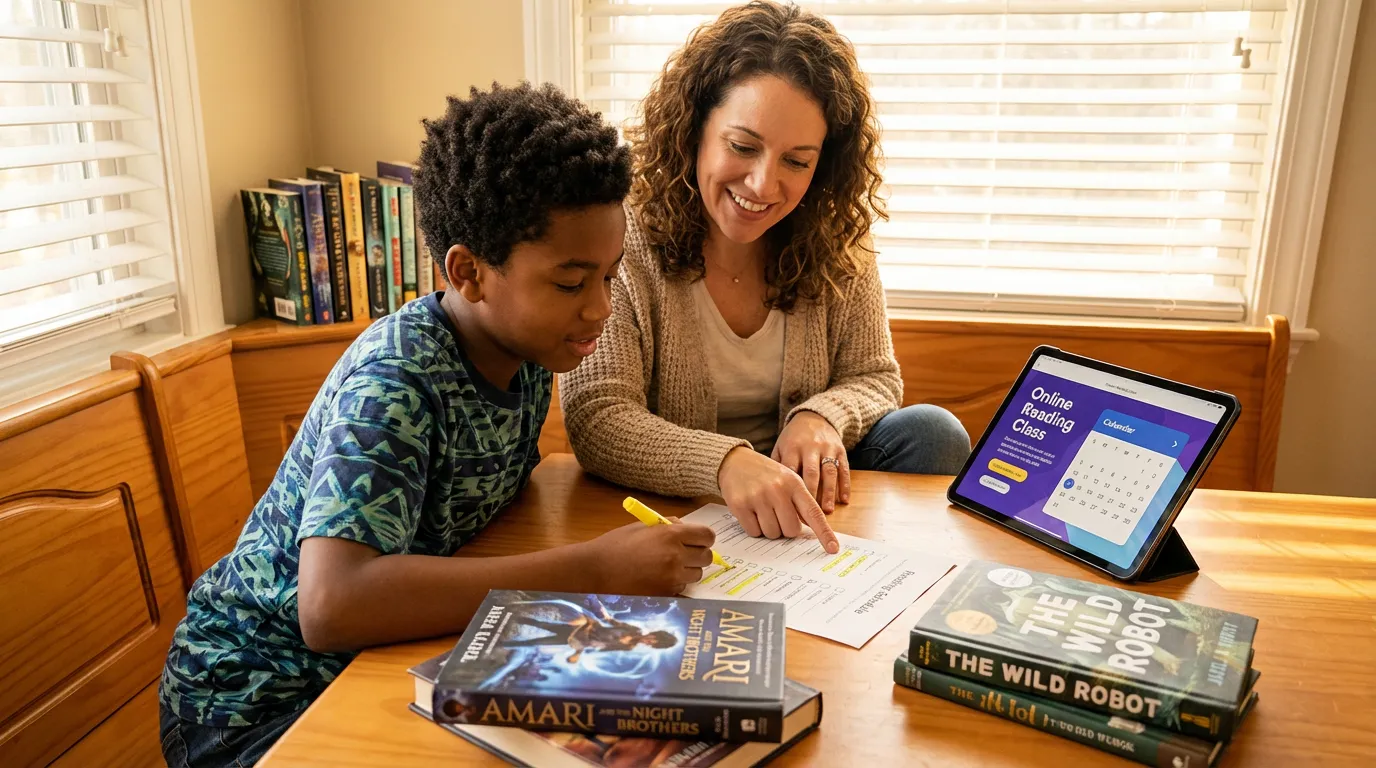
A weekly routine may begin with a core novel as your anchor. For example, if you are reading The Lightning Thief, you might start by reading a chapter together or having your child read it independently. After reading, have a short discussion about what Percy learns and how it relates to the theme or conflict. This will build comprehension before the writing process.
The next day, you return to a short passage for a process called close reading, which is simply a thoughtful analysis of a passage. Identify two unfamiliar words, then use context clues to define them. Finally, highlight a line that shows character development or motivation. Your child can record the vocabulary and the character analysis in their journal.
Later this week, your child will write a paragraph. They will answer questions or complete sentence starters about how Percy changes from the start to the end of the chapter. This helps build text-evidence skills while keeping writing manageable.
Independent reading happens throughout the week regularly with a book of their choice. 10-15 minutes a day is recommended, but you know your child and should adapt that time if they are able or want to read more. Reading, discussing, and responding regularly will boost both comprehension and confidence over time.
This daily routine uses a novel study approach. It balances independent reading with the analytical skills needed for the Common Core ELA Standards.
Popular Homeschool Reading Curricula for 6th Graders
Most likely, you will combine a core literature study with independent reading and targeted skills practice. The goal is to build those analytical skills while exploring various types of texts. A combination of the curricula below can be very effective and engaging.
Outschool’s online curricula and classes
Outschool provides online book studies, reading comprehension courses, and vocabulary classes for 6th graders. These often include guided discussions, close reading exercises, and written responses.
All of these are key to learning at this stage. Combining your homeschool curriculum with a live novel study or book club will give your 6th grader the peer interaction that is so valuable at this age. Experienced literacy teachers also teach Outschool classes and can offer expert-level instruction.
Free and low-cost resources
The Library of Congress has many resources. You can find activities, free books, and historical images. This is a strong resource for finding connected materials to accompany a novel or informational text. The student discovery sets are perfect for adding visual interest and historical connection to integrated units.
The Institute of Education Sciences provides a free clearinghouse full of hundreds of teaching strategies. For example, the “stretch text strategy” for difficult books, where you read a challenging paragraph with your child, ask guiding questions, and then have them read it again independently.
Using the Core Standards for reading, grade 6, can help you organize your year or identify specific learning gaps. Think of this as a diagnostic tool rather than a to-do list. For example, if you notice that your child has difficulty understanding how to compare and contrast, you can incorporate a specific activity or an online course to strengthen that skill.
These resources are most effective with a steady routine. You can pair them with reading, discussion, vocabulary work, and short journal responses.
Frequently Asked Questions: 6th Grade Homeschool Reading Curricula.
It is natural to have questions and concerns before teaching an important subject like 6th-grade reading. Below are answers to some commonly asked questions.
How do I choose books for a 6th grade reading curriculum?
First of all, try to balance academic books with personal-interest books. This year, your child's reading skills will be tested. This can cause frustration, so make sure to include books they will enjoy. Balance “mirror” books that let kids see themselves in stories with “window” books that show them new experiences. Check out the ALA Newbery list for ideas. Also, consider using different formats, such as audiobooks and read-alouds.
Do I need a separate reading and literature curriculum for 6th grade?
Not necessarily. You can easily blend reading and literature into Language Arts. If your child has trouble with vocabulary or understanding, emphasize word study and provide extra help. If your child reads well and has strong comprehension, a separate word study program is not necessary at this age.
How many books should a 6th grader read in homeschool?
There isn't a specific number. A 6th grade program usually features 4-5 full novel studies throughout the year. Students also engage in independent reading at their own reading level. The goal is to read daily and understand what you read. It’s not about speed or counting books.
Building Strong Readers at Home
6th grade is not about finishing books. It is about building stamina and a lifelong relationship with literacy. Celebrate the small wins, and learn from the frustrations. At the end of a successful year with your chosen curriculum, you may notice that your child is reading longer without tiring, connecting what they read to the real world, and asking deeper questions. Whether your child starts as reluctant or advanced, the goal is growth and a greater love of reading.
Sources
Association for Supervision and Curriculum Development. “Strategies for Teaching Complex Texts.” ASCD, https://www.ascd.org/el/articles/strategies-for-teaching-complex-texts
Institute of Education Sciences. Improving Adolescent Literacy: Effective Classroom and Intervention Practices. U.S. Department of Education, https://ies.ed.gov/sites/default/files/rel-southeast/document/2025/12/6.2.x.14%20Improving%20Adolescent%20Literacy%20ELA.pdf.
Library of Congress. “Analyzing Primary Sources.” Library of Congress, https://www.loc.gov/programs/teachers/getting-started-with-primary-sources/. Accessed 14 Feb. 2026.
National Assessment of Educational Progress. Reading Framework for the 2022 National Assessment of Educational Progress. National Center for Education Statistics, U.S. Department of Education, https://www.nagb.gov/content/dam/nagb/en/documents/publications/frameworks/reading/2026-reading-framework/naep-2026-reading-framework.pdf.
National Endowment for the Arts. To Read or Not to Read: A Question of National Consequence. NEA, 2007.
RAND Reading Study Group. Reading for Understanding: Toward an R&D Program in Reading Comprehension. RAND Corporation, 2002. https://www.arts.gov/sites/default/files/ToRead.pdf


.svg)
.svg)