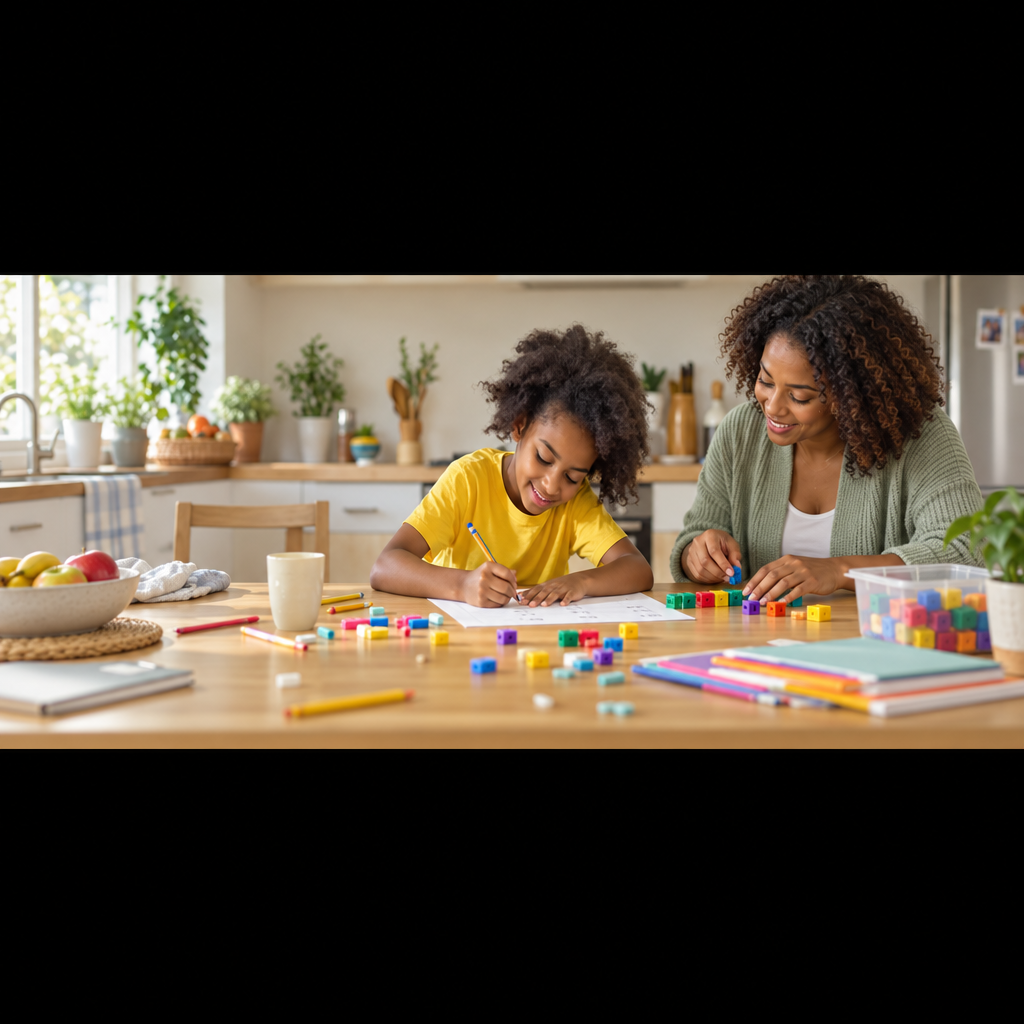
Second grade math is where the numbers get bigger and the thinking gets harder, and where the gap between a child who understood first grade math and one who memorized it becomes clear.
Addition and subtraction with regrouping, three-digit numbers, measurement with standard units, early multiplication concepts: these are the landmarks of second grade math. They're achievable for almost every child, but they require genuine understanding of place value, not just procedural knowledge.
Second grade is also when children start to develop their identity as mathematicians. They're figuring out how they like to learn, what strategies feel natural, and whether math is something they can do. Offering varied approaches and manipulatives isn't just pedagogically sound — it's how you discover what works for this specific child. Teaching the way you learned isn't the goal. Finding the way they learn is.
What second grade math covers
1. Addition and subtraction within 1,000
Second graders extend their first grade skills to three-digit numbers, first without regrouping, then with. The regrouping step trips up many kids, and often the culprit is language rather than ability. Phrases like "1 goes up" don't tell a child that the digit they're carrying is actually a 10. When children learn regrouping as a pattern of moves rather than a conceptual exchange, subtraction with borrowing breaks down shortly after.
The fix is hands-on: base-ten blocks, coins, pennies, or cotton balls let a child physically see that when 7 + 5 = 12, they keep 2 ones and regroup that group of 10 into the tens column. Labeling worksheet columns with T (tens) and O (ones) reinforces the language. Let them build the problem before they write it.
2. Place value to 1,000
Understanding that 347 means 3 hundreds, 4 tens, and 7 ones is the starting point. True mastery goes further: a child who really owns place value can express 347 as 34 tens and 7 ones, or as 347 ones. That flexibility, the ability to regroup and degroup fluidly, is the clearest indicator of solid understanding. It also flows directly into fractions and decimals, where deconstructing numbers becomes essential. Place value isn't just a second grade topic; it's the thread that runs through all of elementary math from here forward.
3. Measurement
Second graders use standard units (inches, feet, centimeters, meters) to measure and estimate lengths. Estimation is part of the standard alongside measurement, and it builds the number sense that makes precision meaningful. They also work with time to the nearest 5 minutes, elapsed time, and begin adding and subtracting amounts in dollars and cents.
4. Early multiplication and equal groups
Second grade introduces multiplication through equal groups, repeated addition, and skip counting. Skip counting, by 2s, 5s, and 10s, is the bridge: it builds the intuition that multiplication and addition are connected before any formal notation is introduced. The key understanding is that multiplication makes repeated addition faster, not that it's a separate operation entirely. Full multiplication fact fluency comes in third grade, but the conceptual groundwork begins here.
5. Geometry and fractions
Second graders identify and draw shapes with specific attributes, partition shapes into equal parts, and work with basic fractions: halves, thirds, and fourths as equal shares of a whole. Fractions are among the most commonly under-retained concepts in elementary math. Second grade is the foundation, and that foundation needs time, repeated exposure, and physical modeling to stick. A child who moves through fractions quickly without building the visual and conceptual understanding will feel that gap in third grade and beyond.
How long should second grade math take?
Most homeschooling families budget 35 to 45 minutes of math per day at this level. A productive session might look like: 5 to 10 minutes of warm-up (mental math, place value review, a quick fact game), 20 to 25 minutes of new concept work, and 10 minutes of review or a math game. Some families find two shorter sessions (around 30 minutes each, morning and afternoon) more effective than one longer block, particularly for children who fatigue quickly.
Second grade math curriculum approaches
The same principle that applies in kindergarten and first grade applies here: hands-on, varied, game-rich instruction before worksheets. Children at this age are still figuring out what kind of mathematicians they are. Exposing them to different formats and strategies is how you find what resonates.
Game-based approaches
Some families cover second grade math primarily through games, real-life application, and short targeted practice. Card games, dice games, and board games build number sense and fact fluency in a format children choose to engage with. Jackie Krulia on Outschool teaches second grade math concepts in ways that build genuine understanding alongside procedural fluency, using approaches like Nearpod to bring a play-based experience into live online instruction.
Best for: Active learners. Families where worksheets create daily resistance.
Watch for: Keep a skills checklist to ensure all second grade standards are covered, particularly place value flexibility and fractions, which are easy to skip in an unstructured approach.
Spiral programs
Programs like Saxon Math 2 and Horizons Math Grade 2 revisit every concept repeatedly throughout the year. Best for kids who need repeated exposure to cement new concepts.
Watch for: Spiral programs can tire out kids who understand concepts quickly. The built-in review is a strength, but the pace can feel slow for confident learners.
Mastery programs
Programs like Math-U-See Beta/Gamma work through one concept at a time until mastery before moving to the next. Best for kids who do well with focused, deep work on one topic at a time.
Watch for: Mastery programs typically require a separate spiral review component to keep earlier skills sharp. What a child masters in October may fade by March without revisiting.
Singapore Math
Primary Mathematics 2A/2B uses the concrete-pictorial-abstract sequence and is well known for producing strong number sense and problem-solving skills. Best for mathematically strong kids ready for a challenge.
Watch for: Singapore Math moves fast and expects parent engagement in lesson design. Consider adding a supplemental review component if your child tends to forget material over time.
Teaching second grade math at home: practical tips
Don't introduce regrouping until place value is solid. Regrouping only makes sense to a child who genuinely understands what tens and hundreds are. If your child is struggling with regrouping, go back to base-ten blocks and rebuild place value understanding before trying the algorithm again.
Keep base-ten blocks on the table. Let your child build the problem in blocks before writing it symbolically, every time, until it's automatic.
Use money as a real-world math context. Second grade money work becomes much more engaging when the money is real. Keep the penny in your coin set: even as it becomes less common in everyday transactions, the penny remains conceptually important for place value work, connecting ones to tens to hundreds in a tangible way.
Introduce multiplication through story problems and skip counting, not memorization. "There are 4 bags with 3 apples each. How many apples?" Let your child count the groups physically. Then connect it to skip counting: 3, 6, 9, 12. The goal is for them to see multiplication as repeated addition made faster, before introducing any notation.
Play math games to maintain first grade fluency. Daily games keep fact fluency sharp without adding formal drilling time.
When your child needs a different approach
Signs that your current second grade math curriculum isn't working: regrouping consistently breaks down even after weeks of practice, first grade fact fluency has eroded, your child can complete problems but can't explain their reasoning, or math resistance is increasing over time.
The most common culprit is a place value gap from first grade that wasn't obvious until the numbers got bigger.
When a child is shutting down at math every day, the first move isn't to push through. Their brain is in what educators call the red zone: no new learning is happening, and pressing forward wastes everyone's time. The more effective move is to pivot completely, return to a task where the child feels genuinely confident and successful, and rebuild from that foundation. If the current approach isn't working, that's not a child problem. It's a teaching problem. Finding the approach that clicks for this specific child is the job of whoever is running the lesson, whether that's a parent or a teacher.
Jackie Krulia on Outschool offers second grade math instruction that meets kids where they are, builds confidence alongside concept understanding, and uses varied strategies to find what works for each learner.
How Outschool fits into your second grade math plan
Browse second grade math classes to find regrouping and place value classes, math enrichment clubs, tutoring and small group classes, and mental math and problem-solving classes. You can also browse elementary school math classes for options that span the K-5 level.
Putting it all together
Second grade math is challenging, genuinely challenging, and that's a good thing. The families who navigate it best kept the manipulatives out, taught regrouping conceptually before procedurally, and paid more attention to whether their child understood than whether they finished the page. Explore second grade math classes on Outschool to find live instruction that fits your schedule and supports your homeschool math plan.


.svg)
.svg)