The 3:30 problem most parents don't talk about
Your kid gets home from school, drops the backpack, maybe eats something, and then you see it: the face. The one that says I sat through seven hours of this and I still don't get fractions. Or long division. Or whatever concept their teacher covered for 12 minutes before moving on to the next thing.
You want to help. But you're also making dinner, answering emails, refereeing a sibling dispute, and quietly wondering whether the way you learned to multiply is even how they teach it now. (It isn't.)
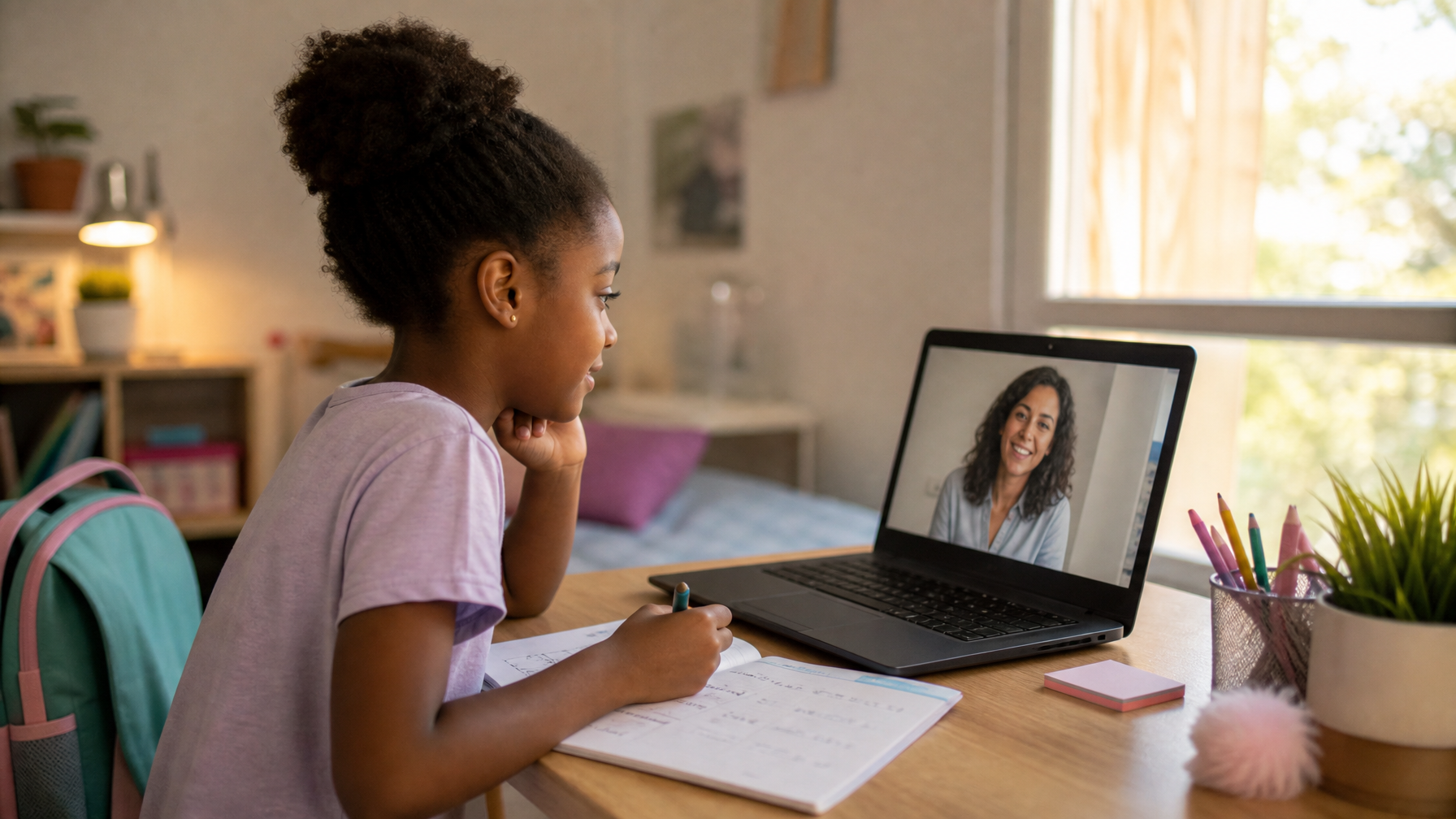
This is where after-school tutoring comes in. Not the fluorescent-lit Kumon center of the early 2000s, and not the $80-an-hour private tutor your neighbor swears by. The landscape has shifted, and for a lot of families, the best option is a live online tutor who meets your kid right where they are, on the subjects they're struggling with, at a time that fits your actual life.
Here's what the research says about why it works, what to look for, and how to find a setup that lasts longer than two weeks.
Why after-school tutoring works differently than homework help
Parents sometimes conflate tutoring with homework help, but they solve different problems. Homework help is reactive: your kid gets stuck on problem 14, someone walks them through it, and they move on. Tutoring addresses the gap underneath the stuckness. A kid who can't do problem 14 usually can't do it because they missed something three weeks ago, and the classroom kept moving.
A 2020 NBER meta-analysis by Nickow, Oreopoulos, and Quan reviewed 96 randomized controlled trials of tutoring programs. The average effect size was +0.37 standard deviations on test scores. To put that in plain terms: tutored kids gained roughly the equivalent of a full additional year of learning in the subject area. The effects were strongest for younger kids and for math, though reading gains were significant too. [1]
What made the difference wasn't the setting or the platform. It was consistency and relationship. Programs where kids worked with the same tutor over time outperformed drop-in models. Programs that ran at least three times a week outperformed once-a-week sessions. The takeaway for parents: a tutor your kid actually likes, showing up on a predictable schedule, matters more than credentials on a resume.
Online vs. in-person: what the evidence shows
If you're picturing online tutoring as a glorified Zoom call where your kid zones out, the research tells a different story. A 2024 randomized controlled trial published in the Journal of Public Economics evaluated a fully online math tutoring program for secondary school kids from disadvantaged neighborhoods. The eight-week program, delivered in small groups of two after school, produced a +0.26 SD increase in standardized test scores and a +0.49 SD increase in end-of-year math grades. It also reduced the probability of repeating a grade. [2]
Multiple studies since 2022 have confirmed that virtual tutoring produces outcomes comparable to in-person tutoring, while solving a bunch of logistical headaches. No commute. No geographic constraints on finding the right tutor. Your kid can work with a teacher who specializes in exactly what they need, even if that person lives three states away.
Online tutoring also removes a subtle barrier that trips up a lot of families: the after-school scheduling crunch. If your kid has soccer at 4:30 and the only local tutoring center runs sessions from 4 to 5, the math doesn't work. Online sessions can slot into whatever 30- or 45-minute window you have. Before practice. After dinner. Saturday morning.
What to look for in an after-school tutor
Not all tutoring is built the same. Here's what separates the sessions that move the needle from the ones your kid endures for three weeks before you both quietly give up.
A real human who teaches, not just corrects
The best tutors don't just fix the wrong answer. They figure out why the answer was wrong, which often means backing up to a concept from last month or last year. Look for someone who asks your kid questions rather than lecturing at them. If your kid can explain back what they learned in their own words at the end of a session, that's a good sign.
Consistency over intensity
Two 30-minute sessions per week, every week, beats a single marathon session on Sundays. The NBER meta-analysis found that programs with three or more sessions per week produced the largest gains, but even twice a week showed meaningful improvement. [1] The key is that it's predictable. Your kid knows: Tuesday and Thursday at 4pm, I work with Ms. Rivera on math. It becomes routine, not punishment.
Subject-specific expertise
A great reading tutor is not automatically a great math tutor. For elementary kids, generalist tutors can cover a lot of ground. But by middle school, you want someone who knows the subject deeply enough to explain it three different ways when the first explanation doesn't land.
A personality your kid can connect with
This one sounds soft, but it's backed by the research. Tutoring programs where kids had a consistent, trusted relationship with their tutor produced effect sizes roughly twice as large as programs using rotating tutors. [1] If your kid dreads the session, something isn't working. The right tutor makes your kid feel smart, not stupid.
The real cost of after-school tutoring (and what's worth it)
- Learning centers (Kumon, Mathnasium, Sylvan): Typically $150 to $400 per month. Sessions are often worksheet-based and group-paced, which works for some kids but not for the ones who need individualized attention.
- Private in-person tutors: $40 to $100+ per hour depending on location and subject. High quality when you find the right person, but expensive at the frequency the research recommends.
- Online tutoring platforms: Vary widely. Some charge per session ($20 to $60), others per month. The advantage is that you can often find subject-specific tutors at a lower cost than local options because you're drawing from a national pool.
On Outschool, 1-on-1 tutoring sessions start as low as $10, with most sessions running between $20 and $45 depending on the subject and the teacher's experience. Because sessions are live and online, your kid gets the focused attention of a dedicated tutor without the overhead cost of a physical center. You can book a single session to try it out, or set up a recurring weekly schedule.
If your state offers an Education Savings Account (ESA), tutoring is almost always an approved expense. Families in Texas (TEFA), Arizona, Utah, West Virginia, and a growing number of other states can use ESA funds to cover tutoring costs entirely.
How to know if your kid needs a tutor vs. more practice
Not every kid who struggles with homework needs a tutor. Some need more repetition with the material, a better study environment, or simply a break before attempting it. Here's a rough framework for deciding.
More practice is probably enough if:
- Your kid understands the concept but makes careless errors
- They can explain the "why" behind a problem, even when they get the answer wrong
- The struggle is limited to one unit or topic, not a pattern across the year
- A good night's sleep and a second attempt usually clears things up
A tutor is worth exploring if:
- Your kid is consistently behind grade-level expectations in a core subject
- They can't explain why they're doing what they're doing, they're just following steps
- Frustration or math anxiety has set in to the point where they avoid the subject entirely
- You're spending more than 30 minutes a night on homework battles and neither of you is enjoying it
- Their teacher has flagged a concern at conferences
If three or more items from the second list ring true, a tutor can address the root cause in ways that extra worksheets can't.
Making the most of 30 minutes: what a good session looks like
One of the best things about online tutoring is that sessions can be short and still effective. A well-structured 30-minute session typically looks something like this:
First 5 minutes: Quick check-in. The tutor asks what the kid worked on in school that day, what felt hard, what they have coming up. This isn't small talk. It helps the tutor calibrate the session in real time.
Middle 20 minutes: Focused work on 1 to 2 concepts. The tutor might use a shared whiteboard, work through problems together, or talk through a reading passage. The best tutors adjust mid-session. If the kid gets it quickly, they push further. If the kid is stuck, they back up.
Last 5 minutes: The kid explains what they learned. This is the most underrated part. When a kid puts a concept into their own words, it sticks differently than when they just nod along. Some tutors also use this time to set a small goal for the next session.
If your tutor skips the bookends and jumps straight to worksheets for 30 minutes, that's a signal to find a different tutor.
Grade-by-grade: what after-school tutoring looks like at different ages
Kindergarten through second grade (ages 5 to 8)
At this age, tutoring is more about building confidence than drilling content. A good tutor uses games, stories, and manipulatives (even virtual ones) to help kids build number sense and early reading fluency. Sessions are short, 20 to 30 minutes max, and the tutor's personality matters more than their degree. If your kid looks forward to the session, the learning follows.
Third through fifth grade (ages 8 to 11)
This is where gaps in math and reading start to compound. A kid who doesn't solidify multiplication facts in third grade will struggle with fractions in fourth and feel lost by fifth. Tutoring at this stage should be targeted: not "general homework help" but "we're building fraction fluency for the next six weeks." The tutor should communicate with you about what they're working on and why.
Sixth through eighth grade (ages 11 to 14)
Middle school is where many families first look into tutoring, often because the content has outpaced what parents can comfortably help with. (Pre-algebra is nobody's idea of a fun Tuesday night.) Tutors at this level should have subject expertise, not just patience. Look for someone who can teach math concepts multiple ways and who treats your kid like a capable person having a tough time, not like a project to fix.
High school (ages 14 to 18)
High school tutoring often shifts from "catching up" to "getting ahead" or preparing for specific tests. Whether it's AP Chemistry, SAT prep, or keeping a GPA high enough for college applications, the tutor needs deep content knowledge and the ability to teach test-taking strategy alongside the material. Online tutoring is especially valuable here because the pool of qualified tutors for niche subjects (AP Physics, AP Latin, IB Math) is small locally but large online.
Red flags: when tutoring isn't working
Give a new tutoring arrangement at least 4 to 6 weeks before judging results. Gains don't show up overnight. But if you notice any of these patterns after that window, something needs to change:
- Your kid dreads every session. Some resistance in the first week or two is normal. Persistent dread after a month means the fit is wrong.
- Grades or understanding haven't budged. A good tutor should be able to articulate what progress looks like, even if test scores haven't caught up yet. If they can't explain what's improving, ask.
- The tutor is doing the work for your kid. If your kid finishes tutoring with completed homework but still can't explain the material, the tutor is a homework-completion service, not a teacher.
- There's no communication with you. You should know what your kid is working on and why. A tutor who just logs in, works for 30 minutes, and logs off without any parent-facing summary is leaving you out of the loop.
How to get started without overthinking it
The biggest mistake parents make with tutoring is treating the decision like it's permanent. It's not. You're booking a session, not signing a lease.
Here's a low-pressure way to start:
- Pick the one subject that causes the most friction at home. Not three subjects. One.
- Book a single trial session with 2 to 3 different tutors. On Outschool, you can browse 1-on-1 tutoring by subject and age, read teacher reviews from other parents, and book a single session with no commitment.
- After the trial, ask your kid two questions: "Did you understand more at the end than at the beginning?" and "Would you want to work with that person again?"
- If both answers are yes, set up a recurring schedule. Twice a week is ideal. Once a week is a solid starting point if budget is a factor.
- Check in after 4 to 6 weeks. Look for signs beyond grades: does your kid attempt homework independently more often? Do they seem less stressed about the subject? Are they asking fewer "I don't get it" questions?
After-school tutoring doesn't need to be a big production. The best arrangements start small, build trust, and quietly make the hardest part of your kid's day a little easier.
Frequently asked questions
How much does after-school tutoring cost?
Costs vary widely. Local learning centers run $150 to $400 per month. Private in-person tutors charge $40 to $100+ per hour. Online tutoring is often more affordable because there's no facility overhead. On Outschool, 1-on-1 sessions start as low as $10, with most running $20 to $45. If your state has an ESA program, tutoring is typically a covered expense.
How many times a week should my kid get tutored?
Research shows the biggest gains with three or more sessions per week, but even twice a week produces meaningful improvement. [1] Start with whatever fits your schedule and budget, and increase frequency if you see it helping. Consistency matters more than duration.
Is online tutoring as effective as in-person?
Yes. Multiple studies, including a 2024 randomized controlled trial in the Journal of Public Economics, found that online tutoring produces outcomes comparable to in-person programs. [2] Online tutoring also solves scheduling and geography problems that make in-person tutoring impractical for many families.
What subjects benefit most from tutoring?
Math consistently shows the largest effect sizes in tutoring research, likely because it's sequential (each concept builds on the last, so gaps compound quickly). Reading and writing also respond well to tutoring, especially for kids in the early grades who are building foundational fluency. By middle and high school, any subject where your kid has a persistent gap is a candidate.
How do I know if the tutor is a good fit?
Give it 2 to 3 sessions. A good fit looks like: your kid is willing to try, the tutor adjusts when something isn't clicking, and your kid can explain at least one thing they learned after each session. A bad fit looks like: your kid shuts down, the tutor plows through material regardless, or sessions feel like homework completion rather than teaching.
Sources
[1] Nickow, A., Oreopoulos, P., & Quan, V. "The Impressive Effects of Tutoring on PreK-12 Learning: A Systematic Review and Meta-Analysis of the Experimental Evidence." NBER Working Paper No. 27476, 2020. https://www.nber.org/papers/w27476
[2] Gortazar, L., Hupkau, C., & Roldán-Monés, A. "Online tutoring works: Experimental evidence from a program with vulnerable children." Journal of Public Economics, Volume 232, April 2024. https://doi.org/10.1016/j.jpubeco.2024.105082


.svg)
.svg)