What makes a STEM activity actually work
Before the list: a quick word on what separates activities kids do once and forget from ones they return to. The best STEM activities at home share a few qualities. They involve an open question your child has to figure out, not just follow instructions to a predetermined outcome. They use inexpensive or household materials. And they leave room to fail, adjust, and try again, which is the actual science part.
Ages 3 to 6: building STEM foundations
Young children are natural scientists. Everything is an experiment. The activities that work best at this age are sensory, physical, and short enough to match their attention span.
Science: color mixing and dissolution
Fill three clear cups with water. Add food coloring — red, yellow, blue — to each. Let your child mix them together to predict and discover secondary colors. Extend it: what dissolves in water and what doesn't? Sugar, salt, sand, flour. Each trial teaches observation and prediction.
Engineering: block and tower building
Give your child a pile of blocks and one rule: build the tallest tower that doesn't fall over. Then ask: why did it fall? What would make it stronger? This is engineering at its most direct — and the debrief after a collapse is where the learning happens.
Math: sorting and counting in daily routines
Sort socks by color. Count crackers before lunch. Organize crayons by shade. For this age group, math is embedded in daily routines. You don't need a separate activity, just language that makes the math visible. "We have six crackers. If you eat two, how many are left?"
Technology: ScratchJr
ScratchJr is a free block-based coding app designed for ages 5 to 7. Kids create simple animations by connecting command blocks — move a character left, make it jump, add a sound. It builds basic programming logic without reading requirements and keeps young kids genuinely engaged.
Ages 7 to 9: hands-on experiments and first projects
This is the sweet spot for STEM at home. Kids this age have the focus for multi-step projects, the coordination for fine motor tasks, and enough reading ability to follow simple instructions independently.
Science: baking soda and vinegar, done right
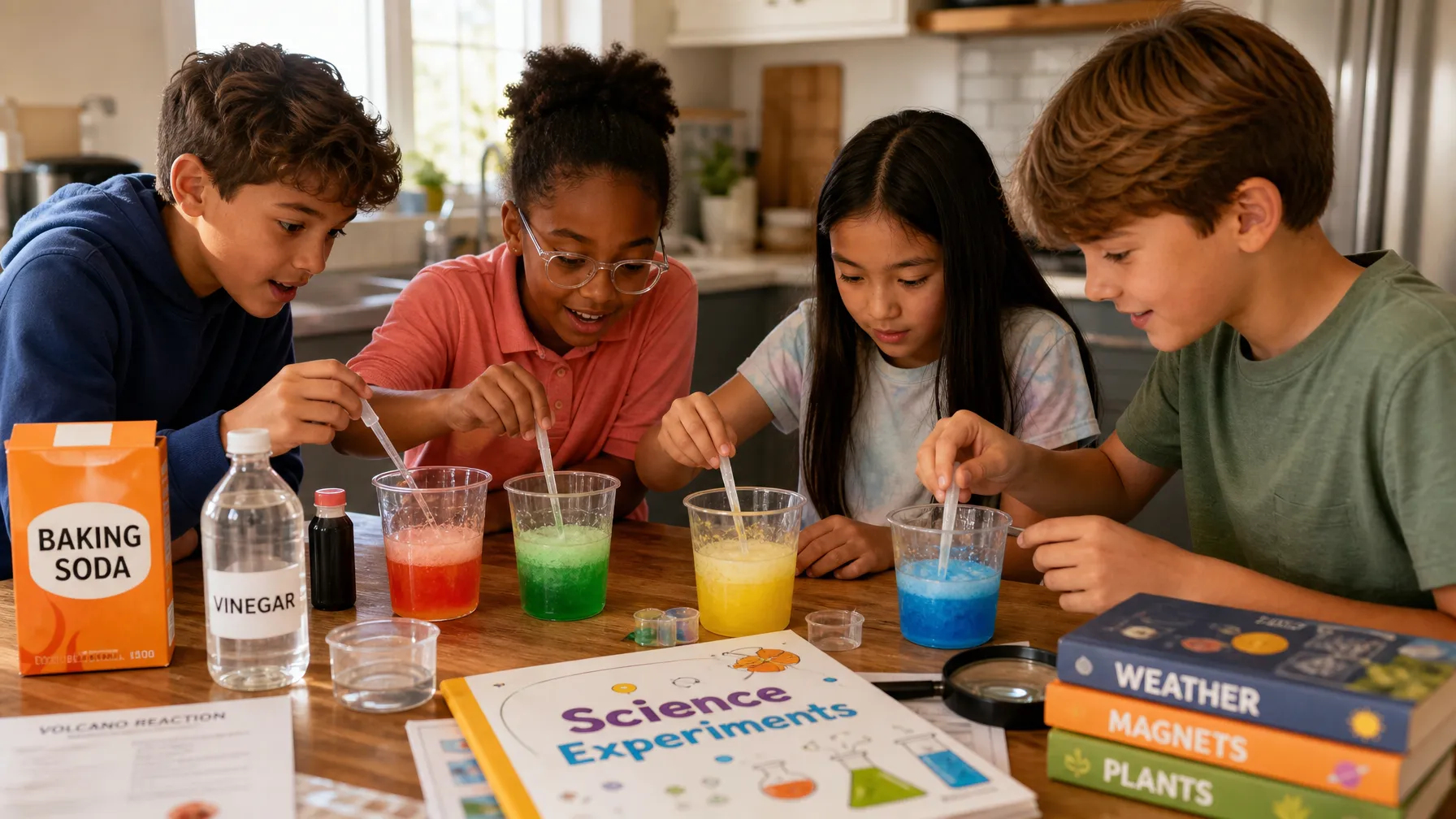
Yes, everyone has done the volcano. Do it anyway — but take it further. Once your child has seen the reaction, ask: what happens if you add more vinegar? Less baking soda? What if the vinegar is cold versus warm? The reaction becomes a controlled experiment instead of a one-time trick, which is where the real learning is.
Science: oobleck and non-Newtonian fluids
Mix cornstarch and water in roughly a 2:1 ratio. The result behaves like a solid when hit and a liquid when resting — a property called non-Newtonian behavior. Kids at this age are captivated by it, and it naturally generates questions: why does it act this way? What is it made of at a tiny level?
Engineering: bridge building with index cards
Give your child 20 index cards, 30 centimeters of tape, and one challenge: build a bridge between two stacks of books that holds as many pennies as possible. Load it until it fails, figure out why, and try again. The iteration is the point.
Math: measurement cooking
Pick a recipe and have your child do all the measuring. Doubling a recipe requires multiplication; halving requires fractions. The math is immediate and real in a way worksheets aren't.
Technology: Scratch
Scratch (scratch.mit.edu) is MIT's free visual coding platform for ages 8 to 16. Kids build games, animations, and interactive stories by connecting code blocks. The shared project library means your child can play games other kids built, which is often what motivates them to start building their own. [2]
$20 off your first class WITH promo code: blog
Build the Education your Kid Deserves
Discover thousands of live classes taught by expert teachers, across academics and enrichment.
Browse classesAges 10 to 12: deeper projects and real tools
Kids in this range can handle longer projects, more complex math, and introductory work with actual tools — with supervision.
Science: kitchen chemistry with a pH indicator
Boil a cup of red cabbage in water for 10 minutes, strain the liquid, and you have a natural pH indicator. Test it with vinegar (acid), baking soda dissolved in water (base), lemon juice, and milk. The color changes are dramatic and the chemistry is real — this is the same type of pH testing used in actual labs.
Engineering: Rube Goldberg machines
A Rube Goldberg machine is a deliberately complicated system that accomplishes a simple task — rolling a ball, ringing a bell — using a chain of falling dominos, ramps, and levers. Building one requires systems thinking, spatial reasoning, and iterative problem-solving. Start with three or four steps, then build up.
Math: probability with games
Card games, dice games, and coin flips are natural probability experiments. Ask your child: if we flip this coin 20 times, how many times will it land on heads? Then test it. Then do it 100 times and see if the result gets closer to 50%. This introduces sampling and variance in a way that sticks.
Technology: Python for beginners
Python is one of the most readable programming languages, and free platforms like Replit let kids run Python code in a browser with no setup. Start with a simple number-guessing game — about 15 lines of code that introduces variables, conditionals, and loops all at once.
Electronics kits
Snap Circuits teaches basic electronics concepts — circuits, resistors, switches — by snapping components together on a board. No soldering required. Kids build working projects like a radio, a doorbell, or a light sensor while learning how electrical circuits actually function.
Ages 13 and up: real projects and applications
Teenagers can work with adult tools and tackle projects that produce something genuinely useful.
Science: biology and DNA extraction
Extracting DNA from a banana is a genuine lab procedure that works at home using dish soap, salt, and cold rubbing alcohol. The hands-on experience opens a natural conversation about how DNA works, connecting to some of the most important science of the past 30 years.
Engineering: Arduino or Raspberry Pi
Arduino is a microcontroller platform that lets teenagers build electronic projects that interact with the physical world — a light that turns on when it detects sound, a thermometer, a simple robot. Both Arduino and Raspberry Pi have large online communities, free tutorials, and genuinely interesting project libraries. [3]
Math: statistics with real data
Download a dataset from data.gov (free, massive, and genuinely interesting) and have your teen ask a question of it: which cities have the highest average commute times? How has global temperature changed over the past 50 years? Learning to work with real data applies to almost every field, and free tools like Google Sheets make the analysis accessible without specialized software.
STEM activities that work across multiple ages
Some activities scale naturally across a wide age range — useful for families with multiple kids at different levels.
Nature journaling: Observe and draw plants, insects, or weather patterns over time. Young children sketch and name things they see; older kids add measurements, look up species, and track patterns across weeks.
Cooking as applied science: For a six-year-old, it is measuring and mixing. For a twelve-year-old, it is chemistry — what does heat do to proteins? For a sixteen-year-old, it is nutrition math or food science.
Astronomy: A free app like SkySafari can turn a backyard on a clear night into a lesson in the solar system, constellations, and scale. All ages, no equipment required beyond a blanket and curiosity.
When to add a live teacher
Self-directed STEM resources take kids a long way, but some concepts click faster with a teacher who can answer the exact question your child is stuck on. Outschool has live STEM classes for every age and interest area — chemistry experiments for elementary students, Python for teens, robotics for middle schoolers — taught in small groups where kids can ask questions and get real-time feedback. Many classes are also available in self-paced formats for families who need scheduling flexibility.
Browse STEM classes on Outschool
Sources
[1] Gottfried, M.A. & Williams, D. (2013). STEM club participation and STEM schooling outcomes. Education Policy Analysis Archives, 21(79). https://epaa.asu.edu/index.php/epaa/article/view/1361
[2] Resnick, M. et al. (2009). Scratch: Programming for all. Communications of the ACM, 52(11), 60-67. https://dl.acm.org/doi/10.1145/1592761.1592779
[3] Arduino Foundation (2026). What is Arduino? https://www.arduino.cc/en/Guide/Introduction


.svg)
.svg)